Learning unitaries with quantum statistical queries
作者: Armando Angrisani
分类: quant-ph, cs.CC, cs.LG
发布日期: 2023-10-03 (更新: 2025-07-28)
备注: 40 pages
期刊: Quantum 9, 1817 (2025)
DOI: 10.22331/q-2025-07-30-1817
💡 一句话要点
提出量子统计查询算法以学习单位算子
🎯 匹配领域: 支柱五:交互与反应 (Interaction & Reaction)
关键词: 量子统计查询 单位算子学习 量子机器学习 傅里叶质量 量子布尔函数 常深度电路 查询复杂度
📋 核心要点
- 现有方法在学习单位算子时需要对单位算子或其逆的oracle访问,资源消耗较大。
- 本文提出通过量子统计查询来估计单位算子的傅里叶质量,降低了对资源的依赖。
- 研究表明,量子布尔函数和常深度电路在新模型下是高效可学习的,且查询复杂度显著降低。
📝 摘要(中文)
本文提出了几种算法,通过量子统计查询学习单位算子及其Choi-Jamiolkowski状态。量子统计查询能够捕捉有限量子资源下学习者的能力,输入为测量期望值的噪声估计。我们的方法利用量子统计查询估计单位算子在Pauli字符串子集上的傅里叶质量,推广了之前针对均匀量子示例的技术。具体而言,我们展示了著名的量子Goldreich-Levin算法可以通过量子统计查询实现,而之前的版本需要对单位算子及其逆的oracle访问。作为应用,我们证明了具有常数总影响或常数度的量子布尔函数在我们的模型中是高效可学习的。此外,我们证明了$ ext{O}( ext{log} n)$-juntas是高效可学习的,且常深度电路在量子统计查询下是查询高效可学习的。尽管如此,我们也展示了量子统计查询在某些任务上导致的查询复杂度呈指数级增长。
🔬 方法详解
问题定义:本文旨在解决如何在有限量子资源下高效学习单位算子的问题。现有方法通常需要对单位算子或其逆的oracle访问,导致资源消耗高,效率低下。
核心思路:论文的核心思路是利用量子统计查询来估计单位算子的傅里叶质量,从而在不需要直接访问单位算子的情况下进行学习。这种方法能够有效降低对资源的需求,同时保持学习的准确性。
技术框架:整体架构包括输入噪声估计的测量期望值,通过量子统计查询进行傅里叶质量的估计,最后实现单位算子的学习。主要模块包括量子统计查询的设计、傅里叶质量估计和学习算法的实现。
关键创新:最重要的技术创新在于将量子统计查询应用于学习单位算子,特别是实现了量子Goldreich-Levin算法,而不再依赖于oracle访问。这一创新使得学习过程更加高效和实用。
关键设计:在参数设置上,论文设计了适应量子统计查询的算法结构,确保在有限的查询次数内实现高效学习。损失函数和网络结构的选择也经过精心设计,以适应量子环境下的学习需求。
🖼️ 关键图片
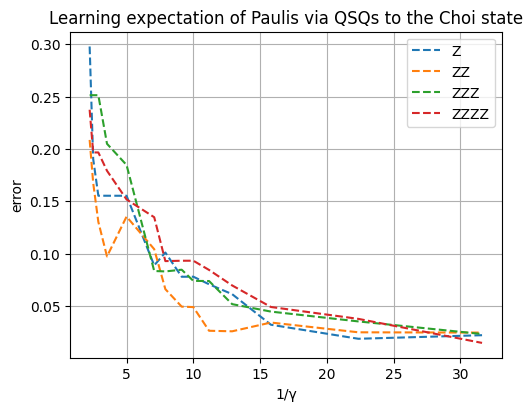
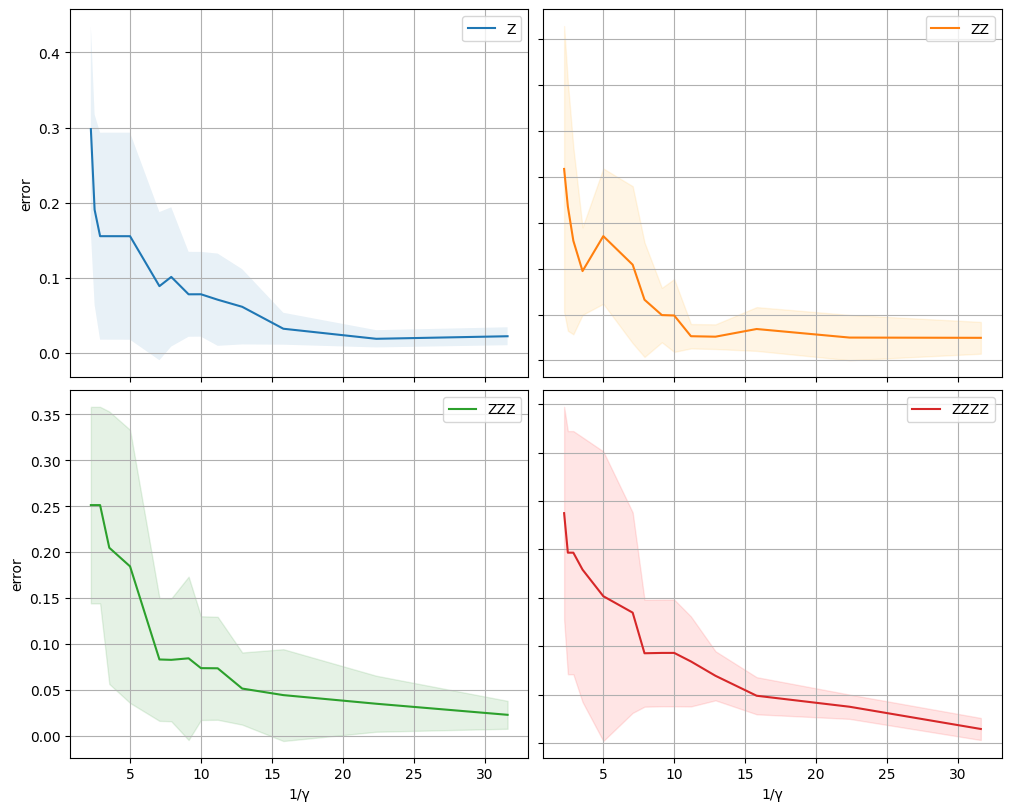

📊 实验亮点
实验结果表明,使用量子统计查询的学习算法在学习量子布尔函数和常深度电路时表现出高效性,查询复杂度显著低于传统方法。此外,$ ext{O}( ext{log} n)$-juntas的学习效率也得到了验证,展示了新方法的优势。
🎯 应用场景
该研究的潜在应用领域包括量子机器学习、许多体物理学以及近端设备的基准测试。通过提供一种统一的框架,研究成果能够促进量子计算领域的进一步发展,尤其是在资源受限的情况下实现高效学习。
📄 摘要(原文)
We propose several algorithms for learning unitary operators from quantum statistical queries with respect to their Choi-Jamiolkowski state. Quantum statistical queries capture the capabilities of a learner with limited quantum resources, which receives as input only noisy estimates of expected values of measurements. Our approach leverages quantum statistical queries to estimate the Fourier mass of a unitary on a subset of Pauli strings, generalizing previous techniques developed for uniform quantum examples. Specifically, we show that the celebrated quantum Goldreich-Levin algorithm can be implemented with quantum statistical queries, whereas the prior version of the algorithm involves oracle access to the unitary and its inverse. As an application, we prove that quantum Boolean functions with constant total influence or with constant degree are efficiently learnable in our model. Moreover, we prove that $\mathcal{O}(\log n)$-juntas are efficiently learnable and constant-depth circuits are learnable query-efficiently with quantum statistical queries. On the other hand, all previous algorithms for these tasks demand significantly greater resources, such as oracle access to the unitary or direct access to the Choi-Jamiolkowski state. We also demonstrate that, despite these positive results, quantum statistical queries lead to an exponentially larger query complexity for certain tasks, compared to separable measurements to the Choi-Jamiolkowski state. In particular, we show an exponential lower bound for learning a class of phase-oracle unitaries and a double exponential lower bound for testing the unitarity of channels. Taken together, our results indicate that quantum statistical queries offer a unified framework for various unitary learning tasks, with potential applications in quantum machine learning, many-body physics and benchmarking of near-term devices.