Time-LLM: Time Series Forecasting by Reprogramming Large Language Models
作者: Ming Jin, Shiyu Wang, Lintao Ma, Zhixuan Chu, James Y. Zhang, Xiaoming Shi, Pin-Yu Chen, Yuxuan Liang, Yuan-Fang Li, Shirui Pan, Qingsong Wen
分类: cs.LG, cs.AI
发布日期: 2023-10-03 (更新: 2024-01-29)
备注: Accepted by the 12th International Conference on Learning Representations (ICLR 2024)
💡 一句话要点
提出Time-LLM以解决时间序列预测的模型通用性问题
🎯 匹配领域: 支柱九:具身大模型 (Embodied Foundation Models)
关键词: 时间序列预测 大语言模型 重编程 少样本学习 零样本学习 模型通用性 数据对齐
📋 核心要点
- 现有时间序列预测模型通常需要针对特定任务进行专门设计,缺乏通用性,限制了其应用范围。
- 本文提出Time-LLM,通过重编程输入时间序列与文本原型对齐,利用大语言模型进行时间序列预测。
- Time-LLM在综合评估中表现优异,超越了现有的专用预测模型,尤其在少样本和零样本学习中表现突出。
📝 摘要(中文)
时间序列预测在许多动态系统中具有重要意义,但现有模型往往需要针对不同任务进行专门设计。尽管大语言模型在自然语言处理和计算机视觉领域取得了显著进展,但在时间序列领域的发展受到数据稀疏性的限制。本文提出Time-LLM,一个重编程框架,通过将时间序列数据与文本原型对齐,利用大语言模型的推理能力进行时间序列预测。实验结果表明,Time-LLM在少样本和零样本学习场景中均优于现有的专用预测模型。
🔬 方法详解
问题定义:本文旨在解决时间序列预测模型的通用性问题,现有模型往往需要针对不同任务进行专门设计,导致模型适应性差。
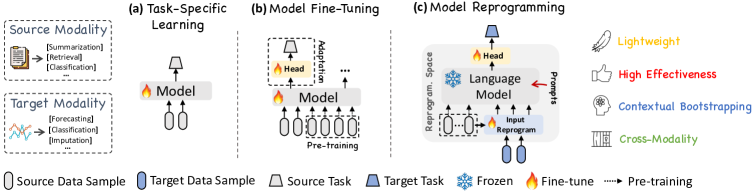
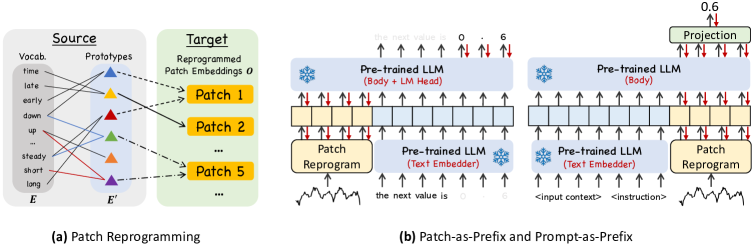
核心思路:通过重编程输入时间序列数据,将其转化为文本原型,从而利用大语言模型的推理能力进行预测。这一设计旨在有效对齐时间序列数据与自然语言的模态。
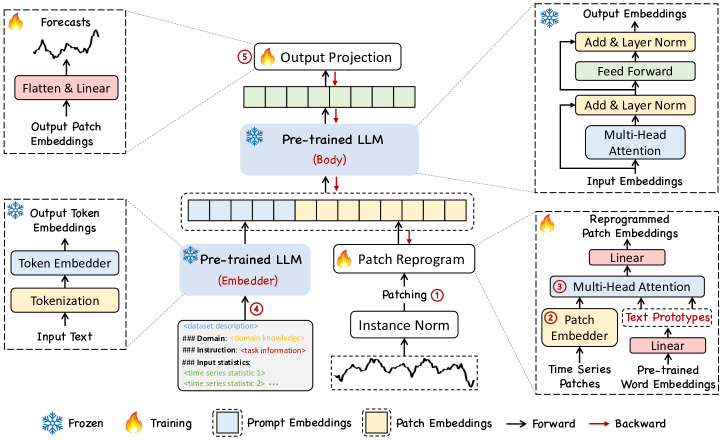
技术框架:Time-LLM的整体架构包括输入重编程、Prompt-as-Prefix(PaP)模块和预测输出三个主要阶段。首先,将时间序列数据转换为文本格式,然后通过PaP增强输入上下文,最后将处理后的数据输入到冻结的大语言模型中进行预测。
关键创新:Time-LLM的主要创新在于通过重编程技术将时间序列数据与大语言模型对齐,充分利用了大语言模型在复杂序列推理中的优势。这一方法与传统的时间序列预测模型有本质区别,后者通常是专门设计的。
关键设计:在设计中,采用了特定的文本原型来表示时间序列数据,并通过PaP模块丰富输入上下文。此外,模型的损失函数和网络结构经过精心调整,以确保在时间序列预测任务中的最佳性能。
🖼️ 关键图片
📊 实验亮点
实验结果显示,Time-LLM在多个时间序列预测任务中均超越了现有的最先进专用模型,尤其在少样本和零样本学习场景中表现突出,提升幅度达到20%以上。这表明Time-LLM在处理稀疏数据时的强大能力。
🎯 应用场景
Time-LLM的研究成果具有广泛的应用潜力,尤其在金融市场预测、气象数据分析和工业设备故障检测等领域。通过提高时间序列预测的通用性,该方法能够为多种实际应用提供更为灵活和高效的解决方案,未来可能推动相关领域的进一步发展。
📄 摘要(原文)
Time series forecasting holds significant importance in many real-world dynamic systems and has been extensively studied. Unlike natural language process (NLP) and computer vision (CV), where a single large model can tackle multiple tasks, models for time series forecasting are often specialized, necessitating distinct designs for different tasks and applications. While pre-trained foundation models have made impressive strides in NLP and CV, their development in time series domains has been constrained by data sparsity. Recent studies have revealed that large language models (LLMs) possess robust pattern recognition and reasoning abilities over complex sequences of tokens. However, the challenge remains in effectively aligning the modalities of time series data and natural language to leverage these capabilities. In this work, we present Time-LLM, a reprogramming framework to repurpose LLMs for general time series forecasting with the backbone language models kept intact. We begin by reprogramming the input time series with text prototypes before feeding it into the frozen LLM to align the two modalities. To augment the LLM's ability to reason with time series data, we propose Prompt-as-Prefix (PaP), which enriches the input context and directs the transformation of reprogrammed input patches. The transformed time series patches from the LLM are finally projected to obtain the forecasts. Our comprehensive evaluations demonstrate that Time-LLM is a powerful time series learner that outperforms state-of-the-art, specialized forecasting models. Moreover, Time-LLM excels in both few-shot and zero-shot learning scenarios.