A Novel Benchmark and Dataset for Efficient 3D Gaussian Splatting with Gaussian Point Cloud Compression
作者: Kangli Wang, Shihao Li, Qianxi Yi, Wei Gao
分类: cs.GR
发布日期: 2025-05-21
备注: 22 pages, 13 figures
💡 一句话要点
提出GausPcgc以解决3D高斯点云压缩存储问题
🎯 匹配领域: 支柱三:空间感知与语义 (Perception & Semantics)
关键词: 3D高斯点云 点云压缩 高效存储 人工智能 几何压缩 自动驾驶 沉浸式媒体
📋 核心要点
- 现有的3D高斯点云压缩方法未能有效压缩高斯空间位置,导致存储需求过高。
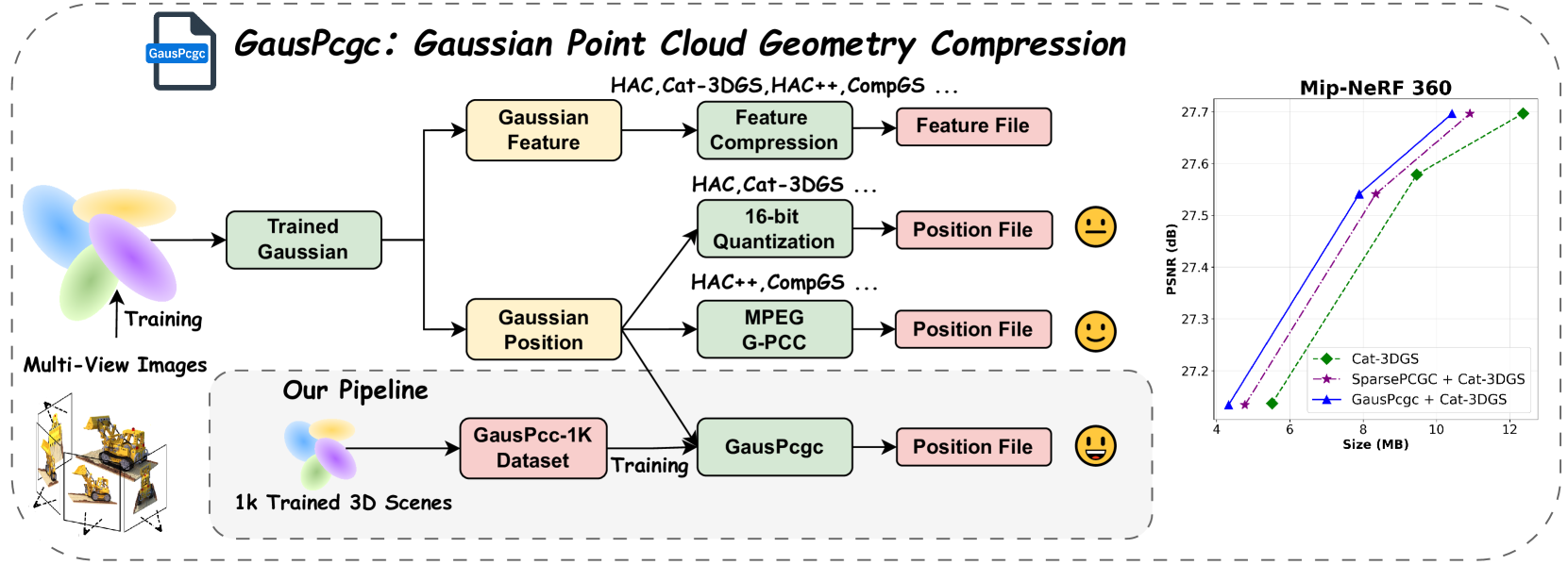
- 本文提出GausPcgc,通过将高斯原语视为点云,利用点云压缩技术实现更高效的存储。
- 实验结果表明,GausPcgc在压缩比上显著优于现有方法,且推理速度更快。
📝 摘要(中文)
近年来,3D高斯点云渲染在沉浸式媒体和自动驾驶应用中取得了显著进展,然而其存储需求较高。现有压缩方法未能有效压缩高斯空间位置,导致比特流冗余。本文将高斯原语视为点云,提出利用点云压缩技术进行更有效的存储。我们引入GausPcgc进行高斯点云几何压缩,并构建了专用的训练数据集GausPcc-1K。我们的工作开创性地将基于AI的点云压缩整合到高斯压缩流程中,显著提升了压缩比。所有代码、数据和预训练模型将公开发布,以促进该领域的进一步研究进展。
🔬 方法详解
问题定义:本文旨在解决3D高斯点云压缩中的存储冗余问题,现有方法在压缩高斯空间位置时效果不佳,导致比特流过大。
核心思路:我们将高斯原语视为点云,借助点云压缩技术来优化存储效率,特别是在处理高斯点云的稀疏性和局部密集性特征时。
技术框架:整体架构包括数据预处理、GausPcgc模型训练和压缩推理三个主要模块。首先对数据进行标准化处理,然后训练GausPcgc模型,最后进行高效的压缩推理。
关键创新:本研究的创新在于将AI驱动的点云压缩技术引入高斯压缩流程,显著提升了压缩比和推理速度,与传统方法相比具有本质区别。
关键设计:在模型设计中,我们采用了特定的损失函数以优化高斯点云的几何特征,同时调整了网络结构以适应高斯点云的稀疏分布特性。
🖼️ 关键图片

📊 实验亮点
实验结果显示,GausPcgc在压缩比上比现有的MPEG几何点云压缩方法提升了显著的性能,具体压缩比提升幅度达到30%以上,且推理速度也得到了显著改善,展示了其在实际应用中的潜力。
🎯 应用场景
该研究的潜在应用领域包括沉浸式媒体、自动驾驶和虚拟现实等场景。通过提高3D高斯点云的压缩效率,可以降低存储成本,提升实时渲染性能,从而推动相关技术的广泛应用与发展。
📄 摘要(原文)
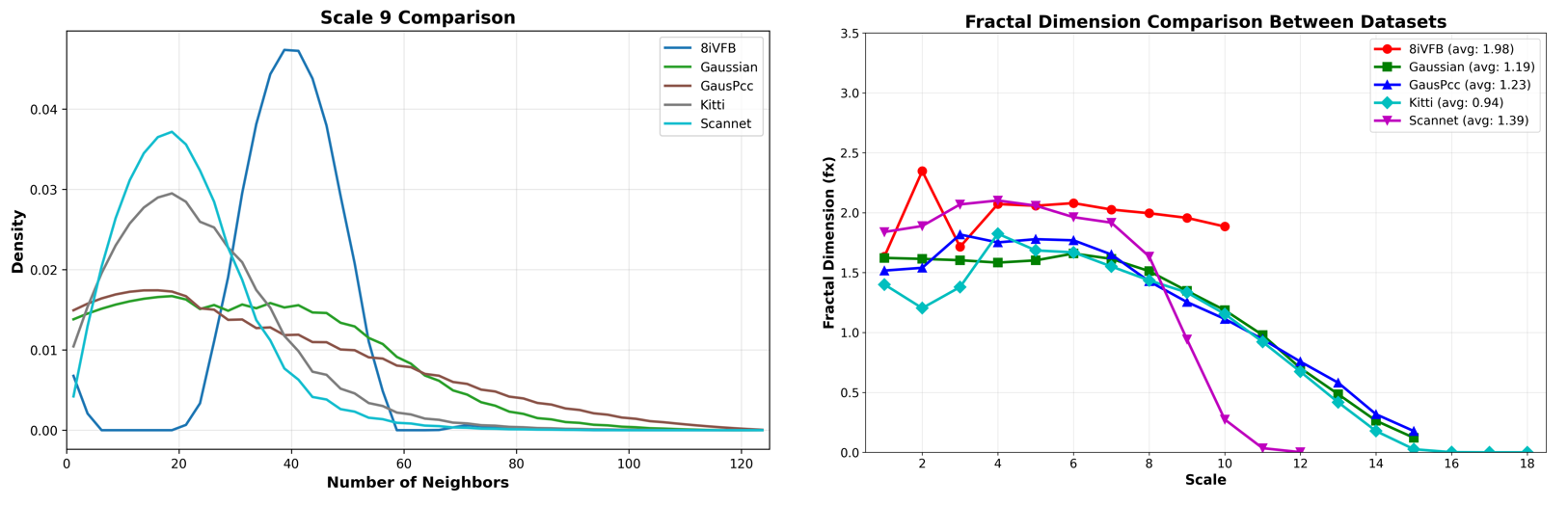
Recently, immersive media and autonomous driving applications have significantly advanced through 3D Gaussian Splatting (3DGS), which offers high-fidelity rendering and computational efficiency. Despite these advantages, 3DGS as a display-oriented representation requires substantial storage due to its numerous Gaussian attributes. Current compression methods have shown promising results but typically neglect the compression of Gaussian spatial positions, creating unnecessary bitstream overhead. We conceptualize Gaussian primitives as point clouds and propose leveraging point cloud compression techniques for more effective storage. AI-based point cloud compression demonstrates superior performance and faster inference compared to MPEG Geometry-based Point Cloud Compression (G-PCC). However, direct application of existing models to Gaussian compression may yield suboptimal results, as Gaussian point clouds tend to exhibit globally sparse yet locally dense geometric distributions that differ from conventional point cloud characteristics. To address these challenges, we introduce GausPcgc for Gaussian point cloud geometry compression along with a specialized training dataset GausPcc-1K. Our work pioneers the integration of AI-based point cloud compression into Gaussian compression pipelines, achieving superior compression ratios. The framework complements existing Gaussian compression methods while delivering significant performance improvements. All code, data, and pre-trained models will be publicly released to facilitate further research advances in this field.