Saliency-Aware Multi-Route Thinking: Revisiting Vision-Language Reasoning
作者: Mingjia Shi, Yinhan He, Yaochen Zhu, Jundong Li
分类: cs.CV
发布日期: 2026-02-18
备注: preprint 10 pages, 4 figures
💡 一句话要点
提出显著性意识多路径思维以解决视觉语言推理问题
🎯 匹配领域: 支柱九:具身大模型 (Embodied Foundation Models)
关键词: 视觉语言模型 显著性意识 多路径推理 推理稳定性 对象幻觉
📋 核心要点
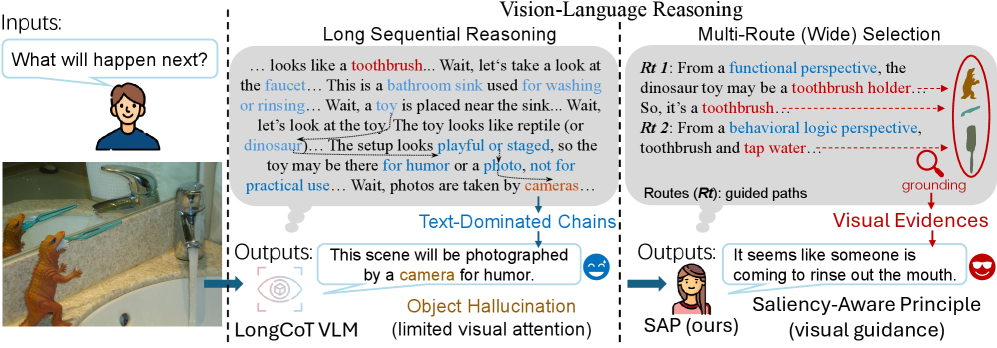
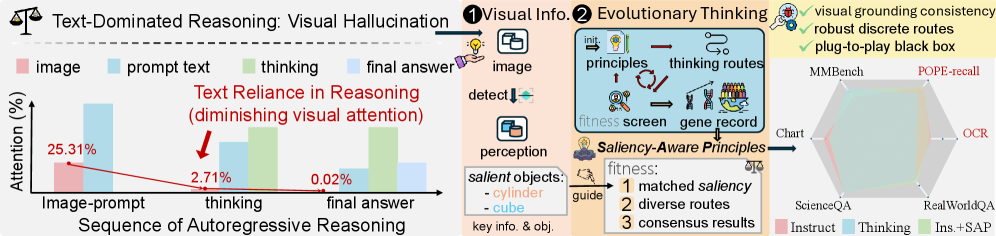
- 现有视觉语言模型在推理时面临视觉输入单次提供和文本主导的问题,导致早期错误累积。
- 本文提出显著性意识原则(SAP)选择,通过高层推理原则实现稳定控制,并支持多路径推理。
- 实验结果表明,SAP在减少对象幻觉方面表现优异,且在相似的生成预算下具有更低的响应延迟。
📝 摘要(中文)
视觉语言模型(VLMs)旨在通过联合利用视觉和文本模态进行推理。然而,现有方法在推理过程中面临诸多挑战,例如视觉输入通常仅在生成开始时提供一次,导致文本主导推理并累积早期视觉基础错误。为了解决这些问题,本文提出了显著性意识原则(SAP)选择,该方法基于高层推理原则而非单个标记轨迹,能够在噪声反馈下稳定控制离散生成,并在需要重新基础时重新参考视觉证据。此外,SAP支持多路径推理,允许并行探索多样的推理行为。实验证明,SAP在减少对象幻觉方面表现出色,并在相似的标记生成预算下实现了更稳定的推理和更低的响应延迟。
🔬 方法详解
问题定义:本文旨在解决视觉语言模型在推理过程中由于视觉输入单次提供而导致的文本主导问题,进而引发的早期视觉基础错误累积。
核心思路:提出显著性意识原则(SAP)选择,基于高层推理原则而非单个标记轨迹,能够在噪声反馈下稳定控制生成过程,并在需要时重新参考视觉证据。
技术框架:整体架构包括高层推理原则的选择模块和多路径推理模块,前者确保在噪声环境下的稳定性,后者支持并行探索多样的推理行为。
关键创新:SAP选择的最大创新在于其模型无关性和数据无关性,避免了额外训练的需求,同时在推理过程中实现了更高的稳定性和效率。
关键设计:在设计中,SAP选择不依赖于具体的参数设置或损失函数,而是通过高层次的推理原则来引导生成过程,确保在复杂推理任务中的有效性。
🖼️ 关键图片
📊 实验亮点
实验结果显示,SAP在减少对象幻觉方面的表现显著优于传统方法,尤其是在相似的标记生成预算下,推理的稳定性和响应延迟均有明显改善,具体性能数据未提供,但相较于CoT风格的长序列推理,提升幅度显著。
🎯 应用场景
该研究的潜在应用领域包括智能问答系统、视觉内容生成和多模态交互等。通过提高视觉语言模型的推理能力,能够在更复杂的场景中实现更准确的理解和生成,具有重要的实际价值和未来影响。
📄 摘要(原文)
Vision-language models (VLMs) aim to reason by jointly leveraging visual and textual modalities. While allocating additional inference-time computation has proven effective for large language models (LLMs), achieving similar scaling in VLMs remains challenging. A key obstacle is that visual inputs are typically provided only once at the start of generation, while textual reasoning (e.g., early visual summaries) is generated autoregressively, causing reasoning to become increasingly text-dominated and allowing early visual grounding errors to accumulate. Moreover, vanilla guidance for visual grounding during inference is often coarse and noisy, making it difficult to steer reasoning over long texts. To address these challenges, we propose \emph{Saliency-Aware Principle} (SAP) selection. SAP operates on high-level reasoning principles rather than token-level trajectories, which enable stable control over discrete generation under noisy feedback while allowing later reasoning steps to re-consult visual evidence when renewed grounding is required. In addition, SAP supports multi-route inference, enabling parallel exploration of diverse reasoning behaviors. SAP is model-agnostic and data-free, requiring no additional training. Empirical results show that SAP achieves competitive performance, especially in reducing object hallucination, under comparable token-generation budgets while yielding more stable reasoning and lower response latency than CoT-style long sequential reasoning.