Hyperbolic Space Learning Method Leveraging Temporal Motion Priors for Human Mesh Recovery
作者: Xiang Zhang, Suping Wu, Weibin Qiu, Zhaocheng Jin, Sheng Yang
分类: cs.CV, cs.AI
发布日期: 2025-10-21
备注: Accepted by ICME2025
💡 一句话要点
提出一种利用时序运动先验的 hyperbolic 空间学习方法,用于人体网格重建。
🎯 匹配领域: 支柱六:视频提取与匹配 (Video Extraction)
关键词: 人体网格重建 时序运动先验 hyperbolic 空间学习 3D人体姿态估计 视频分析
📋 核心要点
- 现有基于视频的人体网格重建方法难以准确捕捉人体固有的层级结构,导致重建结果不准确。
- 利用时序运动先验信息,在 hyperbolic 空间中优化学习网格特征,从而更好地建模人体结构的层级关系。
- 实验结果表明,该方法在公开数据集上优于现有方法,能够更准确地重建人体网格。
📝 摘要(中文)
本文提出了一种利用时序运动先验的 hyperbolic 空间学习方法,用于从视频中恢复 3D 人体网格。现有方法通常在欧几里得空间学习网格特征,难以准确捕捉人体网格的层级结构(如躯干-四肢-手指),导致重建的人体网格不准确。为了解决这个问题,首先设计了一个时序运动先验提取模块,分别从 3D 姿态序列和图像特征序列中提取时序运动特征,并将它们组合成时序运动先验,从而增强特征在时序运动维度上的表达能力。其次,设计了一种 hyperbolic 空间优化学习策略,利用时序运动先验信息辅助学习,并在 hyperbolic 空间中分别利用 3D 姿态和姿态运动信息来优化和学习网格特征。然后,结合优化结果以获得准确和平滑的人体网格。此外,为了使人体网格在 hyperbolic 空间中的优化学习过程稳定有效,提出了一种 hyperbolic 网格优化损失。在大型公开数据集上的大量实验结果表明,该方法优于大多数最先进的方法。
🔬 方法详解
问题定义:现有基于视频的人体网格重建方法通常在欧几里得空间中学习网格特征,难以准确捕捉人体网格的层级结构(如躯干-四肢-手指),导致重建的人体网格不准确。因此,如何有效地建模人体结构的层级关系是该论文要解决的核心问题。
核心思路:论文的核心思路是利用 hyperbolic 空间来建模人体网格的层级结构,并结合时序运动先验信息来辅助学习。 hyperbolic 空间已被证明能够有效地捕捉现实世界数据集中的层级关系。通过在 hyperbolic 空间中进行优化学习,可以更好地建模人体结构的层级关系,从而提高人体网格重建的准确性。
技术框架:该方法主要包含两个模块:时序运动先验提取模块和 hyperbolic 空间优化学习策略。首先,时序运动先验提取模块从 3D 姿态序列和图像特征序列中提取时序运动特征,并将它们组合成时序运动先验。然后, hyperbolic 空间优化学习策略利用时序运动先验信息辅助学习,并在 hyperbolic 空间中分别利用 3D 姿态和姿态运动信息来优化和学习网格特征。最后,结合优化结果以获得准确和平滑的人体网格。
关键创新:该论文的关键创新在于以下几个方面:1) 提出了一种时序运动先验提取模块,能够有效地提取时序运动特征。2) 设计了一种 hyperbolic 空间优化学习策略,能够更好地建模人体结构的层级关系。3) 提出了一种 hyperbolic 网格优化损失,能够使人体网格在 hyperbolic 空间中的优化学习过程稳定有效。与现有方法相比,该方法能够更准确地重建人体网格。
关键设计:时序运动先验提取模块的具体实现方式未知, hyperbolic 空间优化学习策略中如何将时序运动先验信息融入到 hyperbolic 空间学习中,以及 hyperbolic 网格优化损失的具体形式也未知。这些是影响最终性能的关键设计细节,需要在论文中进一步阐述。
🖼️ 关键图片

📊 实验亮点
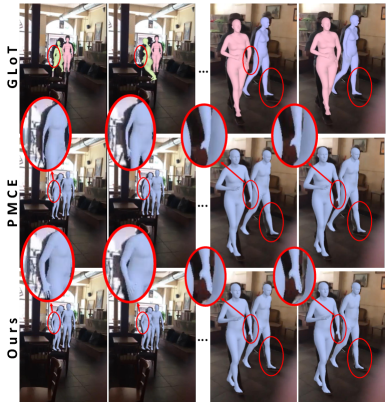
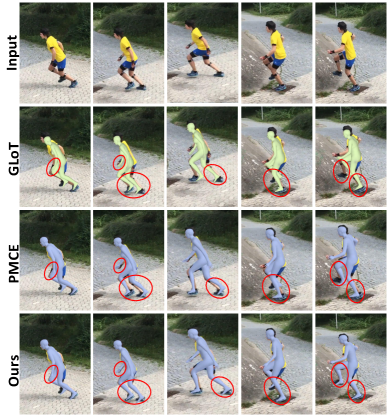
论文在大型公开数据集上进行了大量实验,实验结果表明,该方法在人体网格重建的准确性方面优于大多数最先进的方法。具体的性能数据和对比基线未知,但摘要中明确指出该方法具有优越性,表明其在人体网格重建领域具有一定的竞争力。
🎯 应用场景
该研究成果可应用于虚拟现实、增强现实、游戏、动画制作、运动分析、智能监控等领域。通过准确地重建人体网格,可以为这些应用提供更真实、更自然的人机交互体验,并为运动分析和智能监控提供更精确的数据支持。未来,该方法有望进一步扩展到其他具有层级结构的数据建模任务中。
📄 摘要(原文)
3D human meshes show a natural hierarchical structure (like torso-limbs-fingers). But existing video-based 3D human mesh recovery methods usually learn mesh features in Euclidean space. It's hard to catch this hierarchical structure accurately. So wrong human meshes are reconstructed. To solve this problem, we propose a hyperbolic space learning method leveraging temporal motion prior for recovering 3D human meshes from videos. First, we design a temporal motion prior extraction module. This module extracts the temporal motion features from the input 3D pose sequences and image feature sequences respectively. Then it combines them into the temporal motion prior. In this way, it can strengthen the ability to express features in the temporal motion dimension. Since data representation in non-Euclidean space has been proved to effectively capture hierarchical relationships in real-world datasets (especially in hyperbolic space), we further design a hyperbolic space optimization learning strategy. This strategy uses the temporal motion prior information to assist learning, and uses 3D pose and pose motion information respectively in the hyperbolic space to optimize and learn the mesh features. Then, we combine the optimized results to get an accurate and smooth human mesh. Besides, to make the optimization learning process of human meshes in hyperbolic space stable and effective, we propose a hyperbolic mesh optimization loss. Extensive experimental results on large publicly available datasets indicate superiority in comparison with most state-of-the-art.