Class Prototypes based Contrastive Learning for Classifying Multi-Label and Fine-Grained Educational Videos
作者: Rohit Gupta, Anirban Roy, Claire Christensen, Sujeong Kim, Sarah Gerard, Madeline Cincebeaux, Ajay Divakaran, Todd Grindal, Mubarak Shah
分类: cs.CV
发布日期: 2025-10-13
备注: Published at CVPR 2023
🔗 代码/项目: GITHUB
💡 一句话要点
提出基于类原型对比学习的多标签细粒度教育视频分类方法
🎯 匹配领域: 支柱二:RL算法与架构 (RL & Architecture) 支柱九:具身大模型 (Embodied Foundation Models)
关键词: 教育视频分类 多标签分类 细粒度分类 对比学习 类原型 多模态融合 Transformer网络
📋 核心要点
- 现有方法难以有效区分视觉相似的多标签细粒度教育视频内容,限制了教育资源的精准推荐。
- 论文提出基于类原型的监督对比学习方法,通过拉近同类样本、推远异类样本来提升分类性能。
- 实验表明,该方法在APPROVE、Youtube-8M和COIN等数据集上优于现有方法,验证了其有效性。
📝 摘要(中文)
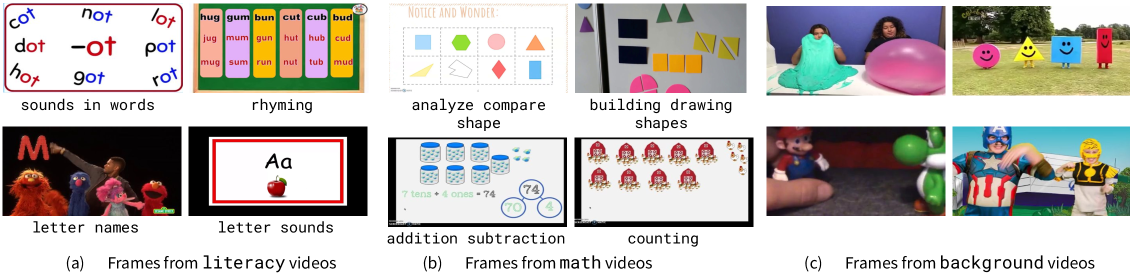
本文提出了一种检测在线视频中教育内容的方法,特别关注幼儿早期教育中广泛使用的识字和数学两类内容。针对每类内容,根据Common Core Standards选择关键的子类(代码),例如识字类的“字母名称”、“字母发音”,以及数学类的“计数”、“排序”。该问题被建模为一个细粒度的多标签分类问题,因为视频可能包含多种类型的教育内容,且内容类别在视觉上可能非常相似。为此,论文提出了一种新颖的基于类原型的监督对比学习方法,能够处理与多个标签相关的细粒度样本。该方法为每个类别学习一个类原型,并使用损失函数来最小化类原型与该类别样本之间的距离,同时最大化类原型与其他类别样本之间的距离。考虑到视觉和音频线索的对齐对于有效理解至关重要,论文采用多模态Transformer网络来捕捉视频中视觉和音频线索之间的交互,从而学习视频的嵌入表示。为了评估,论文提出了一个名为APPROVE的数据集,该数据集包含来自YouTube的教育视频,并由教育研究人员标注了细粒度的教育类别。APPROVE包含193小时的专家标注视频,共19个类别。所提出的方法在APPROVE以及其他基准数据集(如Youtube-8M和COIN)上优于强大的基线方法。
🔬 方法详解
问题定义:论文旨在解决细粒度多标签教育视频分类问题。现有方法难以有效区分视觉上相似的教育内容子类,例如“字母名称”和“字母发音”,并且无法很好地处理视频中同时存在多个教育标签的情况。这导致教育视频分类的准确性不高,影响了教育资源的有效利用。
核心思路:论文的核心思路是利用对比学习,学习每个类别的类原型,并通过最小化同类样本与类原型之间的距离,最大化异类样本与类原型之间的距离,从而提高分类器的区分能力。这种方法能够有效地处理细粒度分类问题中类别间相似性高的问题,并能够同时处理多个标签。
技术框架:整体框架包括以下几个主要模块:1) 多模态特征提取:使用多模态Transformer网络提取视频的视觉和音频特征,捕捉两者之间的交互信息。2) 类原型学习:为每个类别学习一个类原型,该原型代表了该类别的典型特征。3) 对比学习损失:设计对比学习损失函数,最小化同类样本与类原型之间的距离,最大化异类样本与类原型之间的距离。4) 分类器:使用学习到的特征和类原型进行多标签分类。
关键创新:论文的关键创新在于提出了基于类原型的监督对比学习方法,该方法能够有效地处理细粒度多标签分类问题。与传统的对比学习方法不同,该方法显式地学习每个类别的类原型,从而更好地捕捉类别的特征。此外,论文还采用了多模态Transformer网络来捕捉视频中视觉和音频线索之间的交互信息,进一步提高了分类性能。
关键设计:论文的关键设计包括:1) 多模态Transformer网络结构的选择和参数设置。2) 类原型的初始化方法和更新策略。3) 对比学习损失函数的具体形式,例如InfoNCE损失。4) 正负样本的选择策略,如何选择具有代表性的负样本。
🖼️ 关键图片


📊 实验亮点
该方法在APPROVE数据集上取得了显著的性能提升,相较于其他基线方法,在多标签分类任务中取得了更高的平均精度均值(mAP)。此外,该方法在Youtube-8M和COIN等通用视频数据集上也表现出良好的泛化能力,验证了其有效性。
🎯 应用场景
该研究成果可应用于智能教育领域,例如自动识别在线教育视频的内容,为学生推荐合适的学习资源,帮助教师筛选优质的教学材料。此外,该技术还可以用于构建智能化的教育内容管理系统,提高教育资源的利用效率,促进个性化学习的发展。
📄 摘要(原文)
The recent growth in the consumption of online media by children during early childhood necessitates data-driven tools enabling educators to filter out appropriate educational content for young learners. This paper presents an approach for detecting educational content in online videos. We focus on two widely used educational content classes: literacy and math. For each class, we choose prominent codes (sub-classes) based on the Common Core Standards. For example, literacy codes include
letter names',letter sounds', and math codes includecounting',sorting'. We pose this as a fine-grained multilabel classification problem as videos can contain multiple types of educational content and the content classes can get visually similar (e.g.,letter names' vsletter sounds'). We propose a novel class prototypes based supervised contrastive learning approach that can handle fine-grained samples associated with multiple labels. We learn a class prototype for each class and a loss function is employed to minimize the distances between a class prototype and the samples from the class. Similarly, distances between a class prototype and the samples from other classes are maximized. As the alignment between visual and audio cues are crucial for effective comprehension, we consider a multimodal transformer network to capture the interaction between visual and audio cues in videos while learning the embedding for videos. For evaluation, we present a dataset, APPROVE, employing educational videos from YouTube labeled with fine-grained education classes by education researchers. APPROVE consists of 193 hours of expert-annotated videos with 19 classes. The proposed approach outperforms strong baselines on APPROVE and other benchmarks such as Youtube-8M, and COIN. The dataset is available at https://github.com/rohit-gupta/MMContrast/tree/main/APPROVE