FreeRet: MLLMs as Training-Free Retrievers
作者: Yuhan Zhu, Xiangyu Zeng, Chenting Wang, Xinhao Li, Yicheng Xu, Ziang Yan, Yi Wang, Limin Wang
分类: cs.CV
发布日期: 2025-09-29
💡 一句话要点
提出FreeRet框架以实现无训练的多模态检索
🎯 匹配领域: 支柱九:具身大模型 (Embodied Foundation Models)
关键词: 多模态检索 大型语言模型 无训练框架 语义嵌入 重排序 信息检索 智能问答
📋 核心要点
- 现有的多模态检索方法通常需要大量的后期训练,限制了其灵活性和效率。
- FreeRet框架通过直接从MLLM中提取语义嵌入,避免了复杂的训练过程,提升了检索效率。
- 在MMEB和MMEB-V2基准测试中,FreeRet显著超越了经过数百万对训练的模型,展示了其强大的检索能力。
📝 摘要(中文)
多模态大型语言模型(MLLMs)作为混合模态检索的基础,通常需要大量后期训练以转化为对比编码器。本文提出FreeRet,一个即插即用的框架,能够将任何MLLM直接转化为两阶段检索器。FreeRet首先从模型中直接导出语义嵌入以进行快速候选搜索,然后利用其推理能力进行精确的重排序。该框架在多个基准测试中表现优异,且具备模型无关性,支持多种模态组合,统一了检索、重排序和生成的流程。研究表明,经过精心利用的预训练MLLM可以在无需训练的情况下,作为强大的检索引擎,填补其作为通用模型的关键空白。
🔬 方法详解
问题定义:本文旨在解决现有多模态检索方法依赖大量后期训练的问题,这限制了其应用的灵活性和效率。
核心思路:FreeRet框架的核心思想是利用预训练的MLLM直接生成语义嵌入,避免了复杂的训练过程,同时利用模型的推理能力进行精确的重排序。
技术框架:FreeRet的整体架构分为两个主要阶段:第一阶段是快速候选搜索,通过MLLM生成语义嵌入;第二阶段是重排序,利用模型的推理能力对候选结果进行精细调整。
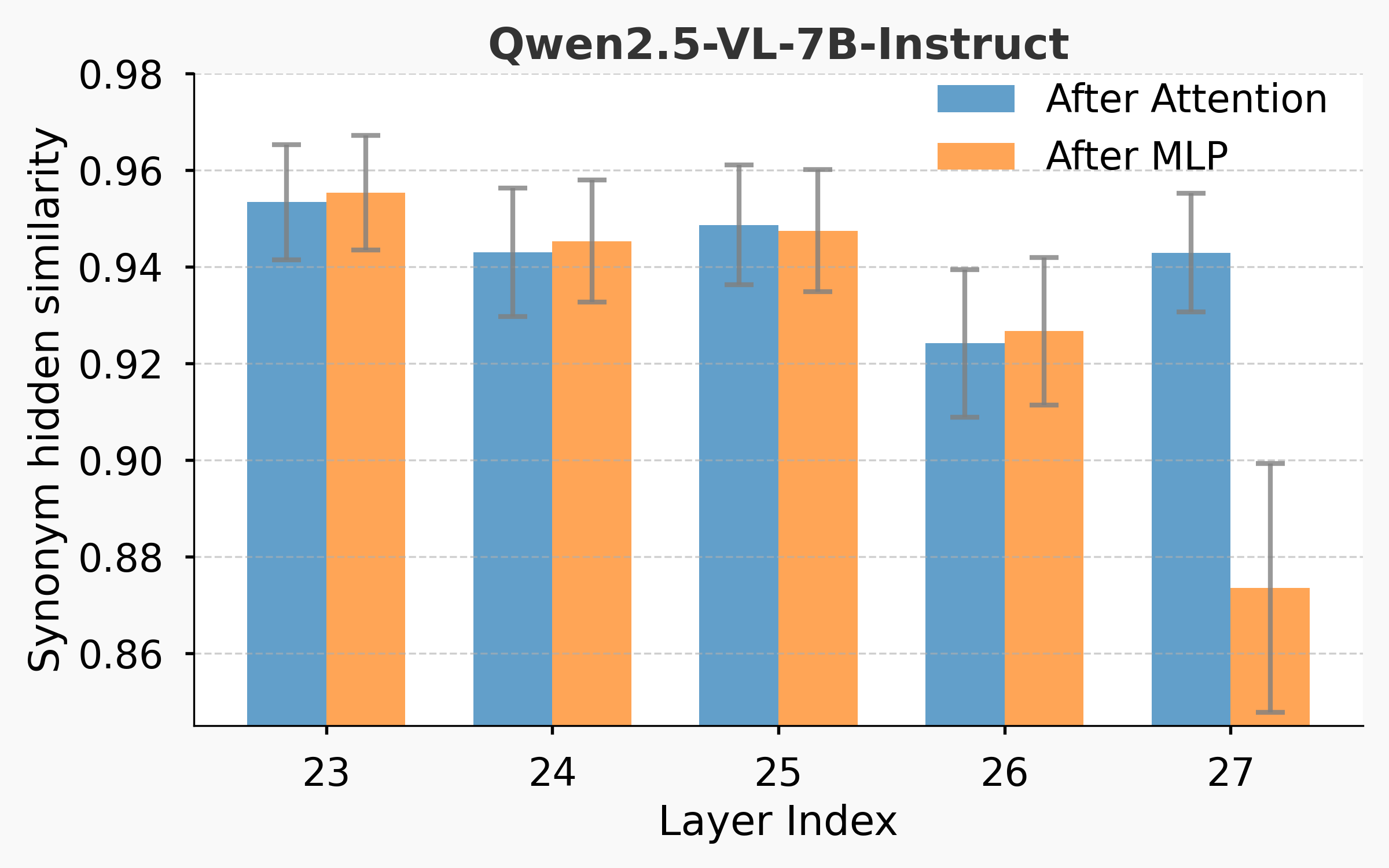
关键创新:FreeRet的主要创新在于绕过词汇对齐层,直接获取语义嵌入,并通过显式先验条件化表示生成,减轻了重排序中的框架效应。这与现有方法的本质区别在于无需后期训练。
关键设计:在设计中,FreeRet采用了特定的参数设置和损失函数,以确保生成的嵌入具有语义一致性,同时优化了重排序过程中的选择框架,以提高结果的准确性。
🖼️ 关键图片


📊 实验亮点
在MMEB和MMEB-V2基准测试中,FreeRet显著超越了经过数百万对训练的模型,展示了在检索效率和准确性上的显著提升。具体而言,FreeRet在多个数据集上均表现出色,证明了其作为无训练检索引擎的有效性。
🎯 应用场景
FreeRet框架具有广泛的应用潜力,适用于需要高效检索的多模态任务,如信息检索、推荐系统和智能问答等领域。其无训练的特性使得在实际应用中能够快速部署,降低了开发成本。未来,FreeRet可能会推动多模态检索技术的进一步发展,促进不同模态之间的融合与应用。
📄 摘要(原文)
Multimodal large language models (MLLMs) are emerging as versatile foundations for mixed-modality retrieval. Yet, they often require heavy post-hoc training to convert them into contrastive encoders for retrieval. This work asks: Can off-the-shelf MLLMs serve as powerful retrievers without additional training? We present FreeRet, a plug-and-play framework that turns any MLLM into a two-stage retriever. FreeRet first derives semantically grounded embeddings directly from the model for fast candidate search, and then exploits its reasoning ability for precise reranking. The framework contributes three advances: bypassing lexical alignment layers to obtain semantically faithful embeddings, conditioning representation generation with explicit priors, and mitigating framing effect in reranking via neutral choice framing. On the MMEB and MMEB-V2 benchmarks spanning 46 datasets, FreeRet substantially outperforms models trained on millions of pairs. Beyond benchmarks, FreeRet is model-agnostic and scales seamlessly across MLLM families and sizes, preserves their generative abilities, supports arbitrary modality combinations, and unifies retrieval, reranking, and generation into end-to-end RAG within a single model. Our findings demonstrate that pretrained MLLMs, when carefully harnessed, can serve as strong retrieval engines without training, closing a critical gap in their role as generalists.