OmniPhysGS: 3D Constitutive Gaussians for General Physics-Based Dynamics Generation
作者: Yuchen Lin, Chenguo Lin, Jianjin Xu, Yadong Mu
分类: cs.CV
发布日期: 2025-01-31
备注: Accepted to ICLR 2025; Project page: https://wgsxm.github.io/projects/omniphysgs/
💡 一句话要点
提出OmniPhysGS以解决复杂物体物理动态生成问题
🎯 匹配领域: 支柱四:生成式动作 (Generative Motion)
关键词: 3D动态生成 物理模拟 高斯分布 材料建模 计算机图形学
📋 核心要点
- 现有方法通常假设所有材料属于特定类别,忽略了多种异质物体的复杂性,导致生成的物理动态不够真实。
- 本文提出OmniPhysGS,通过将每个3D资产视为一组构成的3D高斯分布,利用多个物理子模型来增强模型的灵活性。
- 实验结果表明,OmniPhysGS在视觉质量和文本对齐方面超越了现有方法3%至16%,实现了更真实的物理动态效果。
📝 摘要(中文)
近年来,在3D资产的重建和生成方面取得了显著进展,包括静态场景和具有物理交互的场景。现有方法通常假设所有材料属于特定的预定义类别,这种假设忽略了现实场景中多种异质物体的复杂组成,导致生成的动画在物理上不够可信。为此,本文提出OmniPhysGS,旨在合成由更一般物体组成的基于物理的3D动态场景。OmniPhysGS的关键设计是将每个3D资产视为一组构成的3D高斯分布,并通过12个物理领域专家子模型(如橡胶、金属、蜂蜜、水等)来表示每个高斯的物理材料,从而大大增强了模型的灵活性。实验表明,OmniPhysGS在更广泛的材料范围内实现了更通用和真实的物理动态,超越了现有方法3%至16%的视觉质量和文本对齐指标。
🔬 方法详解
问题定义:本文旨在解决现有方法在处理复杂物体物理动态生成时的局限性,尤其是对多种异质材料的处理不足,导致生成的动画缺乏物理真实性。
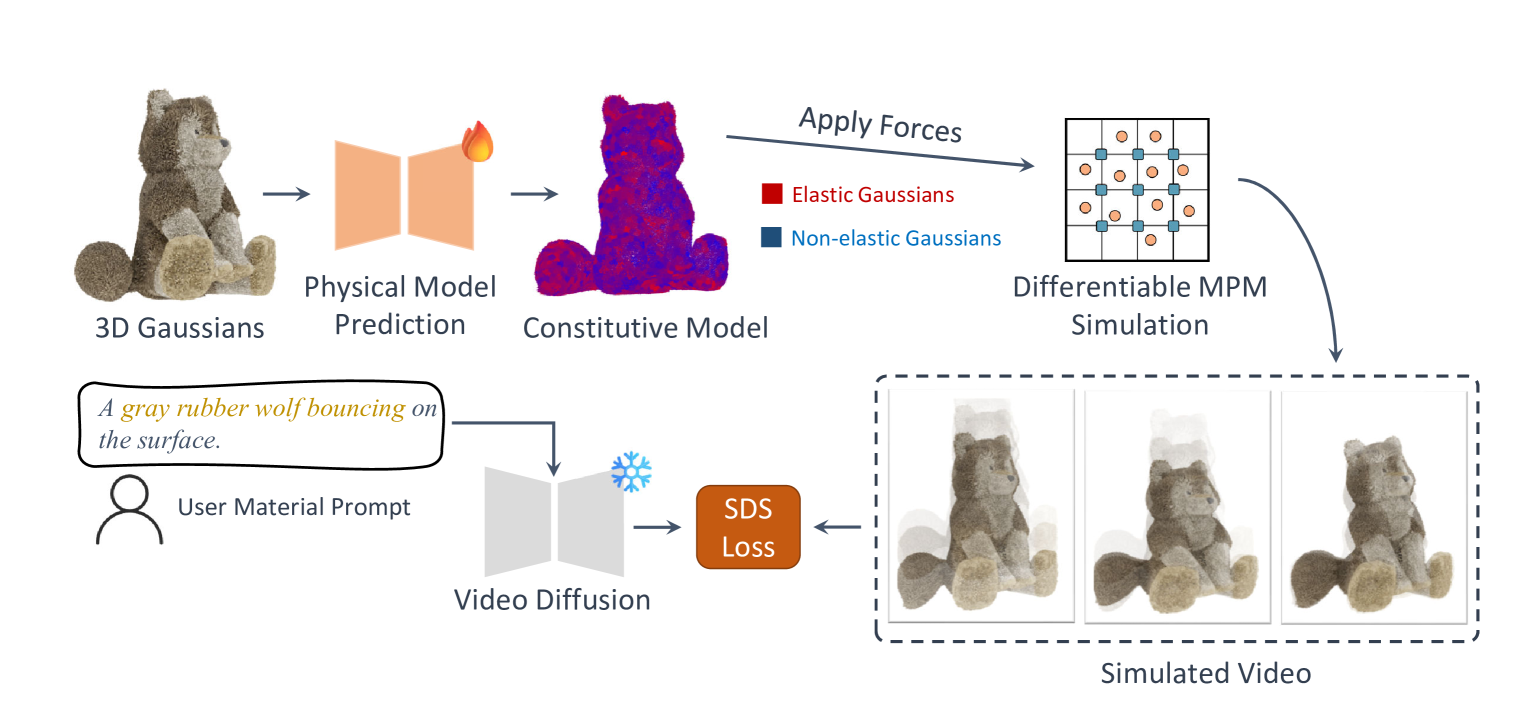
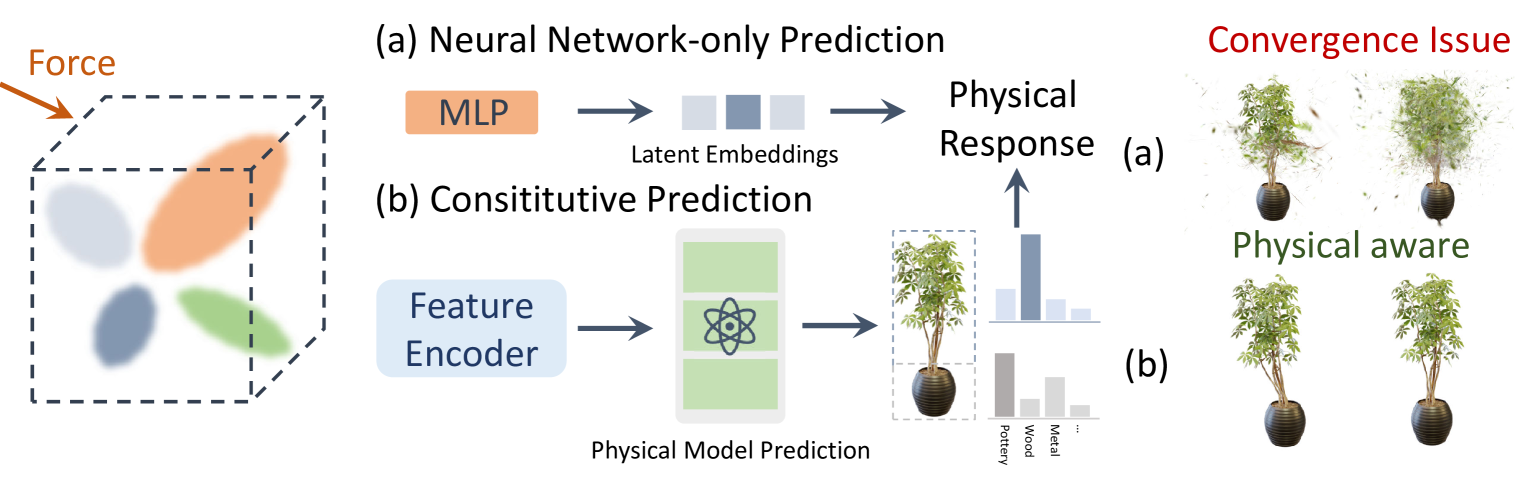
核心思路:OmniPhysGS的核心思路是将每个3D资产视为由多个构成的3D高斯分布,通过引入12个物理领域专家子模型来表示不同材料的物理特性,从而提高模型的灵活性和适应性。
技术框架:该方法的整体架构包括用户指定的场景定义模块和通过预训练视频扩散模型监督材料权重因子的估计模块。具体流程为:用户输入场景提示,模型根据提示生成相应的物理动态场景。
关键创新:最重要的技术创新在于将3D资产视为构成的高斯分布,并通过多个物理子模型来表示材料特性,这一设计使得模型能够处理更广泛的材料类型和复杂的物理交互。
关键设计:在实现过程中,关键参数设置包括高斯分布的数量和物理子模型的选择,损失函数设计用于优化生成的物理动态与真实物理行为之间的匹配度。
🖼️ 关键图片

📊 实验亮点
实验结果显示,OmniPhysGS在视觉质量和文本对齐指标上超越了现有方法3%至16%,在处理弹性、粘弹性、塑料和流体等多种材料的物理动态方面表现出色,展示了其在生成真实物理动态场景中的优势。
🎯 应用场景
该研究的潜在应用领域包括游戏开发、动画制作和虚拟现实等,能够为这些领域提供更真实的物理动态效果,提升用户体验。未来,OmniPhysGS有望在更复杂的物理交互场景中发挥重要作用,推动3D资产生成技术的发展。
📄 摘要(原文)
Recently, significant advancements have been made in the reconstruction and generation of 3D assets, including static cases and those with physical interactions. To recover the physical properties of 3D assets, existing methods typically assume that all materials belong to a specific predefined category (e.g., elasticity). However, such assumptions ignore the complex composition of multiple heterogeneous objects in real scenarios and tend to render less physically plausible animation given a wider range of objects. We propose OmniPhysGS for synthesizing a physics-based 3D dynamic scene composed of more general objects. A key design of OmniPhysGS is treating each 3D asset as a collection of constitutive 3D Gaussians. For each Gaussian, its physical material is represented by an ensemble of 12 physical domain-expert sub-models (rubber, metal, honey, water, etc.), which greatly enhances the flexibility of the proposed model. In the implementation, we define a scene by user-specified prompts and supervise the estimation of material weighting factors via a pretrained video diffusion model. Comprehensive experiments demonstrate that OmniPhysGS achieves more general and realistic physical dynamics across a broader spectrum of materials, including elastic, viscoelastic, plastic, and fluid substances, as well as interactions between different materials. Our method surpasses existing methods by approximately 3% to 16% in metrics of visual quality and text alignment.