Textured Gaussians for Enhanced 3D Scene Appearance Modeling
作者: Brian Chao, Hung-Yu Tseng, Lorenzo Porzi, Chen Gao, Tuotuo Li, Qinbo Li, Ayush Saraf, Jia-Bin Huang, Johannes Kopf, Gordon Wetzstein, Changil Kim
分类: cs.CV, cs.AI, cs.GR, eess.IV
发布日期: 2024-11-27 (更新: 2025-05-29)
备注: Will be presented at CVPR 2025. Project website: https://textured-gaussians.github.io/
💡 一句话要点
提出纹理高斯以增强3D场景外观建模
🎯 匹配领域: 支柱三:空间感知与语义 (Perception & Semantics)
关键词: 3D重建 高斯点云 纹理映射 计算机视觉 图像渲染
📋 核心要点
- 现有的3D高斯点云方法在颜色表现上存在局限,无法有效表示复杂的纹理和几何结构。
- 本文提出了一种新的高斯外观表示,通过引入纹理映射来增强每个高斯的颜色和透明度变化能力。
- 实验验证了该方法在多个标准基准数据集上相较于现有方法在图像质量上的显著提升。
📝 摘要(中文)
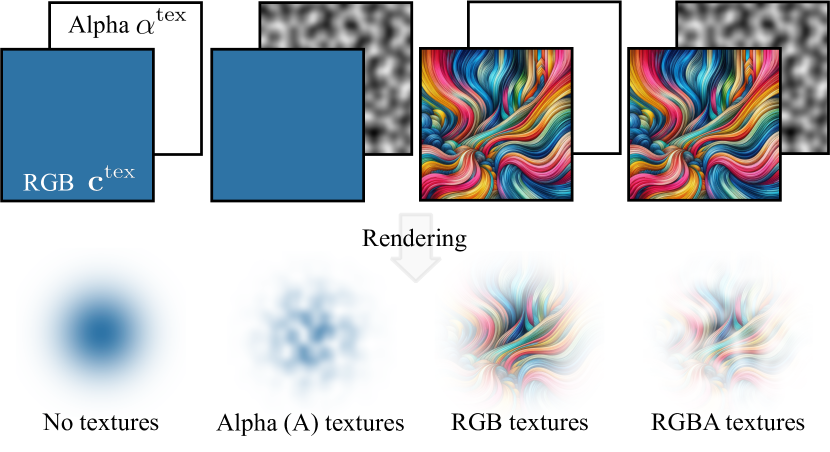
3D高斯点云(3DGS)作为一种先进的3D重建与渲染技术,因其高质量的结果和快速的训练与渲染时间而受到关注。然而,现有方法中同一高斯覆盖的像素总是以相同颜色进行着色,且每个高斯只能表示简单的椭球形几何细节,限制了其表现力。为了解决这些问题,本文借鉴传统图形中的纹理和透明度映射,将其与3DGS相结合,提出了一种新的广义高斯外观表示,增强每个高斯的纹理映射,以实现空间变化的颜色和不透明度建模。实验结果表明,使用仅包含透明度的纹理映射显著提升了高斯的表现力,而进一步结合RGB纹理映射则达到了最佳效果。
🔬 方法详解
问题定义:现有的3D高斯点云(3DGS)方法在颜色表现上存在局限,无法有效表示复杂的纹理和几何结构,导致表现力不足。
核心思路:本文通过引入纹理和透明度映射的概念,增强每个高斯的外观表示,使其能够建模空间变化的颜色和不透明度,从而提升表现力。
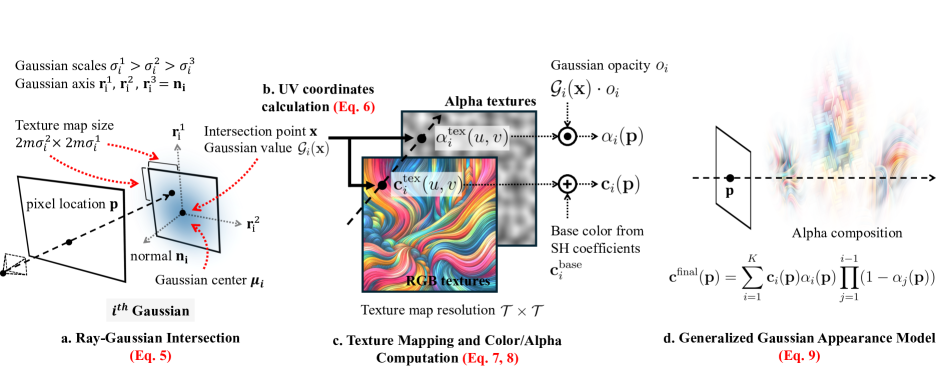
技术框架:整体架构包括高斯生成模块、纹理映射模块和渲染模块。高斯生成模块负责生成基础高斯,纹理映射模块则为每个高斯附加纹理信息,最后通过渲染模块实现最终图像的生成。
关键创新:最重要的技术创新在于将纹理映射与高斯表示相结合,使得每个高斯不仅仅是一个简单的颜色和椭球,而是能够表示更复杂的纹理模式和几何结构。
关键设计:在参数设置上,采用了不同的纹理映射策略,包括仅透明度的纹理映射和RGB纹理映射,损失函数设计上则考虑了纹理与颜色的一致性,以确保生成图像的质量。
🖼️ 关键图片
📊 实验亮点
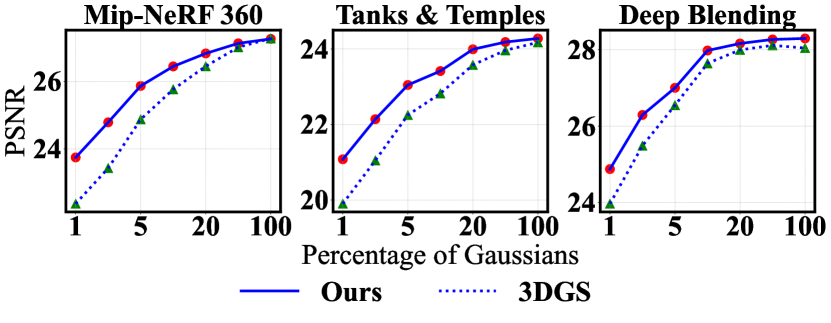
实验结果表明,使用仅透明度的纹理映射时,高斯的表现力显著提升,结合RGB纹理映射后达到了最佳效果。在多个标准数据集上,本文方法在图像质量上超越了现有技术,同时使用的高斯数量相似或更少。
🎯 应用场景
该研究的潜在应用领域包括虚拟现实、游戏开发以及计算机视觉中的3D重建与渲染。通过提升3D场景的外观表现力,可以为用户提供更真实的视觉体验,推动相关领域的发展与创新。
📄 摘要(原文)
3D Gaussian Splatting (3DGS) has recently emerged as a state-of-the-art 3D reconstruction and rendering technique due to its high-quality results and fast training and rendering time. However, pixels covered by the same Gaussian are always shaded in the same color up to a Gaussian falloff scaling factor. Furthermore, the finest geometric detail any individual Gaussian can represent is a simple ellipsoid. These properties of 3DGS greatly limit the expressivity of individual Gaussian primitives. To address these issues, we draw inspiration from texture and alpha mapping in traditional graphics and integrate it with 3DGS. Specifically, we propose a new generalized Gaussian appearance representation that augments each Gaussian with alpha~(A), RGB, or RGBA texture maps to model spatially varying color and opacity across the extent of each Gaussian. As such, each Gaussian can represent a richer set of texture patterns and geometric structures, instead of just a single color and ellipsoid as in naive Gaussian Splatting. Surprisingly, we found that the expressivity of Gaussians can be greatly improved by using alpha-only texture maps, and further augmenting Gaussians with RGB texture maps achieves the highest expressivity. We validate our method on a wide variety of standard benchmark datasets and our own custom captures at both the object and scene levels. We demonstrate image quality improvements over existing methods while using a similar or lower number of Gaussians.