Multimodal Analysis of White Blood Cell Differentiation in Acute Myeloid Leukemia Patients using a β-Variational Autoencoder
作者: Gizem Mert, Ario Sadafi, Raheleh Salehi, Nassir Navab, Carsten Marr
分类: cs.CV, cs.LG, q-bio.QM
发布日期: 2024-08-13 (更新: 2024-08-23)
备注: Accepted for publication at MICCAI 2024 workshop on AI for Imaging Genomics Learning (AIIG)
💡 一句话要点
提出基于β-VAE的多模态分析方法,用于理解急性髓系白血病患者的白细胞分化。
🎯 匹配领域: 支柱九:具身大模型 (Embodied Foundation Models)
关键词: 多模态分析 β-VAE 白细胞分化 急性髓系白血病 单细胞分析
📋 核心要点
- 现有方法在整合形态学和转录组学数据方面存在困难,限制了对细胞分化动态的全面理解。
- 论文提出基于β-VAE的无监督方法,通过定制损失函数和R-CNN架构,实现形态学和转录组学数据的联合分析。
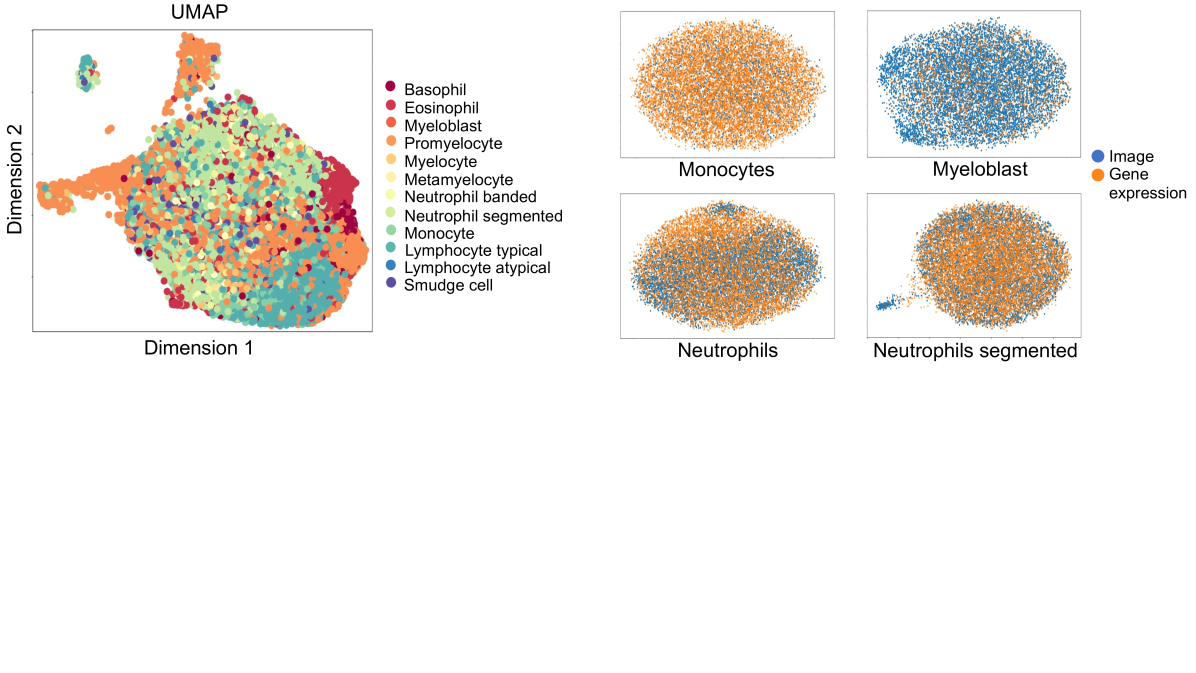
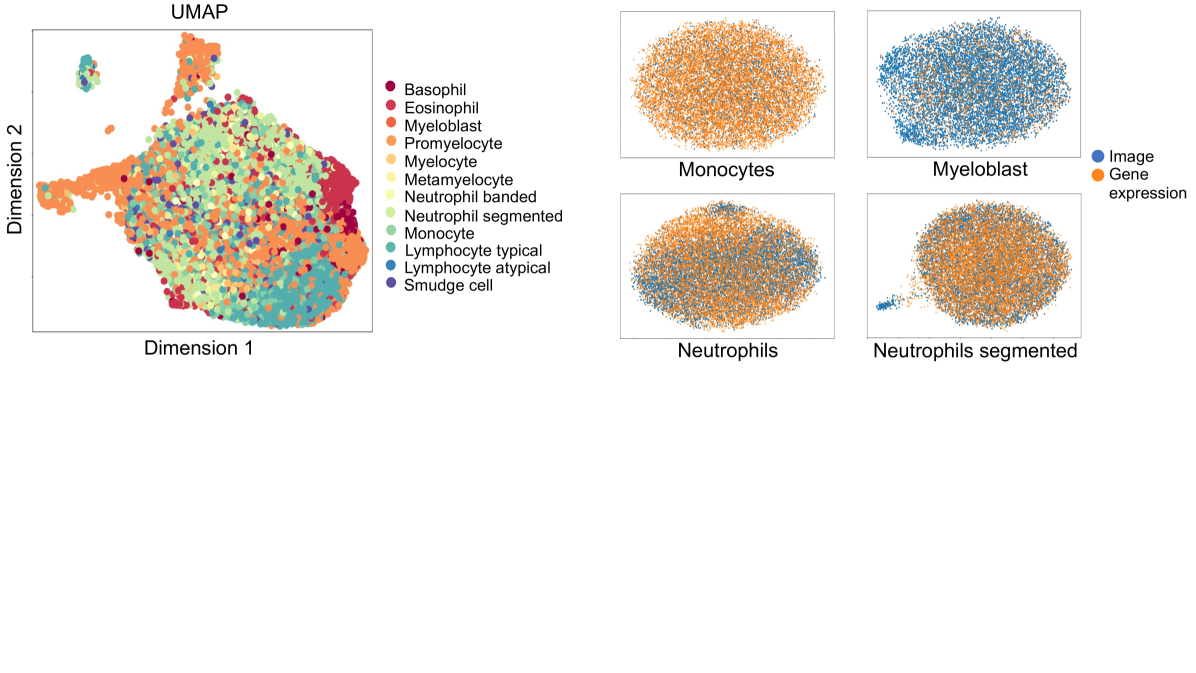
- 该方法在重建能力、潜在嵌入的连续性以及单细胞类别的区分度上表现良好,有助于揭示细胞分化过程中的复杂关联。
📝 摘要(中文)
本研究提出了一种无监督方法,用于探索和重建形态学和转录组学两种模态的数据,并揭示人类外周血涂片中不同类型白细胞在形态和转录组方面的关系。该方法基于β-变分自编码器(β-VAE),并采用定制的损失函数,结合R-CNN架构以区分单细胞与背景,并最大限度地减少伪影的干扰。该β-VAE实现展示了良好的重建能力和连续的潜在嵌入,同时保持了单细胞类之间的清晰区分。这种新方法尤其有助于揭示复杂生物过程中(如细胞中颗粒形成(粒细胞生成))与基因表达模式之间的相关性。因此,它为改进生物医学和诊断中对白细胞成熟的理解提供了一种独特的工具。
🔬 方法详解
问题定义:论文旨在解决急性髓系白血病患者白细胞分化过程中,形态学特征和转录组学数据难以有效整合分析的问题。现有方法难以充分挖掘两种模态数据之间的关联,限制了对白细胞分化机制的深入理解。
核心思路:论文的核心思路是利用β-变分自编码器(β-VAE)学习形态学和转录组学数据的共享潜在空间表示。通过将两种模态的数据映射到同一潜在空间,可以有效地捕捉它们之间的关联,并用于重建和分析细胞分化过程。
技术框架:整体框架包含数据预处理、特征提取、β-VAE模型训练和结果分析四个主要阶段。首先,对形态学图像和RNA测序数据进行预处理和特征提取。然后,将提取的特征输入到β-VAE模型中进行训练,学习共享的潜在空间表示。最后,利用学习到的潜在空间表示进行细胞分类、分化轨迹分析等。其中,R-CNN用于细胞分割,以减少背景噪声。
关键创新:论文的关键创新在于将β-VAE应用于多模态白细胞分化分析,并设计了定制的损失函数和R-CNN架构。β-VAE能够学习数据的解耦表示,有助于发现隐藏在复杂生物过程中的关键因素。定制的损失函数和R-CNN架构进一步提高了模型的重建能力和分类精度。
关键设计:β-VAE的损失函数包括重建损失和KL散度损失,其中KL散度损失用于约束潜在空间的分布。β参数用于控制潜在空间的解耦程度。R-CNN用于从形态学图像中分割出单个细胞,减少背景噪声的干扰。具体的网络结构和参数设置在论文中有详细描述(未知)。
🖼️ 关键图片

📊 实验亮点
论文提出的β-VAE方法在白细胞分化分析中表现出良好的性能。实验结果表明,该方法能够有效地重建形态学和转录组学数据,并学习到具有区分性的潜在空间表示。此外,该方法还能够揭示细胞中颗粒形成与基因表达模式之间的相关性,为深入理解白细胞分化机制提供了新的视角。具体的性能数据和对比基线未知。
🎯 应用场景
该研究成果可应用于白血病等血液系统疾病的诊断和治疗。通过深入理解白细胞分化过程中的形态学和转录组学变化,可以为疾病的早期诊断、预后评估和个性化治疗提供新的思路。此外,该方法还可以推广到其他多模态生物医学数据的分析中,促进相关领域的研究进展。
📄 摘要(原文)
Biomedical imaging and RNA sequencing with single-cell resolution improves our understanding of white blood cell diseases like leukemia. By combining morphological and transcriptomic data, we can gain insights into cellular functions and trajectoriess involved in blood cell differentiation. However, existing methodologies struggle with integrating morphological and transcriptomic data, leaving a significant research gap in comprehensively understanding the dynamics of cell differentiation. Here, we introduce an unsupervised method that explores and reconstructs these two modalities and uncovers the relationship between different subtypes of white blood cells from human peripheral blood smears in terms of morphology and their corresponding transcriptome. Our method is based on a beta-variational autoencoder (ß-VAE) with a customized loss function, incorporating a R-CNN architecture to distinguish single-cell from background and to minimize any interference from artifacts. This implementation of ß-VAE shows good reconstruction capability along with continuous latent embeddings, while maintaining clear differentiation between single-cell classes. Our novel approach is especially helpful to uncover the correlation of two latent features in complex biological processes such as formation of granules in the cell (granulopoiesis) with gene expression patterns. It thus provides a unique tool to improve the understanding of white blood cell maturation for biomedicine and diagnostics.