Patch-based Intuitive Multimodal Prototypes Network (PIMPNet) for Alzheimer's Disease classification
作者: Lisa Anita De Santi, Jörg Schlötterer, Meike Nauta, Vincenzo Positano, Christin Seifert
分类: cs.CV
发布日期: 2024-07-19 (更新: 2024-07-22)
备注: Accepted "late-breaking work" at XAI-2024
💡 一句话要点
PIMPNet:基于Patch的多模态原型网络,用于阿尔茨海默病分类
🎯 匹配领域: 支柱九:具身大模型 (Embodied Foundation Models)
关键词: 阿尔茨海默病 深度学习 原型网络 多模态学习 医学图像分析
📋 核心要点
- 现有基于深度学习的AD诊断系统缺乏可解释性,难以区分AD引起的脑部形态变化与正常衰老。
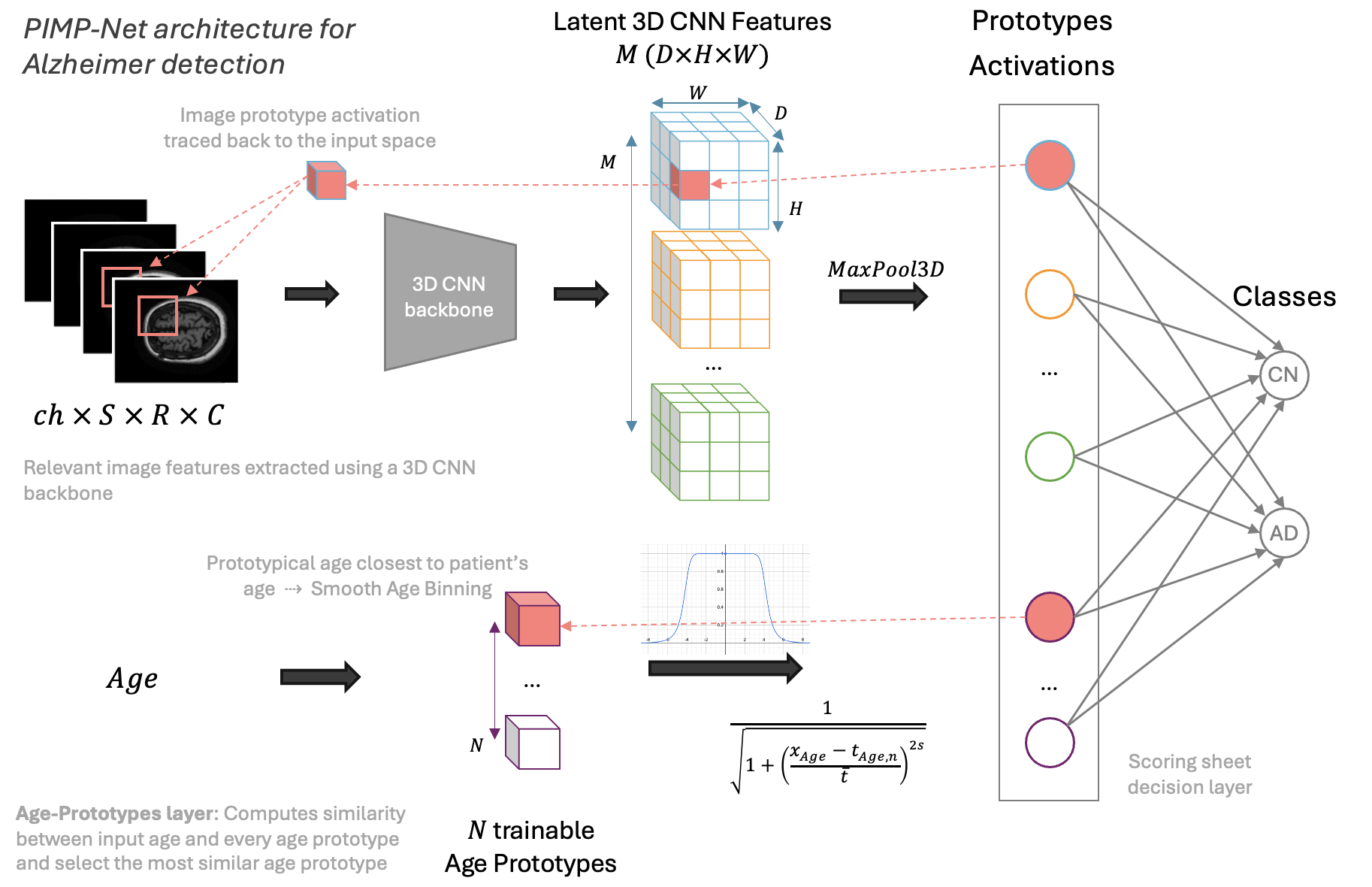
- PIMPNet采用原型网络架构,结合sMRI图像块和患者年龄信息,实现AD的二元分类,提升模型的可解释性。
- 实验结果表明,PIMPNet在AD分类任务上取得了有竞争力的结果,为多模态原型网络在医学图像分析中的应用提供了新思路。
📝 摘要(中文)
本研究提出了一种基于Patch的直观多模态原型网络(PIMPNet),用于阿尔茨海默病(AD)的二元分类。该模型利用结构磁共振成像(sMRI)和患者年龄等多模态信息,旨在结合深度学习的计算优势和原型网络的易解释性。PIMPNet是首个应用于3D图像和人口统计学数据的可解释多模态模型。实验结果表明,虽然年龄原型并未显著提高预测性能,但为未来模型设计和多模态原型训练过程的研究奠定了基础。
🔬 方法详解
问题定义:阿尔茨海默病(AD)的诊断依赖于神经影像学检查,如结构磁共振成像(sMRI)。现有的深度学习方法在分析sMRI图像时,难以有效结合患者年龄等信息,并且模型的可解释性较差,难以区分AD病变与正常衰老引起的脑部变化。
核心思路:PIMPNet的核心思路是利用原型网络的可解释性,将sMRI图像分割成多个patch,并结合患者年龄信息,学习具有代表性的原型。通过比较输入样本与原型之间的相似度,实现AD的分类,同时提供对分类结果的解释。
技术框架:PIMPNet的整体架构包含以下几个主要模块:1) sMRI图像预处理;2) 图像patch提取;3) 特征提取网络(例如卷积神经网络);4) 原型层,学习sMRI图像patch和年龄的原型;5) 分类器,基于输入样本与原型之间的距离进行AD分类。
关键创新:PIMPNet的关键创新在于:1) 提出了一种基于patch的多模态原型网络,能够同时处理3D sMRI图像和患者年龄信息;2) 将原型网络应用于AD分类任务,提高了模型的可解释性,有助于医生理解模型的决策过程。
关键设计:PIMPNet的关键设计包括:1) 使用卷积神经网络提取sMRI图像patch的特征;2) 使用对比损失函数训练原型层,使得同类样本的原型更加接近,不同类样本的原型更加远离;3) 通过可视化原型,可以观察模型学习到的AD相关脑部特征。
🖼️ 关键图片

📊 实验亮点
论文提出的PIMPNet模型在AD二分类任务上取得了有竞争力的结果。虽然加入年龄原型并没有显著提高预测性能,但为后续研究多模态原型网络的训练方法和模型设计提供了基础。该模型的可解释性是其主要亮点,通过可视化原型,可以观察模型学习到的AD相关脑部特征。
🎯 应用场景
PIMPNet可应用于阿尔茨海默病的辅助诊断,帮助医生更准确地识别AD患者。该模型的可解释性有助于医生理解诊断结果,并为临床决策提供依据。未来,该模型可扩展到其他神经退行性疾病的诊断,并结合更多模态的信息,如基因数据和认知测试结果,提高诊断的准确性和可靠性。
📄 摘要(原文)
Volumetric neuroimaging examinations like structural Magnetic Resonance Imaging (sMRI) are routinely applied to support the clinical diagnosis of dementia like Alzheimer's Disease (AD). Neuroradiologists examine 3D sMRI to detect and monitor abnormalities in brain morphology due to AD, like global and/or local brain atrophy and shape alteration of characteristic structures. There is a strong research interest in developing diagnostic systems based on Deep Learning (DL) models to analyse sMRI for AD. However, anatomical information extracted from an sMRI examination needs to be interpreted together with patient's age to distinguish AD patterns from the regular alteration due to a normal ageing process. In this context, part-prototype neural networks integrate the computational advantages of DL in an interpretable-by-design architecture and showed promising results in medical imaging applications. We present PIMPNet, the first interpretable multimodal model for 3D images and demographics applied to the binary classification of AD from 3D sMRI and patient's age. Despite age prototypes do not improve predictive performance compared to the single modality model, this lays the foundation for future work in the direction of the model's design and multimodal prototype training process