Video Frame Interpolation with Many-to-many Splatting and Spatial Selective Refinement
作者: Ping Hu, Simon Niklaus, Lu Zhang, Stan Sclaroff, Kate Saenko
分类: cs.CV, cs.MM
发布日期: 2023-10-29
备注: T-PAMI. arXiv admin note: substantial text overlap with arXiv:2204.03513
💡 一句话要点
提出多对多溅射框架以解决视频帧插值问题
🎯 匹配领域: 支柱三:空间感知与语义 (Perception & Semantics) 支柱七:动作重定向 (Motion Retargeting) 支柱八:物理动画 (Physics-based Animation)
关键词: 视频帧插值 多对多溅射 运动估计 空间选择性精炼 计算机视觉 深度学习 图像处理
📋 核心要点
- 现有的视频帧插值方法在运动估计质量和表示能力上存在不足,导致插值效果不佳。
- 论文提出的多对多溅射框架通过估计多个双向光流,直接将像素前向扭曲,提高了插值效率和质量。
- 实验结果显示,该方法在多个基准数据集上实现了高效的多帧插值,且插值质量与现有方法相当或更优。
📝 摘要(中文)
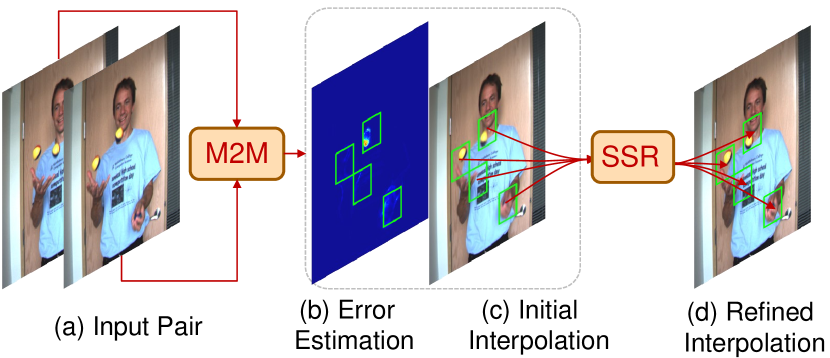
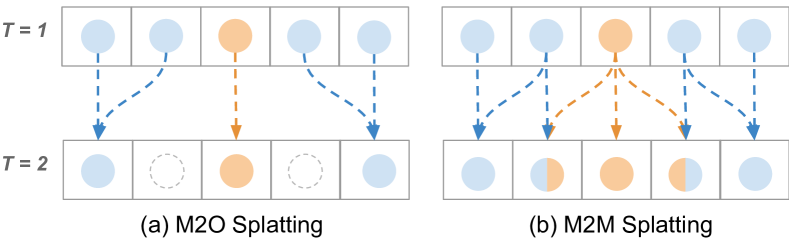
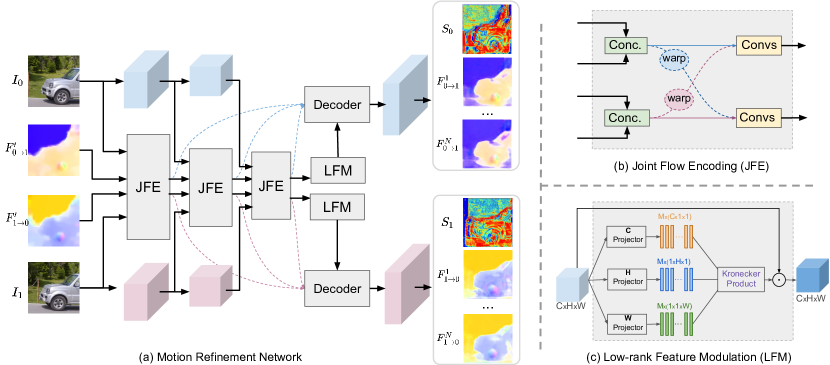
本研究首次提出了一种完全可微的多对多(M2M)溅射框架,以高效插值视频帧。给定一对帧,我们估计多个双向光流,直接将像素前向扭曲到目标时间步,然后融合重叠像素。通过这种方式,每个源像素可以渲染多个目标像素,从而建立了一个对不良伪影具有鲁棒性的多对多溅射方案。为了提高插值精度,我们进一步扩展了M2M++框架,引入了灵活的空间选择性精炼(SSR)组件,仅处理在估计误差图指导下选择的困难区域,从而避免冗余计算。多项基准数据集的评估表明,我们的方法在保持竞争性视频插值质量的同时,提高了效率,并可以根据需要调整计算量。
🔬 方法详解
问题定义:本论文旨在解决视频帧插值中的运动估计质量不足和表示能力有限的问题。现有方法在处理复杂运动时容易产生伪影,影响插值效果。
核心思路:提出的多对多(M2M)溅射框架通过估计多个双向光流,允许每个源像素渲染多个目标像素,从而增强了插值的灵活性和鲁棒性。
技术框架:整体架构包括多个模块:首先,估计双向光流;其次,进行前向扭曲;最后,融合重叠像素。扩展的M2M++框架引入了空间选择性精炼(SSR),仅对困难区域进行处理。
关键创新:最重要的创新在于多对多溅射方案的提出,使得每个目标像素可以从更广泛的视觉上下文中合成,显著提高了插值的质量和效率。
关键设计:在设计中,SSR组件通过估计误差图选择性地处理困难区域,避免了对整个插值帧的冗余计算,优化了计算资源的使用。
🖼️ 关键图片
📊 实验亮点
实验结果表明,提出的方法在多个基准数据集上实现了显著的性能提升,相较于传统方法,插值质量保持竞争力,同时计算效率提高,能够根据需求灵活调整计算资源。
🎯 应用场景
该研究在视频处理、动画制作和虚拟现实等领域具有广泛的应用潜力。通过提高视频帧插值的效率和质量,可以显著提升用户体验,推动相关技术的发展。
📄 摘要(原文)
In this work, we first propose a fully differentiable Many-to-Many (M2M) splatting framework to interpolate frames efficiently. Given a frame pair, we estimate multiple bidirectional flows to directly forward warp the pixels to the desired time step before fusing overlapping pixels. In doing so, each source pixel renders multiple target pixels and each target pixel can be synthesized from a larger area of visual context, establishing a many-to-many splatting scheme with robustness to undesirable artifacts. For each input frame pair, M2M has a minuscule computational overhead when interpolating an arbitrary number of in-between frames, hence achieving fast multi-frame interpolation. However, directly warping and fusing pixels in the intensity domain is sensitive to the quality of motion estimation and may suffer from less effective representation capacity. To improve interpolation accuracy, we further extend an M2M++ framework by introducing a flexible Spatial Selective Refinement (SSR) component, which allows for trading computational efficiency for interpolation quality and vice versa. Instead of refining the entire interpolated frame, SSR only processes difficult regions selected under the guidance of an estimated error map, thereby avoiding redundant computation. Evaluation on multiple benchmark datasets shows that our method is able to improve the efficiency while maintaining competitive video interpolation quality, and it can be adjusted to use more or less compute as needed.