Localizing Active Objects from Egocentric Vision with Symbolic World Knowledge
作者: Te-Lin Wu, Yu Zhou, Nanyun Peng
分类: cs.CV, cs.CL
发布日期: 2023-10-23
备注: In Proceedings of the 2023 Conference on Empirical Methods in Natural Language Processing (EMNLP)
💡 一句话要点
提出一种新方法以从自我中心视觉中定位主动对象
🎯 匹配领域: 支柱六:视频提取与匹配 (Video Extraction) 支柱九:具身大模型 (Embodied Foundation Models)
关键词: 主动对象定位 自我中心视觉 多模态融合 文本指令 大语言模型 动态环境 机器人任务 智能系统
📋 核心要点
- 现有方法主要从视觉角度出发,缺乏对文本指令与视觉信息交互的深入研究,导致主动对象定位效果不佳。
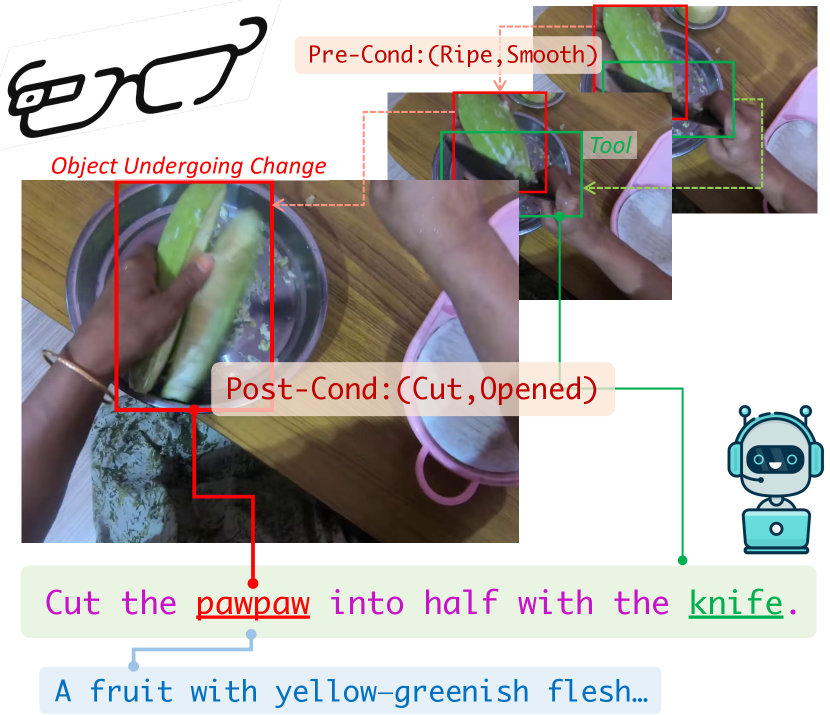
- 论文提出通过学习对象状态变化、利用动作前后条件和描述性知识,来增强主动对象的定位和跟踪能力。
- 在Ego4D和Epic-Kitchens数据集上的实验结果显示,提出的方法在多个任务上均有显著提升,尤其在TREK-150-OPE-Det任务中提升超过54%。
📝 摘要(中文)
从自我中心视角有效地定位和跟踪主动对象是AI代理完成任务的重要步骤。本文提出了一种新方法,通过结合文本指令和视觉信息,提升主动对象的定位能力。具体而言,研究者们通过学习对象状态变化的角色、利用动作的前后条件、以及结合描述性知识来增强模型的鲁棒性。实验结果表明,该方法在Ego4D和Epic-Kitchens数据集上均取得了显著的性能提升,特别是在TREK-150-OPE-Det任务中,所有标准指标提升超过54%。
🔬 方法详解
问题定义:本文旨在解决从自我中心视觉中定位和跟踪主动对象的问题。现有方法往往忽视了文本指令与视觉信息的结合,导致在动态环境中定位效果不理想。
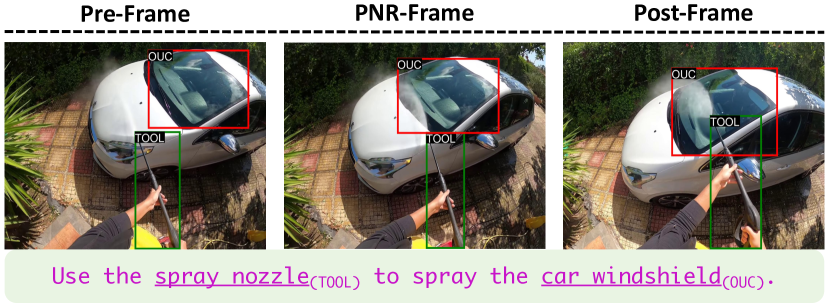
核心思路:通过结合文本指令中的对象状态变化信息与视觉数据,提升模型对主动对象的定位能力。具体设计包括提取对象变化角色、利用动作的前后条件,以及结合描述性知识。
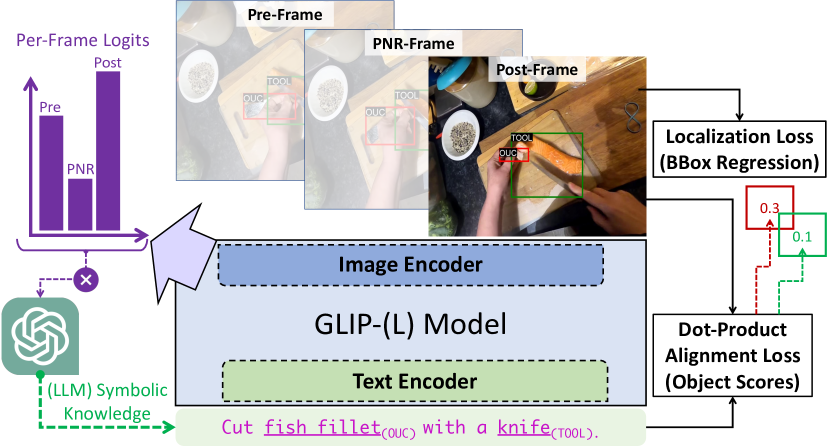
技术框架:整体框架包括三个主要模块:1) 文本指令解析模块,提取对象变化信息;2) 视觉信息处理模块,进行对象检测与跟踪;3) 联合推理模块,结合文本和视觉信息进行最终的对象定位。
关键创新:最重要的创新在于引入了文本指令与视觉信息的交互,特别是通过大语言模型提取动作-对象知识,显著提升了模型的定位能力。
关键设计:在模型设计中,采用了基于对象的聚合掩码技术,以实现对对象短语和符号知识的有效联合推理,同时在损失函数中考虑了对象状态变化的影响。
🖼️ 关键图片
📊 实验亮点
实验结果显示,提出的框架在TREK-150-OPE-Det定位与跟踪任务中,所有标准指标提升超过54%;在TREK-150-OPE跟踪任务中提升超过7%;在Ego4D SCOD任务中,平均精度(AP)提升超过3%。这些结果表明该方法在多模态融合和主动对象定位方面的有效性。
🎯 应用场景
该研究的潜在应用领域包括机器人操作、智能家居助手和增强现实等场景。通过提升AI代理对主动对象的理解能力,可以更好地完成复杂任务,增强人机交互的自然性和有效性。未来,该方法有望在更多实际应用中得到推广,推动智能系统的智能化发展。
📄 摘要(原文)
The ability to actively ground task instructions from an egocentric view is crucial for AI agents to accomplish tasks or assist humans virtually. One important step towards this goal is to localize and track key active objects that undergo major state change as a consequence of human actions/interactions to the environment without being told exactly what/where to ground (e.g., localizing and tracking the
spongein video from the instruction "Dip thespongeinto the bucket."). While existing works approach this problem from a pure vision perspective, we investigate to which extent the textual modality (i.e., task instructions) and their interaction with visual modality can be beneficial. Specifically, we propose to improve phrase grounding models' ability on localizing the active objects by: (1) learning the role ofobjects undergoing changeand extracting them accurately from the instructions, (2) leveraging pre- and post-conditions of the objects during actions, and (3) recognizing the objects more robustly with descriptional knowledge. We leverage large language models (LLMs) to extract the aforementioned action-object knowledge, and design a per-object aggregation masking technique to effectively perform joint inference on object phrases and symbolic knowledge. We evaluate our framework on Ego4D and Epic-Kitchens datasets. Extensive experiments demonstrate the effectiveness of our proposed framework, which leads to>54% improvements in all standard metrics on the TREK-150-OPE-Det localization + tracking task, >7% improvements in all standard metrics on the TREK-150-OPE tracking task, and >3% improvements in average precision (AP) on the Ego4D SCOD task.