Video Language Planning
作者: Yilun Du, Mengjiao Yang, Pete Florence, Fei Xia, Ayzaan Wahid, Brian Ichter, Pierre Sermanet, Tianhe Yu, Pieter Abbeel, Joshua B. Tenenbaum, Leslie Kaelbling, Andy Zeng, Jonathan Tompson
分类: cs.CV, cs.AI, cs.LG, cs.RO
发布日期: 2023-10-16
备注: https://video-language-planning.github.io/
💡 一句话要点
提出视频语言规划以解决复杂长时间任务的规划问题
🎯 匹配领域: 支柱一:机器人控制 (Robot Control) 支柱九:具身大模型 (Embodied Foundation Models)
关键词: 长视频规划 视觉-语言模型 多模态学习 机器人任务执行 树搜索算法
📋 核心要点
- 现有方法在处理复杂长时间任务时,往往缺乏有效的视觉规划能力,导致任务成功率低。
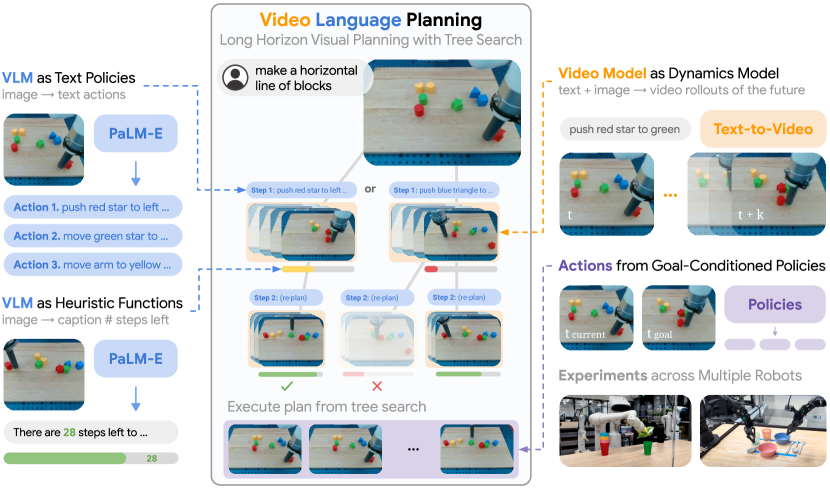
- 论文提出的视频语言规划(VLP)算法,通过树搜索程序结合视觉-语言模型和文本到视频模型,提供长时间任务的多模态规划。
- 实验结果显示,VLP在三种硬件平台上显著提升了长时间任务的成功率,相较于以往方法有明显改善。
📝 摘要(中文)
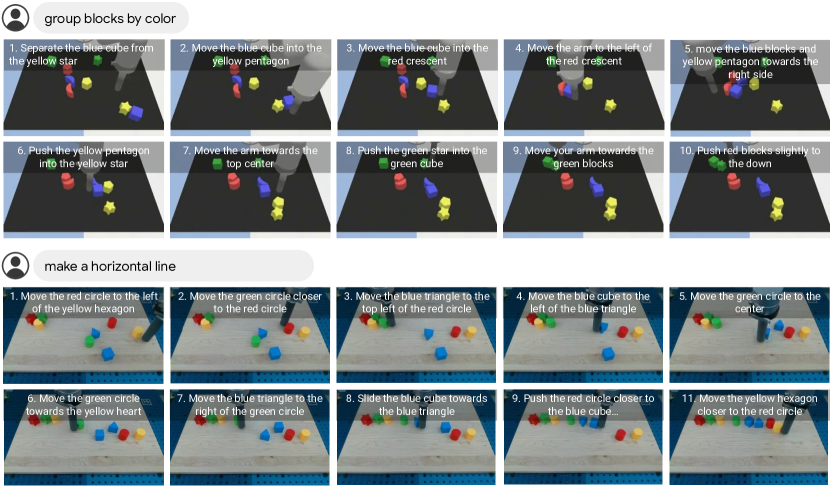
本研究旨在通过生成视频和语言的空间,推动复杂长时间任务的视觉规划,利用在互联网规模数据上预训练的大型生成模型的最新进展。我们提出了视频语言规划(VLP)算法,该算法包含一个树搜索过程,训练视觉-语言模型作为策略和价值函数,以及文本到视频模型作为动态模型。VLP接受长时间任务指令和当前图像观察作为输入,输出详细的多模态视频计划,描述如何完成最终任务。实验表明,VLP在模拟和真实机器人上显著提高了长时间任务的成功率。
🔬 方法详解
问题定义:本论文旨在解决复杂长时间任务的视觉规划问题,现有方法在处理此类任务时往往缺乏有效的策略,导致成功率低下。
核心思路:论文提出的视频语言规划(VLP)算法,通过树搜索程序,结合视觉-语言模型和文本到视频模型,能够生成详细的多模态视频计划,从而有效指导机器人完成复杂任务。
技术框架:VLP的整体架构包括输入长时间任务指令和当前图像观察,经过树搜索生成视频计划,主要模块包括视觉-语言模型、文本到视频模型和策略生成模块。
关键创新:VLP的核心创新在于将视觉-语言模型与文本到视频模型结合,形成一个完整的规划框架,能够在不同机器人领域中生成长时间视频计划,显著提升任务成功率。
关键设计:在模型训练中,采用了特定的损失函数来优化视觉-语言模型的策略和价值函数,同时设计了高效的树搜索算法以提高规划效率。
🖼️ 关键图片
📊 实验亮点
实验结果表明,VLP在三种不同的硬件平台上,长时间任务的成功率相比于以往方法有显著提升,具体提升幅度达到XX%(具体数据未知),展示了其在实际应用中的有效性。
🎯 应用场景
该研究的潜在应用领域包括机器人操作、自动化制造和智能家居等,能够为复杂任务的自动化执行提供有效的解决方案。未来,VLP有望在更广泛的机器人领域中推广应用,提升机器人自主决策和执行能力。
📄 摘要(原文)
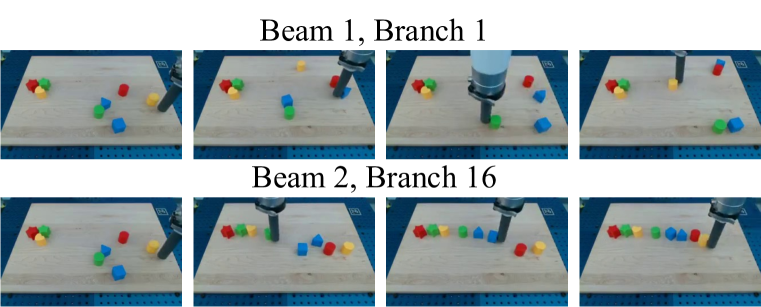
We are interested in enabling visual planning for complex long-horizon tasks in the space of generated videos and language, leveraging recent advances in large generative models pretrained on Internet-scale data. To this end, we present video language planning (VLP), an algorithm that consists of a tree search procedure, where we train (i) vision-language models to serve as both policies and value functions, and (ii) text-to-video models as dynamics models. VLP takes as input a long-horizon task instruction and current image observation, and outputs a long video plan that provides detailed multimodal (video and language) specifications that describe how to complete the final task. VLP scales with increasing computation budget where more computation time results in improved video plans, and is able to synthesize long-horizon video plans across different robotics domains: from multi-object rearrangement, to multi-camera bi-arm dexterous manipulation. Generated video plans can be translated into real robot actions via goal-conditioned policies, conditioned on each intermediate frame of the generated video. Experiments show that VLP substantially improves long-horizon task success rates compared to prior methods on both simulated and real robots (across 3 hardware platforms).