PonderV2: Pave the Way for 3D Foundation Model with A Universal Pre-training Paradigm
作者: Haoyi Zhu, Honghui Yang, Xiaoyang Wu, Di Huang, Sha Zhang, Xianglong He, Hengshuang Zhao, Chunhua Shen, Yu Qiao, Tong He, Wanli Ouyang
分类: cs.CV
发布日期: 2023-10-12 (更新: 2025-04-15)
备注: arXiv admin note: text overlap with arXiv:2301.00157
🔗 代码/项目: GITHUB
💡 一句话要点
提出PonderV2以解决3D基础模型预训练的挑战
🎯 匹配领域: 支柱三:空间感知与语义 (Perception & Semantics) 支柱九:具身大模型 (Embodied Foundation Models)
关键词: 3D基础模型 预训练框架 可微分神经渲染 3D表示学习 计算机视觉
📋 核心要点
- 现有3D基础模型的学习面临数据多样性和下游任务复杂性带来的巨大挑战。
- 本文提出了一种通用的3D预训练框架,通过可微分神经渲染来学习3D表示,促进了3D基础模型的发展。
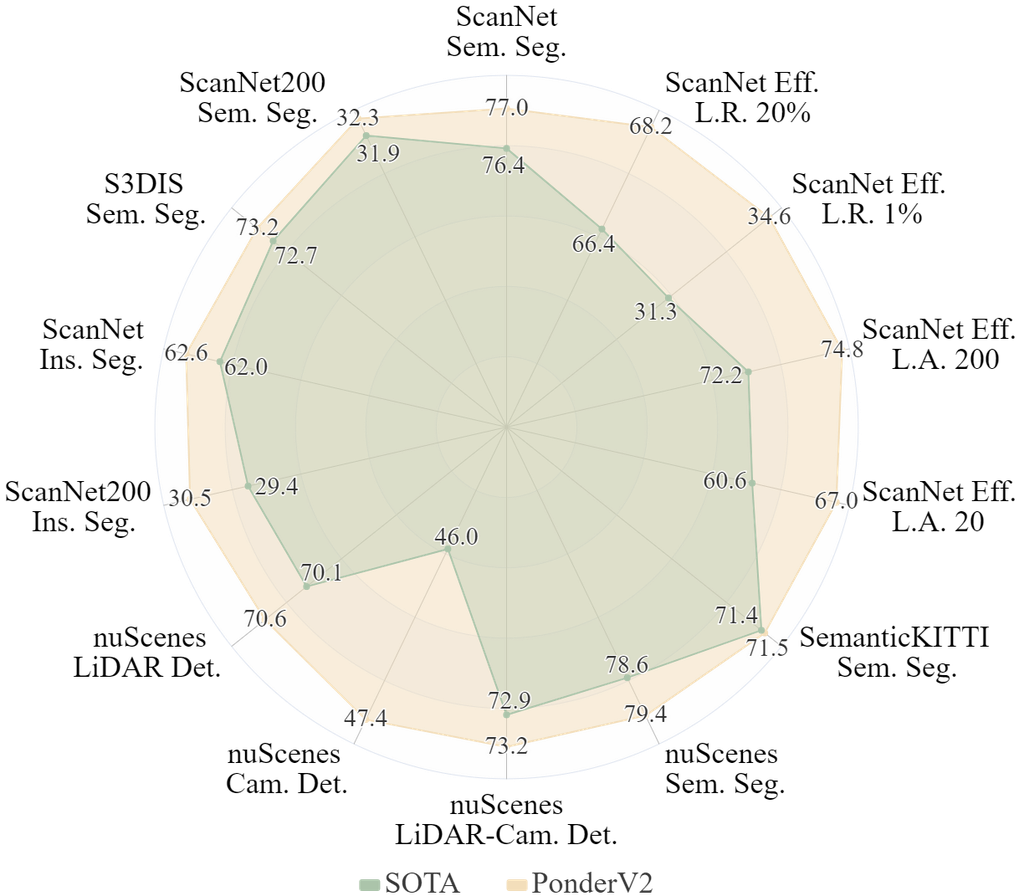
- PonderV2在11个室内和室外基准测试中首次实现了最先进的性能,展示了其优越性。
📝 摘要(中文)
与众多自然语言处理和二维视觉基础模型相比,学习3D基础模型面临更大的挑战,主要源于数据的多样性和下游任务的复杂性。本文提出了一种新颖的通用3D预训练框架,旨在高效获取3D表示,从而为3D基础模型铺平道路。我们通过可微分神经渲染学习3D表示,训练3D骨干网络,并将学习到的3D编码器无缝集成到多种下游任务中。这些任务不仅包括3D检测和分割等高层次挑战,还涵盖3D重建和图像合成等低层次目标,适用于室内和室外场景。此外,我们还展示了使用该方法预训练2D骨干网络的能力,显著超越传统预训练方法。PonderV2首次在11个室内和室外基准测试中实现了最先进的性能,证明了其有效性。
🔬 方法详解
问题定义:本文旨在解决3D基础模型预训练中的数据多样性和任务复杂性问题。现有方法在处理3D表示时,往往无法有效捕捉几何和外观特征,导致性能不足。
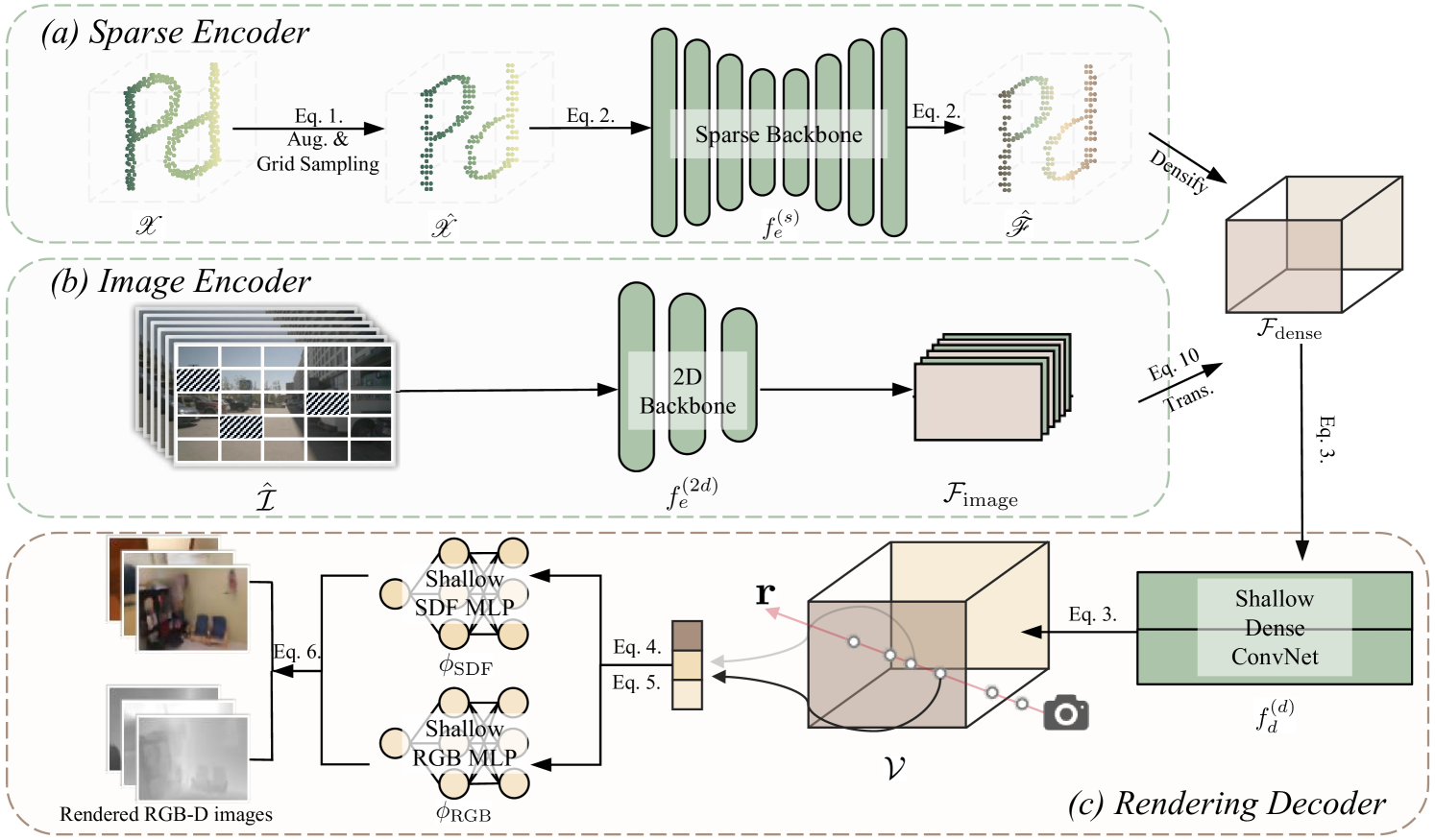
核心思路:论文提出通过可微分神经渲染来学习3D表示,利用渲染图像与真实图像的对比来训练3D骨干网络。这种方法能够更好地捕捉3D特征,并适应多种下游任务。
技术框架:整体架构包括一个3D骨干网络和一个体积神经渲染器。首先,利用体积渲染生成3D图像,然后通过与真实图像的比较来优化网络。该框架能够无缝集成到3D检测、分割、重建和图像合成等任务中。
关键创新:PonderV2的主要创新在于其通用的3D预训练框架和可微分神经渲染技术,显著提升了3D表示的学习效率和效果。这与传统方法的显著区别在于其对3D特征的深度理解和应用。
关键设计:在网络结构上,采用了多层卷积和反卷积层以增强特征提取能力。损失函数设计上,结合了重建损失和对比损失,以确保生成图像与真实图像的高相似度。
🖼️ 关键图片

📊 实验亮点
PonderV2在11个室内和室外基准测试中实现了最先进的性能,超越了传统预训练方法,展示了其在3D检测、分割、重建和图像合成等任务中的显著提升,证明了其有效性和广泛适用性。
🎯 应用场景
该研究的潜在应用领域包括虚拟现实、增强现实、自动驾驶、机器人导航等。通过提供高效的3D表示,PonderV2能够在多种实际场景中实现更准确的物体识别、环境理解和交互,具有重要的实际价值和广泛的应用前景。
📄 摘要(原文)
In contrast to numerous NLP and 2D vision foundational models, learning a 3D foundational model poses considerably greater challenges. This is primarily due to the inherent data variability and diversity of downstream tasks. In this paper, we introduce a novel universal 3D pre-training framework designed to facilitate the acquisition of efficient 3D representation, thereby establishing a pathway to 3D foundational models. Considering that informative 3D features should encode rich geometry and appearance cues that can be utilized to render realistic images, we propose to learn 3D representations by differentiable neural rendering. We train a 3D backbone with a devised volumetric neural renderer by comparing the rendered with the real images. Notably, our approach seamlessly integrates the learned 3D encoder into various downstream tasks. These tasks encompass not only high-level challenges such as 3D detection and segmentation but also low-level objectives like 3D reconstruction and image synthesis, spanning both indoor and outdoor scenarios. Besides, we also illustrate the capability of pre-training a 2D backbone using the proposed methodology, surpassing conventional pre-training methods by a large margin. For the first time, PonderV2 achieves state-of-the-art performance on 11 indoor and outdoor benchmarks, implying its effectiveness. Code and models are available at https://github.com/OpenGVLab/PonderV2.