Im4D: High-Fidelity and Real-Time Novel View Synthesis for Dynamic Scenes
作者: Haotong Lin, Sida Peng, Zhen Xu, Tao Xie, Xingyi He, Hujun Bao, Xiaowei Zhou
分类: cs.CV
发布日期: 2023-10-12
备注: SIGGRAPH Asia 2023; Project page: https://zju3dv.github.io/im4d
💡 一句话要点
提出Im4D以解决动态场景中的视图合成问题
🎯 匹配领域: 支柱八:物理动画 (Physics-based Animation)
关键词: 动态视图合成 多视角视频 混合场景表示 4D密度函数 实时渲染 计算机视觉 图像处理
📋 核心要点
- 现有的网格基方法在渲染一致性上表现良好,但难以捕捉复杂动态场景的外观细节。
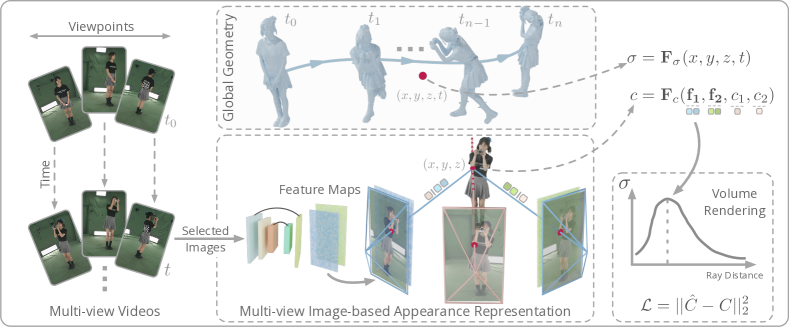
- Im4D通过结合网格几何表示和多视角图像外观表示,提出了一种新的混合场景表示方法。
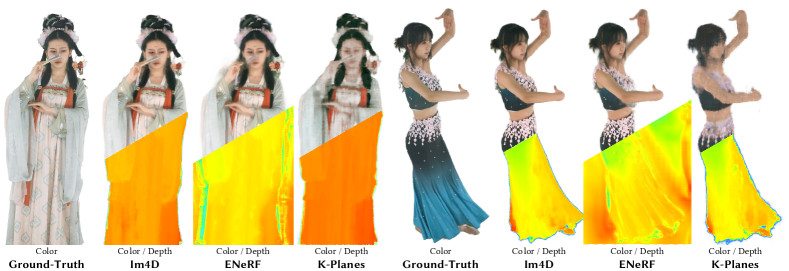
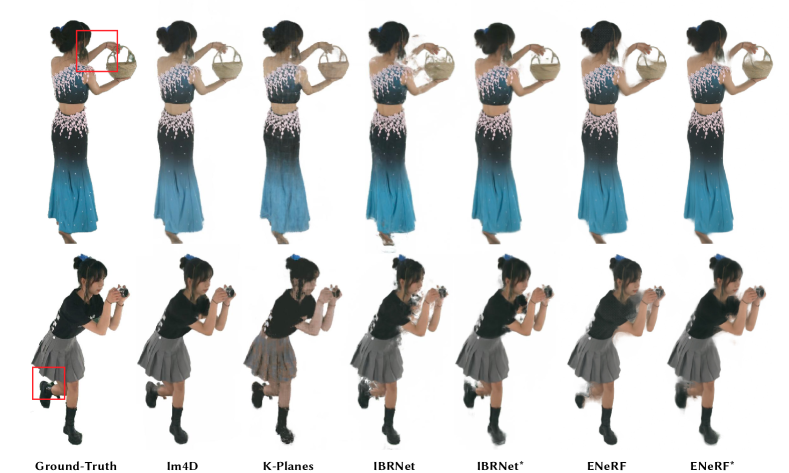
- 在五个动态视图合成数据集上的实验表明,Im4D在渲染质量上达到了最先进的水平,并且训练效率高。
📝 摘要(中文)
本文旨在解决多视角视频中的动态视图合成挑战。关键观察是,尽管现有的基于网格的方法在渲染一致性上表现良好,但在捕捉复杂动态场景的外观细节方面存在不足。为此,本文提出了Im4D,一种混合场景表示,结合了基于网格的几何表示和基于多视角图像的外观表示。动态几何通过一个4D密度函数进行编码,场景外观则通过原始多视角视频和一个网络来预测3D点的颜色。实验结果表明,Im4D在渲染质量上表现出色,并且在单个RTX 3090 GPU上实现了79.8 FPS的实时渲染速度。
🔬 方法详解
问题定义:本文要解决的具体问题是动态场景的视图合成,现有方法在捕捉复杂场景的外观细节方面存在不足,导致渲染效果不理想。
核心思路:论文的核心解决思路是结合网格几何表示和多视角图像外观表示,利用4D密度函数来编码动态几何,并通过网络预测3D点的颜色,从而提高渲染质量和一致性。
技术框架:整体架构包括两个主要模块:一个是基于网格的几何表示,另一个是基于多视角图像的外观表示。动态几何通过时空特征平面和小型MLP网络进行编码,外观则通过原始视频和特征学习网络进行表示。
关键创新:最重要的技术创新点在于提出了混合场景表示,既保持了渲染的一致性,又能有效捕捉复杂场景的外观细节,这与现有方法的单一表示方式形成了本质区别。
关键设计:在网络结构设计上,使用了小型MLP网络来建模4D密度函数,并通过损失函数优化网络的学习过程,确保能够有效地预测3D点的颜色。
🖼️ 关键图片
📊 实验亮点
Im4D在五个动态视图合成数据集上的实验结果显示,其渲染质量达到了最先进的水平,且在单个RTX 3090 GPU上实现了79.8 FPS的实时渲染速度,显著提高了训练效率和渲染性能。
🎯 应用场景
该研究在虚拟现实、增强现实和影视制作等领域具有广泛的应用潜力。通过实现高保真和实时的动态视图合成,Im4D可以提升用户体验,促进更高质量的内容创作和交互。
📄 摘要(原文)
This paper aims to tackle the challenge of dynamic view synthesis from multi-view videos. The key observation is that while previous grid-based methods offer consistent rendering, they fall short in capturing appearance details of a complex dynamic scene, a domain where multi-view image-based rendering methods demonstrate the opposite properties. To combine the best of two worlds, we introduce Im4D, a hybrid scene representation that consists of a grid-based geometry representation and a multi-view image-based appearance representation. Specifically, the dynamic geometry is encoded as a 4D density function composed of spatiotemporal feature planes and a small MLP network, which globally models the scene structure and facilitates the rendering consistency. We represent the scene appearance by the original multi-view videos and a network that learns to predict the color of a 3D point from image features, instead of memorizing detailed appearance totally with networks, thereby naturally making the learning of networks easier. Our method is evaluated on five dynamic view synthesis datasets including DyNeRF, ZJU-MoCap, NHR, DNA-Rendering and ENeRF-Outdoor datasets. The results show that Im4D exhibits state-of-the-art performance in rendering quality and can be trained efficiently, while realizing real-time rendering with a speed of 79.8 FPS for 512x512 images, on a single RTX 3090 GPU.