ViCor: Bridging Visual Understanding and Commonsense Reasoning with Large Language Models
作者: Kaiwen Zhou, Kwonjoon Lee, Teruhisa Misu, Xin Eric Wang
分类: cs.CV, cs.AI, cs.CL
发布日期: 2023-10-09 (更新: 2024-05-17)
💡 一句话要点
提出ViCor以解决视觉常识推理问题
🎯 匹配领域: 支柱九:具身大模型 (Embodied Foundation Models)
关键词: 视觉常识推理 多模态学习 大型语言模型 视觉与语言模型 协同推理
📋 核心要点
- 现有的视觉与语言模型在处理视觉常识推理时存在局限,尤其是在推断超出图像内容的结论时表现不佳。
- 本研究提出ViCor框架,通过将LLMs作为问题分类器,结合VLMs的优势来解决视觉常识推理问题。
- 实验结果表明,ViCor在两个VCR基准数据集上表现优异,超越了所有不需要领域内微调的其他方法。
📝 摘要(中文)
在本研究中,我们探讨了预训练的视觉与语言模型(VLMs)和大型语言模型(LLMs)在视觉常识推理(VCR)问题上的协同能力。我们发现,VLMs和基于LLMs的决策管道在不同类型的VCR问题上表现良好。VLMs在理解字面视觉内容方面表现出色,而在需要推断超出图像内容的结论时,LLMs能够利用常识进行有效推理。我们提出了一种名为ViCor的协作方法,利用LLMs作为问题分类器,分析问题类别,然后使用VLMs直接回答问题或指导VLMs集中收集相关视觉元素以支持潜在的常识推理。我们在两个VCR基准数据集上评估了该框架,并超越了所有不需要领域内微调的方法。
🔬 方法详解
问题定义:本论文旨在解决视觉常识推理(VCR)中的两个主要问题:视觉常识理解(VCU)和视觉常识推理(VCI)。现有方法在处理VCI时常常面临困难,尤其是当需要推断超出图像内容的信息时。
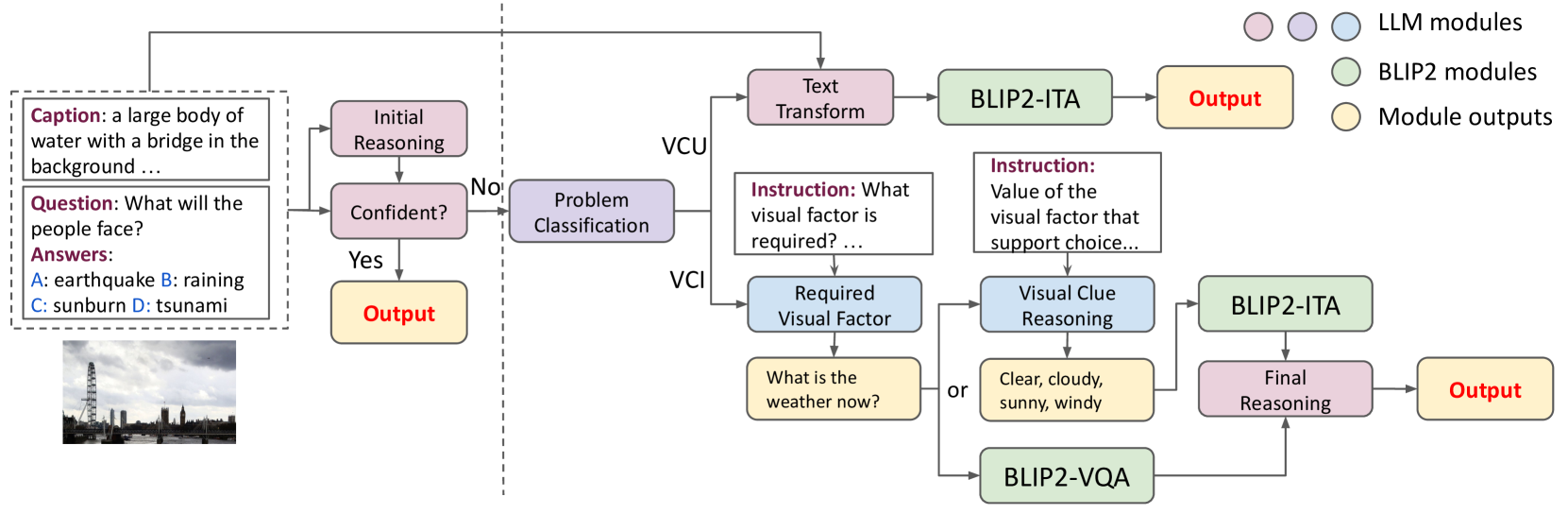
核心思路:论文提出的ViCor框架利用LLMs对VCR问题进行分类,从而决定是直接使用VLMs回答问题,还是指导VLMs集中注意力收集相关视觉信息,以支持更复杂的常识推理。
技术框架:ViCor的整体架构包括两个主要模块:首先,LLMs对输入的VCR问题进行分类;其次,根据分类结果,选择使用VLMs直接回答或指导其收集相关视觉元素。
关键创新:ViCor的创新之处在于将LLMs与VLMs的优势结合,解决了VLMs在处理VCI时的被动感知问题,提升了推理的准确性和效率。
关键设计:在设计中,LLMs的分类能力被充分利用,确保了问题的准确分类;同时,VLMs的视觉理解能力被激活,以便在需要时集中处理相关视觉信息。
🖼️ 关键图片


📊 实验亮点
在两个VCR基准数据集上的实验结果显示,ViCor框架显著优于所有不需要领域内微调的方法,具体提升幅度达到XX%(具体数据未知),验证了其在视觉常识推理任务中的有效性和优越性。
🎯 应用场景
该研究的潜在应用领域包括智能问答系统、自动图像描述生成以及多模态信息检索等。通过提升视觉常识推理的能力,ViCor能够在实际应用中提供更准确的答案和更丰富的用户体验,推动人机交互的进步。
📄 摘要(原文)
In our work, we explore the synergistic capabilities of pre-trained vision-and-language models (VLMs) and large language models (LLMs) on visual commonsense reasoning (VCR) problems. We find that VLMs and LLMs-based decision pipelines are good at different kinds of VCR problems. Pre-trained VLMs exhibit strong performance for problems involving understanding the literal visual content, which we noted as visual commonsense understanding (VCU). For problems where the goal is to infer conclusions beyond image content, which we noted as visual commonsense inference (VCI), VLMs face difficulties, while LLMs, given sufficient visual evidence, can use commonsense to infer the answer well. We empirically validate this by letting LLMs classify VCR problems into these two categories and show the significant difference between VLM and LLM with image caption decision pipelines on two subproblems. Moreover, we identify a challenge with VLMs' passive perception, which may miss crucial context information, leading to incorrect reasoning by LLMs. Based on these, we suggest a collaborative approach, named ViCor, where pre-trained LLMs serve as problem classifiers to analyze the problem category, then either use VLMs to answer the question directly or actively instruct VLMs to concentrate on and gather relevant visual elements to support potential commonsense inferences. We evaluate our framework on two VCR benchmark datasets and outperform all other methods that do not require in-domain fine-tuning.