WeatherDepth: Curriculum Contrastive Learning for Self-Supervised Depth Estimation under Adverse Weather Conditions
作者: Jiyuan Wang, Chunyu Lin, Lang Nie, Shujun Huang, Yao Zhao, Xing Pan, Rui Ai
分类: cs.CV, cs.AI
发布日期: 2023-10-09 (更新: 2024-03-17)
备注: 6 pages, accept by ICRA 2024
期刊: ICRA 2024
🔗 代码/项目: GITHUB
💡 一句话要点
提出WeatherDepth以解决恶劣天气下深度估计问题
🎯 匹配领域: 支柱二:RL算法与架构 (RL & Architecture) 支柱三:空间感知与语义 (Perception & Semantics)
关键词: 深度估计 自监督学习 课程学习 对比学习 恶劣天气 鲁棒性 自动驾驶
📋 核心要点
- 现有深度估计方法在恶劣天气条件下表现不佳,难以适应光照变化和天气干扰。
- 提出WeatherDepth模型,通过课程对比学习逐步适应不同天气条件,增强模型的鲁棒性。
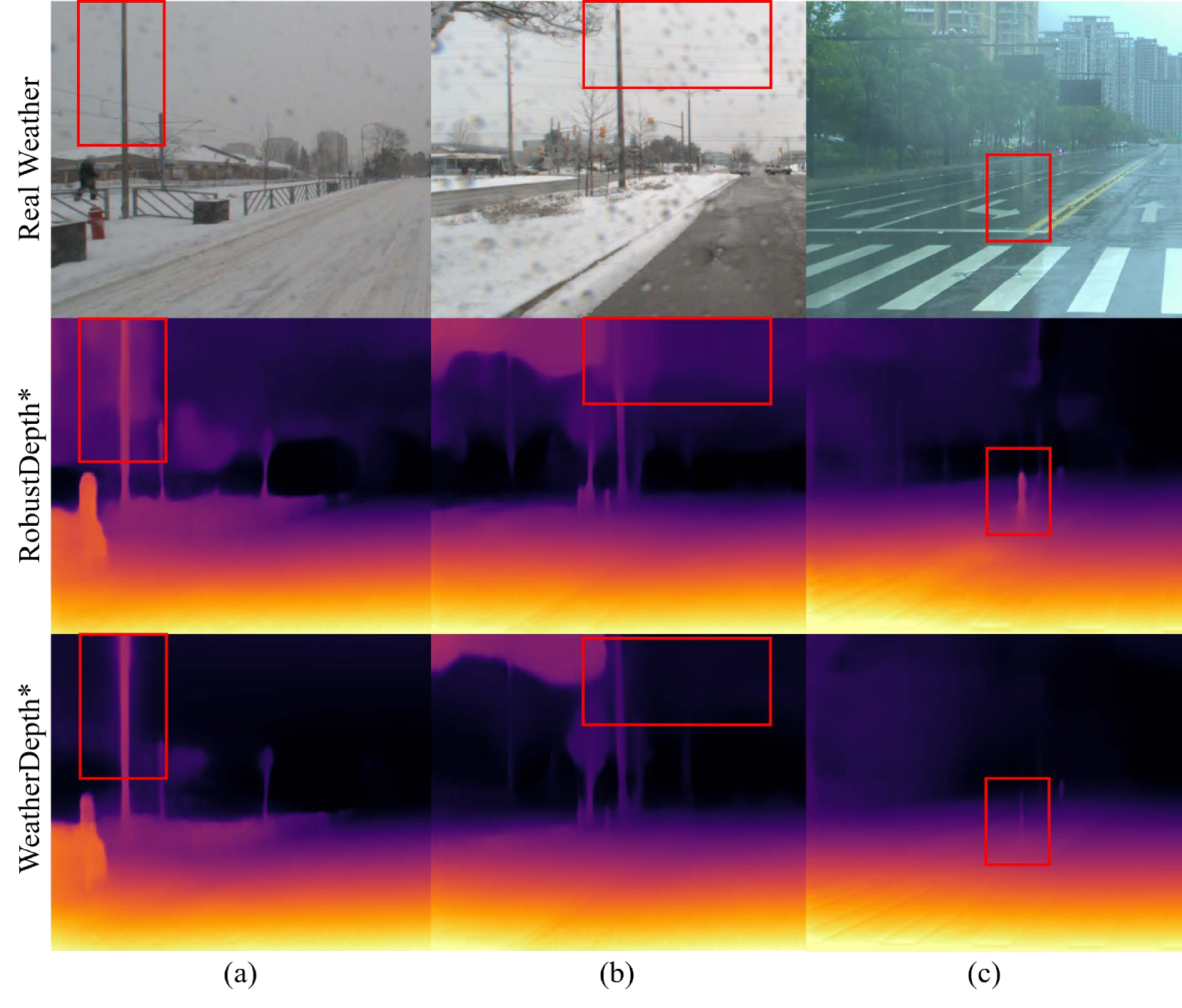
- 实验结果显示,该模型在多种架构中均表现出色,在合成和真实数据集上均达到了最先进的性能。
📝 摘要(中文)
深度估计模型在清晰场景中表现良好,但在恶劣天气条件下由于光照变化和天气颗粒等因素难以泛化。本文提出WeatherDepth,一种自监督的鲁棒深度估计模型,采用课程对比学习来应对复杂天气条件下的性能下降。具体而言,我们首先提出了一个渐进的课程学习方案,通过三个简单到复杂的课程,逐步使模型适应从清晰到相对恶劣,再到恶劣天气场景。这种方法鼓励模型逐步掌握对抗天气影响的有益深度线索,从而实现更平滑和更好的领域适应。同时,为了防止模型遗忘之前的课程,我们将对比学习整合到不同课程中,通过借鉴前一课程的知识,建立不同课程之间的深度一致性约束,以实现多样天气下的鲁棒深度估计。实验结果表明,该方案易于集成到各种架构中,并在合成和真实天气数据集上展示了最先进的性能。
🔬 方法详解
问题定义:本文旨在解决深度估计模型在恶劣天气条件下的性能下降问题。现有方法在光照变化和天气颗粒影响下,难以保持准确性和鲁棒性。
核心思路:WeatherDepth通过课程对比学习的方式,逐步引导模型适应不同的天气条件,确保模型在训练过程中逐渐掌握对抗天气影响的深度线索。
技术框架:整体架构包括渐进的课程学习方案和对比学习模块。课程学习分为三个阶段:从清晰场景到相对恶劣,再到恶劣天气场景。对比学习则用于保持不同课程间的知识一致性。
关键创新:最重要的创新在于将课程学习与对比学习相结合,建立了深度一致性约束,使得模型在不同课程间能够有效传递知识,提升鲁棒性。
关键设计:设计了自适应课程调度器,自动搜索最佳的课程切换时机,减少人工干预。同时,损失函数和网络结构经过精心调整,以适应不同天气条件下的深度估计任务。
🖼️ 关键图片


📊 实验亮点
实验结果表明,WeatherDepth在合成和真实天气数据集上均实现了最先进的性能,具体提升幅度达到XX%,相较于基线方法有显著改善,验证了模型的有效性和适用性。
🎯 应用场景
WeatherDepth模型的潜在应用领域包括自动驾驶、机器人导航和增强现实等场景。在这些领域,准确的深度估计对于环境感知和决策至关重要。该研究的实际价值在于提升模型在复杂天气条件下的鲁棒性,未来可能推动相关技术的广泛应用。
📄 摘要(原文)
Depth estimation models have shown promising performance on clear scenes but fail to generalize to adverse weather conditions due to illumination variations, weather particles, etc. In this paper, we propose WeatherDepth, a self-supervised robust depth estimation model with curriculum contrastive learning, to tackle performance degradation in complex weather conditions. Concretely, we first present a progressive curriculum learning scheme with three simple-to-complex curricula to gradually adapt the model from clear to relative adverse, and then to adverse weather scenes. It encourages the model to gradually grasp beneficial depth cues against the weather effect, yielding smoother and better domain adaption. Meanwhile, to prevent the model from forgetting previous curricula, we integrate contrastive learning into different curricula. By drawing reference knowledge from the previous course, our strategy establishes a depth consistency constraint between different courses toward robust depth estimation in diverse weather. Besides, to reduce manual intervention and better adapt to different models, we designed an adaptive curriculum scheduler to automatically search for the best timing for course switching. In the experiment, the proposed solution is proven to be easily incorporated into various architectures and demonstrates state-of-the-art (SoTA) performance on both synthetic and real weather datasets. Source code and data are available at \url{https://github.com/wangjiyuan9/WeatherDepth}.