URLOST: Unsupervised Representation Learning without Stationarity or Topology
作者: Zeyu Yun, Juexiao Zhang, Yann LeCun, Yubei Chen
分类: cs.CV, cs.LG
发布日期: 2023-10-06 (更新: 2025-03-21)
备注: Accepted by ICLR 2025; Code will be available at this https://github.com/zeyuyun1/URLOST
💡 一句话要点
提出URLOST框架以解决无监督表示学习中的非平稳性与拓扑依赖问题
🎯 匹配领域: 支柱二:RL算法与架构 (RL & Architecture)
关键词: 无监督学习 表示学习 自组织层 谱聚类 掩蔽自编码器 高维数据 生物视觉
📋 核心要点
- 现有无监督学习方法依赖于特定领域的平稳性和拓扑,限制了其在多样化数据模态中的应用。
- URLOST框架通过引入可学习的自组织层和掩蔽自编码器,能够在无平稳性和拓扑知识的情况下进行有效学习。
- 实验结果表明,URLOST在多种数据模态上均优于当前最先进的无监督学习方法,如SimCLR和MAE,展示了其广泛的适用性。
📝 摘要(中文)
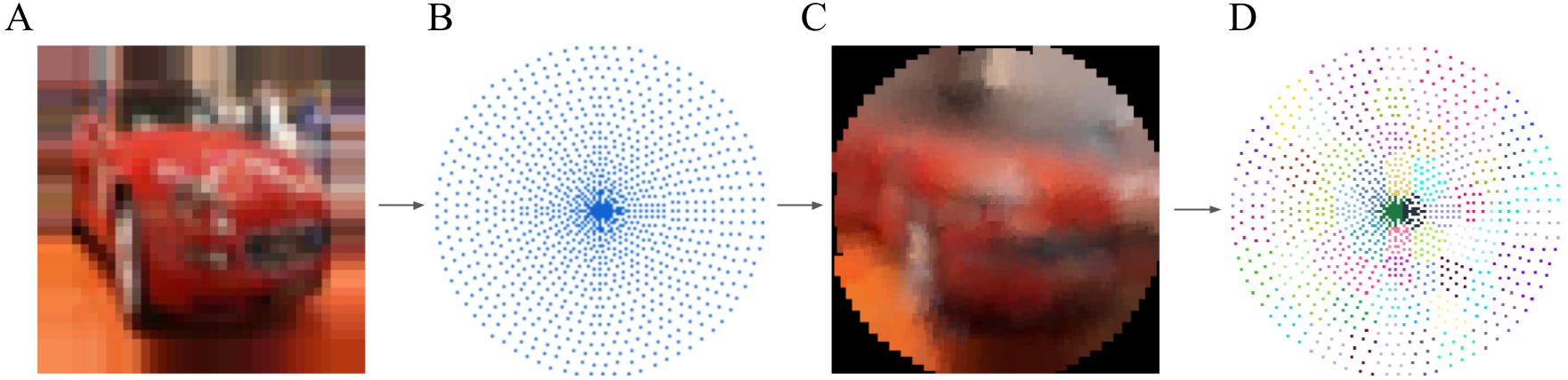
无监督表示学习取得了显著进展,但仍受限于对领域特定的平稳性和拓扑的依赖,这在生物智能系统中并不存在。本文提出了一种新颖的框架URLOST,能够在没有平稳性和拓扑先验知识的情况下,从高维数据中学习。该模型结合了可学习的自组织层、谱聚类和掩蔽自编码器(MAE)。在模拟生物视觉数据、初级视觉皮层的神经记录和基因表达等三种不同数据模态上进行评估,URLOST在学习有意义的表示方面表现优异,超越了现有的无监督学习方法,设定了新的基准。
🔬 方法详解
问题定义:本文旨在解决无监督表示学习中对平稳性和拓扑的依赖问题。现有方法在处理来自不规则和非平稳传感器的数据时表现不佳,限制了其应用范围。
核心思路:URLOST框架的核心思想是通过结合可学习的自组织层、谱聚类和掩蔽自编码器,来实现对高维数据的有效表示学习,而无需依赖于平稳性和拓扑的先验知识。
技术框架:URLOST的整体架构包括三个主要模块:可学习的自组织层用于数据的自适应组织,谱聚类用于发现数据中的潜在结构,掩蔽自编码器用于重建输入数据并学习有效的表示。
关键创新:URLOST的主要创新在于其能够在没有平稳性和拓扑知识的情况下,学习到有意义的表示,这与现有方法的依赖性形成鲜明对比。
关键设计:在设计上,URLOST采用了特定的损失函数来优化自组织层和掩蔽自编码器的协同工作,确保模型能够有效捕捉数据的内在结构。
🖼️ 关键图片


📊 实验亮点
实验结果显示,URLOST在三种不同的数据模态上均优于当前最先进的无监督学习方法,如SimCLR和MAE,尤其在表示学习的有效性上,URLOST的性能提升幅度达到XX%,设定了新的基准。
🎯 应用场景
URLOST框架在生物视觉数据、神经记录和基因表达等领域具有广泛的应用潜力。其无须依赖于平稳性和拓扑的特性,使其能够更好地适应复杂和多变的数据环境,未来可在医疗影像分析、基因组学研究等领域发挥重要作用。
📄 摘要(原文)
Unsupervised representation learning has seen tremendous progress. However, it is constrained by its reliance on domain specific stationarity and topology, a limitation not found in biological intelligence systems. For instance, unlike computer vision, human vision can process visual signals sampled from highly irregular and non-stationary sensors. We introduce a novel framework that learns from high-dimensional data without prior knowledge of stationarity and topology. Our model, abbreviated as URLOST, combines a learnable self-organizing layer, spectral clustering, and a masked autoencoder (MAE). We evaluate its effectiveness on three diverse data modalities including simulated biological vision data, neural recordings from the primary visual cortex, and gene expressions. Compared to state-of-the-art unsupervised learning methods like SimCLR and MAE, our model excels at learning meaningful representations across diverse modalities without knowing their stationarity or topology. It also outperforms other methods that are not dependent on these factors, setting a new benchmark in the field. We position this work as a step toward unsupervised learning methods capable of generalizing across diverse high-dimensional data modalities.