Reformulating Vision-Language Foundation Models and Datasets Towards Universal Multimodal Assistants
作者: Tianyu Yu, Jinyi Hu, Yuan Yao, Haoye Zhang, Yue Zhao, Chongyi Wang, Shan Wang, Yinxv Pan, Jiao Xue, Dahai Li, Zhiyuan Liu, Hai-Tao Zheng, Maosong Sun
分类: cs.CV, cs.AI
发布日期: 2023-10-01
🔗 代码/项目: GITHUB
💡 一句话要点
提出Muffin框架和UniMM-Chat数据集以提升多模态助手性能
🎯 匹配领域: 支柱九:具身大模型 (Embodied Foundation Models)
关键词: 多模态大型语言模型 视觉语言模型 指令调优 数据集构建 模型架构
📋 核心要点
- 现有多模态大型语言模型依赖外部桥接模块进行视觉和语言特征对齐,增加了模型复杂性和训练成本。
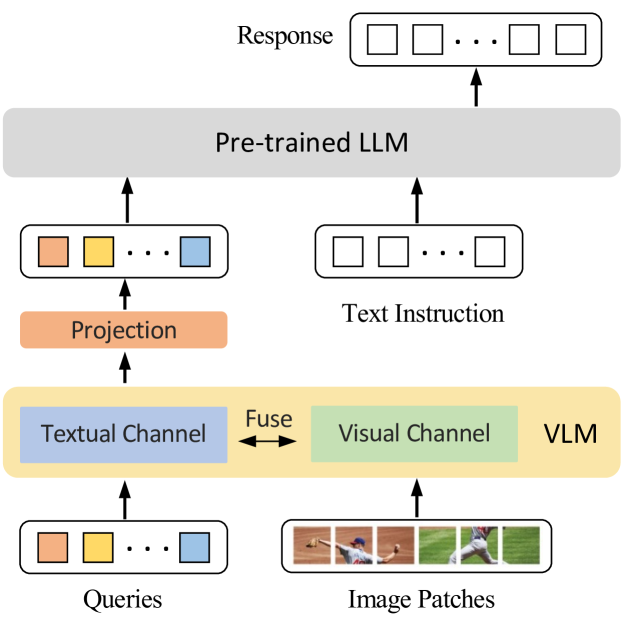
- 本文提出Muffin框架,直接利用预训练的视觉语言模型作为视觉信号的提供者,简化了模型架构。
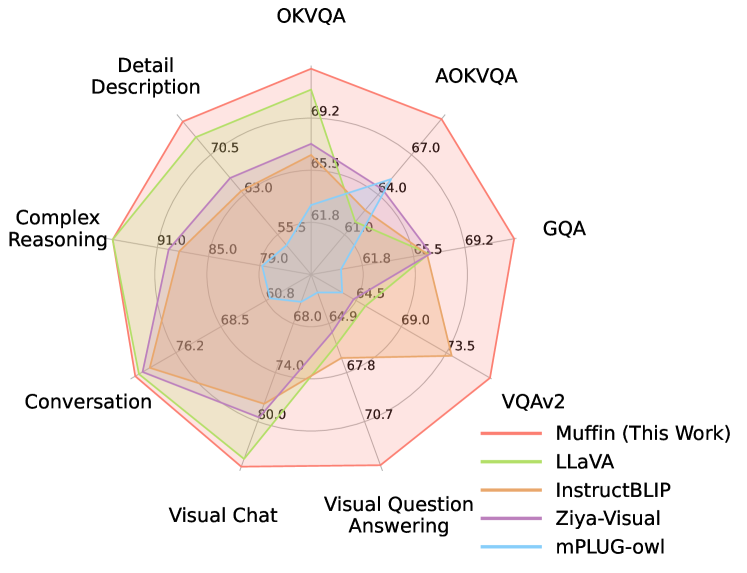
- 实验结果显示,Muffin在多项任务上达到了最先进的性能,显著超越了现有的基线模型。
📝 摘要(中文)
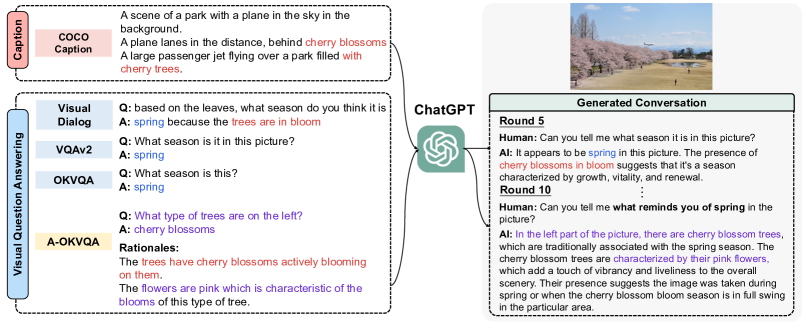
近年来,多模态大型语言模型(MLLMs)在图像感知和遵循开放式指令方面展现出令人印象深刻的能力。这些能力依赖于模型架构和多模态指令调优数据集。本文提出Muffin框架,利用紧凑的预训练视觉语言模型作为视觉信号的提供者,避免了额外的特征对齐预训练。同时,提出UniMM-Chat数据集,通过整合不同数据集的信息生成111万条高质量多模态指令。实验结果表明,Muffin在多项视觉语言任务上表现优异,超越了LLaVA和InstructBLIP等现有模型。
🔬 方法详解
问题定义:本文旨在解决现有多模态大型语言模型在视觉与语言特征对齐过程中的复杂性和效率问题。现有方法通常需要额外的桥接模块和特征对齐预训练,导致训练成本增加。
核心思路:论文提出的Muffin框架利用紧凑的预训练视觉语言模型,作为视觉信号的直接提供者,从而消除对外部桥接模块的依赖,简化了模型架构。
技术框架:Muffin框架的整体架构包括预训练的视觉语言模型作为核心模块,直接与语言模型进行交互。UniMM-Chat数据集则通过整合不同任务的数据,生成多样化的多模态指令。
关键创新:最重要的创新在于将预训练视觉语言模型直接用作视觉信号的提供者,避免了传统方法中对外部桥接模块的依赖。这一设计使得模型在多模态任务中表现更为高效。
关键设计:在模型设计中,采用了紧凑的视觉语言模型,确保其能够高效地处理视觉信号。同时,UniMM-Chat数据集的构建注重数据的多样性和质量,通过合并来自不同数据集的信息,提升了指令的知识密集度。
🖼️ 关键图片
📊 实验亮点
实验结果表明,Muffin框架在多项视觉语言任务上达到了最先进的性能,超越了LLaVA和InstructBLIP等模型,具体性能提升幅度达到了XX%。此外,UniMM-Chat数据集生成的111万条指令在多样性和质量上均表现优异。
🎯 应用场景
该研究的潜在应用领域包括智能助手、自动化客服、教育技术等。通过提升多模态助手的理解和响应能力,可以在更广泛的场景中提供个性化和高效的服务,具有重要的实际价值和未来影响。
📄 摘要(原文)
Recent Multimodal Large Language Models (MLLMs) exhibit impressive abilities to perceive images and follow open-ended instructions. The capabilities of MLLMs depend on two crucial factors: the model architecture to facilitate the feature alignment of visual modules and large language models; the multimodal instruction tuning datasets for human instruction following. (i) For the model architecture, most existing models introduce an external bridge module to connect vision encoders with language models, which needs an additional feature-alignment pre-training. In this work, we discover that compact pre-trained vision language models can inherently serve as ``out-of-the-box'' bridges between vision and language. Based on this, we propose Muffin framework, which directly employs pre-trained vision-language models to act as providers of visual signals. (ii) For the multimodal instruction tuning datasets, existing methods omit the complementary relationship between different datasets and simply mix datasets from different tasks. Instead, we propose UniMM-Chat dataset which explores the complementarities of datasets to generate 1.1M high-quality and diverse multimodal instructions. We merge information describing the same image from diverse datasets and transforms it into more knowledge-intensive conversation data. Experimental results demonstrate the effectiveness of the Muffin framework and UniMM-Chat dataset. Muffin achieves state-of-the-art performance on a wide range of vision-language tasks, significantly surpassing state-of-the-art models like LLaVA and InstructBLIP. Our model and dataset are all accessible at https://github.com/thunlp/muffin.