OmniScientist: Toward a Co-evolving Ecosystem of Human and AI Scientists
作者: Chenyang Shao, Dehao Huang, Yu Li, Keyu Zhao, Weiquan Lin, Yining Zhang, Qingbin Zeng, Zhiyu Chen, Tianxing Li, Yifei Huang, Taozhong Wu, Xinyang Liu, Ruotong Zhao, Mengsheng Zhao, Jiaoyang Li, Xuhua Zhang, Yue Wang, Yuanyi Zhen, Fengli Xu, Yong Li, Tie-Yan Liu
分类: cs.CY, cs.CE, cs.CL
发布日期: 2025-11-21 (更新: 2025-12-14)
💡 一句话要点
提出OmniScientist框架,构建人机协同的AI科学家共生生态系统
🎯 匹配领域: 支柱九:具身大模型 (Embodied Foundation Models)
关键词: AI科学家 人机协作 科研生态系统 大型语言模型 知识图谱
📋 核心要点
- 现有AI科学家忽略了科学研究的社会性和协作性,缺乏对协作机制、贡献归属和同行评审等关键维度的建模。
- OmniScientist框架通过显式编码人类研究机制,实现了端到端的自动化科学流程,并构建了结构化知识系统和协作研究协议。
- OmniScientist引入了基于用户投票和Elo排名的开放评估平台ScienceArena,促进Agent与人类的协作和共同进化。
📝 摘要(中文)
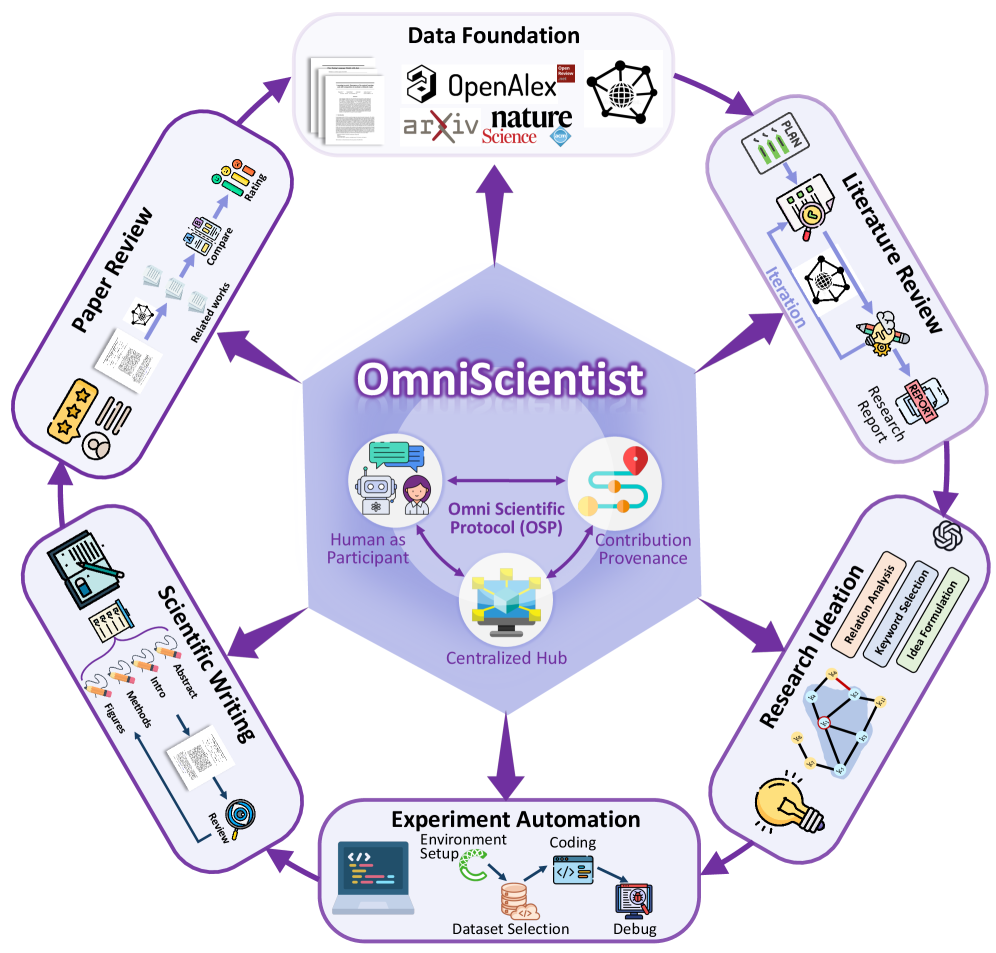
随着大型语言模型(LLMs)的快速发展,AI Agent在科学任务中表现出越来越强的能力,涵盖了从假设生成、实验设计到论文撰写等环节。这类Agent系统通常被称为“AI科学家”。然而,现有的AI科学家主要将科学发现视为一个独立的搜索或优化问题,忽略了科学研究本质上是一种社会和协作活动。现实世界的科学依赖于由协作机制、贡献归属、同行评审和结构化科学知识网络组成的复杂科学基础设施。由于缺乏对这些关键维度的建模,当前的系统难以建立真正的研究生态系统或与人类科学界进行深入互动。为了弥合这一差距,我们引入了OmniScientist,该框架将人类研究的底层机制显式地编码到AI科学工作流程中。OmniScientist不仅实现了跨数据基础、文献综述、研究构思、实验自动化、科学写作和同行评审的端到端自动化,而且通过模拟人类科学系统提供全面的基础设施支持,包括:(1)建立在引文网络和概念相关性之上的结构化知识系统;(2)协作研究协议(OSP),可实现无缝的多Agent协作和人类研究人员参与;(3)基于盲法成对用户投票和Elo排名的开放评估平台(ScienceArena)。这种基础设施使Agent不仅能够理解和利用人类知识系统,而且能够协作和共同进化,从而促进可持续和可扩展的创新生态系统。
🔬 方法详解
问题定义:现有AI科学家将科学发现视为孤立的搜索或优化问题,忽略了科学研究的社会协作本质。它们缺乏对人类科研基础设施(如协作机制、贡献归属、同行评审和结构化知识网络)的建模,导致无法与人类科学界深度互动,难以形成真正的科研生态系统。
核心思路:OmniScientist的核心思路是将人类科研的底层机制显式地编码到AI科学家的工作流程中,使其能够模拟人类的科研过程,并与人类研究者进行协作。通过构建结构化的知识系统、协作研究协议和开放评估平台,促进AI科学家与人类科学家的共同进化,形成可持续的创新生态系统。
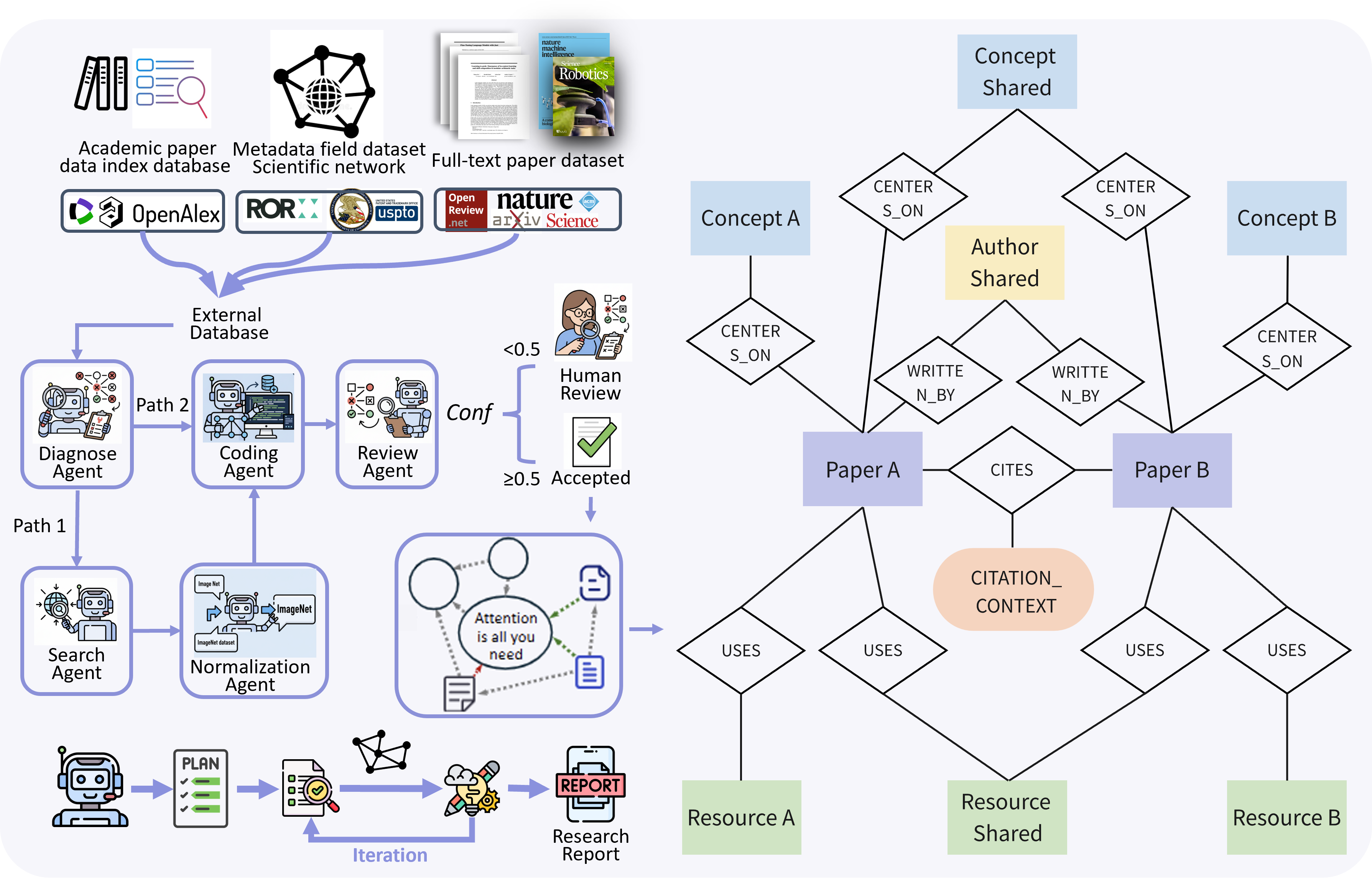
技术框架:OmniScientist框架包含以下主要模块:数据基础(Data Foundation)、文献综述(Literature Review)、研究构思(Research Ideation)、实验自动化(Experiment Automation)、科学写作(Scientific Writing)和同行评审(Peer Review)。此外,框架还提供以下基础设施支持:结构化知识系统(基于引文网络和概念相关性)、协作研究协议(OSP,支持多Agent协作和人类参与)和开放评估平台(ScienceArena,基于盲法成对用户投票和Elo排名)。整体流程是从数据获取和知识构建开始,经过研究构思和实验验证,最终形成科学论文并进行同行评审。
关键创新:OmniScientist的关键创新在于其对人类科研基础设施的建模和整合。它不仅仅是一个能够独立完成科学任务的AI Agent,更是一个能够与人类科学家协作、共同进化的科研生态系统。通过结构化的知识系统、协作研究协议和开放评估平台,OmniScientist促进了AI科学家与人类科学家之间的知识共享、任务分工和成果评估,从而加速科学发现的进程。
关键设计:协作研究协议(OSP)是关键设计之一,它定义了AI Agent和人类研究者之间的协作方式,包括任务分配、成果共享和贡献归属等。开放评估平台(ScienceArena)的设计也至关重要,它采用盲法成对用户投票和Elo排名,确保评估的公平性和客观性。此外,结构化知识系统的构建也需要精细的设计,需要有效地提取和组织科学知识,并建立概念之间的关联。
🖼️ 关键图片

📊 实验亮点
论文提出了OmniScientist框架,并构建了相应的系统原型。通过模拟人类科研流程,OmniScientist能够实现端到端的自动化科学研究,并与人类科学家进行协作。ScienceArena平台的引入,为AI科学家提供了一个公平、客观的评估环境,促进了其能力的提升和发展。具体实验结果未知,但框架的提出为构建人机协同的科研生态系统奠定了基础。
🎯 应用场景
OmniScientist具有广泛的应用前景,可用于加速新药研发、材料科学、人工智能等领域的研究进程。它能够辅助科学家进行文献综述、假设生成、实验设计和数据分析,从而提高科研效率和创新能力。此外,OmniScientist还可以用于构建大规模的科研协作平台,促进不同领域科学家之间的交流与合作,共同解决复杂的科学问题。
📄 摘要(原文)
With the rapid development of Large Language Models (LLMs), AI agents have demonstrated increasing proficiency in scientific tasks, ranging from hypothesis generation and experimental design to manuscript writing. Such agent systems are commonly referred to as "AI Scientists." However, existing AI Scientists predominantly formulate scientific discovery as a standalone search or optimization problem, overlooking the fact that scientific research is inherently a social and collaborative endeavor. Real-world science relies on a complex scientific infrastructure composed of collaborative mechanisms, contribution attribution, peer review, and structured scientific knowledge networks. Due to the lack of modeling for these critical dimensions, current systems struggle to establish a genuine research ecosystem or interact deeply with the human scientific community. To bridge this gap, we introduce OmniScientist, a framework that explicitly encodes the underlying mechanisms of human research into the AI scientific workflow. OmniScientist not only achieves end-to-end automation across data foundation, literature review, research ideation, experiment automation, scientific writing, and peer review, but also provides comprehensive infrastructural support by simulating the human scientific system, comprising: (1) a structured knowledge system built upon citation networks and conceptual correlations; (2) a collaborative research protocol (OSP), which enables seamless multi-agent collaboration and human researcher participation; and (3) an open evaluation platform (ScienceArena) based on blind pairwise user voting and Elo rankings. This infrastructure empowers agents to not only comprehend and leverage human knowledge systems but also to collaborate and co-evolve, fostering a sustainable and scalable innovation ecosystem.