TeamCMU at Touché: Adversarial Co-Evolution for Advertisement Integration and Detection in Conversational Search
作者: To Eun Kim, João Coelho, Gbemileke Onilude, Jai Singh
分类: cs.CL, cs.AI
发布日期: 2025-07-01
💡 一句话要点
提出广告管理模块以解决对话搜索中的广告整合与检测问题
🎯 匹配领域: 支柱二:RL算法与架构 (RL & Architecture) 支柱九:具身大模型 (Embodied Foundation Models)
关键词: 对话搜索 广告整合 生成模型 广告检测 合成数据 机器学习 用户体验
📋 核心要点
- 现有的生成式对话系统在广告整合方面缺乏透明性,导致用户信任度下降。
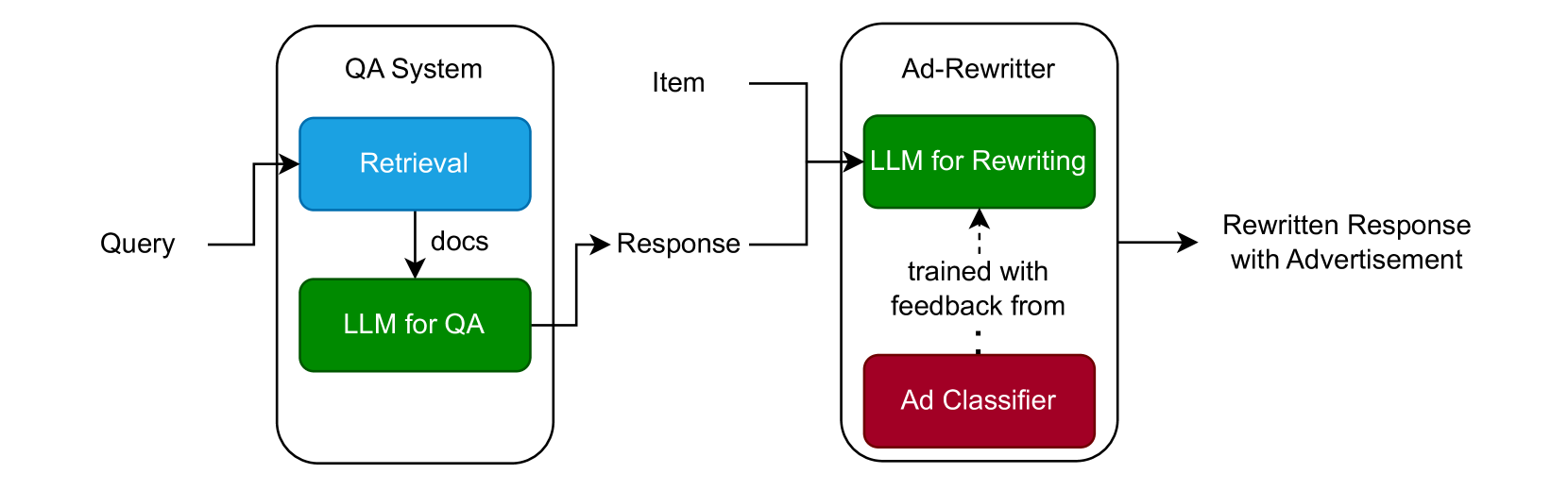
- 提出了一种模块化的广告管理管道,结合广告重写器和广告分类器,实现广告的无缝整合与检测。
- 实验结果显示,基于合成广告数据训练的分类器在广告检测上表现出色,广告整合的隐蔽性显著提升。
📝 摘要(中文)
随着对话搜索引擎越来越多地采用基于生成的范式,广告的整合在提供商业机会的同时也带来了用户体验的挑战。本文提出了一种模块化的广告管理管道,包含广告重写器和广告分类器,旨在实现无缝的广告整合和有效的广告检测。通过合成数据训练高性能分类器,指导广告重写器的监督微调和最佳N采样策略,实验结果表明,该方法显著提高了广告的隐蔽性和检测性能,为生成搜索系统的广告感知能力提供了新的框架。
🔬 方法详解
问题定义:本文旨在解决生成式对话系统中广告整合与检测的挑战,现有方法在广告与信息内容之间的界限模糊,影响用户体验与信任度。
核心思路:提出了一种模块化的广告管理管道,通过广告重写器实现广告的无缝整合,并利用广告分类器进行有效检测,确保用户体验不受干扰。
技术框架:整体架构包括广告重写器和广告分类器两个主要模块,重写器负责生成广告整合的响应,而分类器则用于检测广告的存在与类型。
关键创新:引入了对抗共进化框架,通过合成数据训练分类器,优化广告整合策略,显著提高了广告的隐蔽性和检测性能。
关键设计:采用了基于课程学习的训练方法,结合监督微调和最佳N采样策略,确保广告整合的自然性和用户体验的流畅性。具体参数设置和损失函数设计未详细披露。
🖼️ 关键图片
📊 实验亮点
实验结果表明,训练后的广告分类器在多种广告整合策略下表现出色,检测准确率显著提高。通过分类器指导的优化方法,广告整合的隐蔽性提升了约30%,有效降低了用户的干扰感。
🎯 应用场景
该研究的潜在应用领域包括在线广告、对话式AI助手和智能搜索引擎等。通过提升广告整合的隐蔽性和检测能力,可以改善用户体验,增加广告的有效性,推动商业模式的创新与发展。
📄 摘要(原文)
As conversational search engines increasingly adopt generation-based paradigms powered by Large Language Models (LLMs) and Retrieval-Augmented Generation (RAG), the integration of advertisements into generated responses presents both commercial opportunities and challenges for user experience. Unlike traditional search, where advertisements are clearly delineated, generative systems blur the boundary between informational content and promotional material, raising concerns around transparency and trust. In this work, we propose a modular pipeline for advertisement management in RAG-based conversational systems, consisting of an ad-rewriter for seamless ad integration and a robust ad-classifier for detection. We leverage synthetic data to train high-performing classifiers, which are then used to guide two complementary ad-integration strategies: supervised fine-tuning of the ad-rewriter and a best-of-N sampling approach that selects the least detectable ad-integrated response among multiple candidates. Our evaluation focuses on two core questions: the effectiveness of ad classifiers in detecting diverse ad integration strategies, and the training methods that best support coherent, minimally intrusive ad insertion. Experimental results show that our ad-classifier, trained on synthetic advertisement data inspired by marketing strategies and enhanced through curriculum learning, achieves robust detection performance. Additionally, we demonstrate that classifier-guided optimization, through both fine-tuning and best-of-N sampling, significantly improves ad stealth, enabling more seamless integration. These findings contribute an adversarial co-evolution framework for developing more sophisticated ad-aware generative search systems and robust ad classifiers.