Multimodal Multihop Source Retrieval for Web Question Answering
作者: Navya Yarrabelly, Saloni Mittal
分类: cs.CL, cs.AI
发布日期: 2025-01-07
备注: arXiv admin note: text overlap with arXiv:2010.03604 by other authors
💡 一句话要点
提出图推理网络以解决多模态多跳问答问题
🎯 匹配领域: 支柱九:具身大模型 (Embodied Foundation Models)
关键词: 多模态问答 图推理网络 信息检索 深度学习 语义结构
📋 核心要点
- 现有的多模态多跳问答方法在推理和信息检索方面存在不足,难以有效整合图像和文本信息。
- 论文提出了一种基于图推理网络的解决方案,通过图结构学习多源推理路径,增强了问答的准确性。
- 实验结果显示,所提模型在检索F1分数上比传统变换器基线提高了4.6%,证明了其有效性和轻量化优势。
📝 摘要(中文)
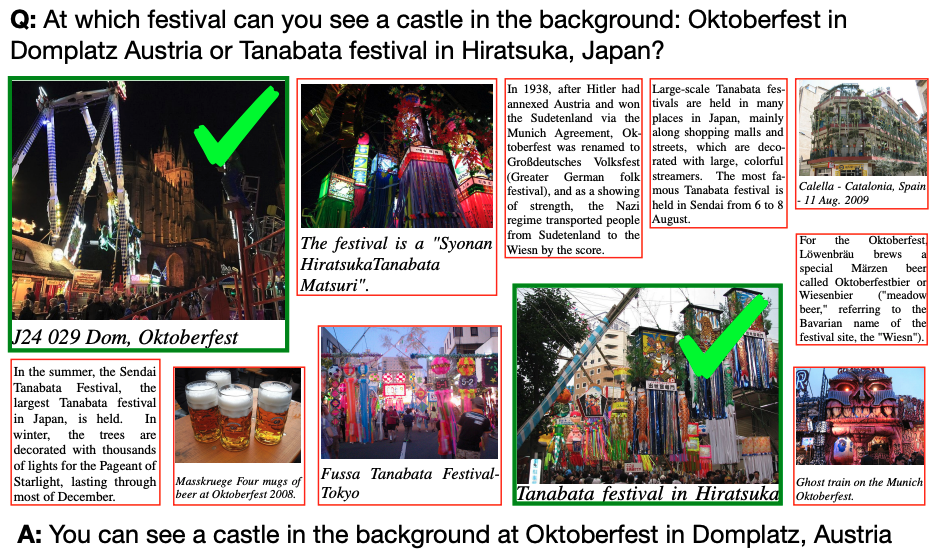
本研究解决了多模态多跳问答(QA)中的学习与推理挑战。我们提出了一种基于句子语义结构的图推理网络,以学习多源推理路径,并在图像和文本模态中找到支持事实来回答问题。通过对WebQA的分析,我们构建了一个强基线模型,利用成对分类任务找到相关源。实验表明,适当使用预训练模型的特征表示,图结构有助于提高多模态多跳问答的性能。我们的模型在检索F1分数上比变换器基线提高了4.6%,且模型轻量化,适用于大规模检索场景。
🔬 方法详解
问题定义:本论文旨在解决多模态多跳问答中的信息检索与推理挑战。现有方法往往无法有效整合来自不同模态的信息,导致问答准确性不足。
核心思路:我们提出了一种基于图推理网络的框架,利用句子的语义结构来学习多源推理路径,从而在图像和文本模态中找到支持事实。这样的设计使得模型能够更好地捕捉信息之间的关系。
技术框架:整体架构包括图推理网络和成对分类任务模块。首先,通过图结构表示句子及其关系,然后进行信息传播以获取支持信息,最后通过分类任务确定相关源。
关键创新:本研究的主要创新在于引入图结构和邻接矩阵作为任务相关的先验知识,利用图结构来提升检索性能,这与传统的基于变换器的方法有本质区别。
关键设计:模型采用轻量化设计,使用预训练模型的特征表示,损失函数基于成对分类,确保了模型在保持性能的同时,计算开销较低。
🖼️ 关键图片
.pdf)

📊 实验亮点
实验结果表明,所提模型在检索F1分数上比传统变换器基线提高了4.6%。通过图网络的消息传播,模型能够有效替代大规模的多模态变换器,展现出更高的效率和准确性。
🎯 应用场景
该研究在多模态问答系统、信息检索和智能助手等领域具有广泛的应用潜力。通过提高多模态信息的整合能力,能够为用户提供更准确的答案,提升用户体验。未来,该方法还可以扩展到其他需要多模态信息处理的任务中。
📄 摘要(原文)
This work deals with the challenge of learning and reasoning over multi-modal multi-hop question answering (QA). We propose a graph reasoning network based on the semantic structure of the sentences to learn multi-source reasoning paths and find the supporting facts across both image and text modalities for answering the question. In this paper, we investigate the importance of graph structure for multi-modal multi-hop question answering. Our analysis is centered on WebQA. We construct a strong baseline model, that finds relevant sources using a pairwise classification task. We establish that, with the proper use of feature representations from pre-trained models, graph structure helps in improving multi-modal multi-hop question answering. We point out that both graph structure and adjacency matrix are task-related prior knowledge, and graph structure can be leveraged to improve the retrieval performance for the task. Experiments and visualized analysis demonstrate that message propagation over graph networks or the entire graph structure can replace massive multimodal transformers with token-wise cross-attention. We demonstrated the applicability of our method and show a performance gain of \textbf{4.6$\%$} retrieval F1score over the transformer baselines, despite being a very light model. We further demonstrated the applicability of our model to a large scale retrieval setting.