Leveraging Lecture Content for Improved Feedback: Explorations with GPT-4 and Retrieval Augmented Generation
作者: Sven Jacobs, Steffen Jaschke
分类: cs.CL, cs.AI, cs.CY
发布日期: 2024-05-05
备注: accepted at CSEE&T 2024: 36th International Conference on Software Engineering Education and Training, Würzburg, Germany
DOI: 10.1109/CSEET62301.2024.10663001
💡 一句话要点
利用RAG增强GPT-4,改进编程学习反馈,提升教学效果
🎯 匹配领域: 支柱九:具身大模型 (Embodied Foundation Models)
关键词: 检索增强生成 大型语言模型 编程教育 反馈生成 GPT-4
📋 核心要点
- 现有编程学习反馈缺乏针对性,学生难以将反馈与课程内容关联,阻碍独立解决问题。
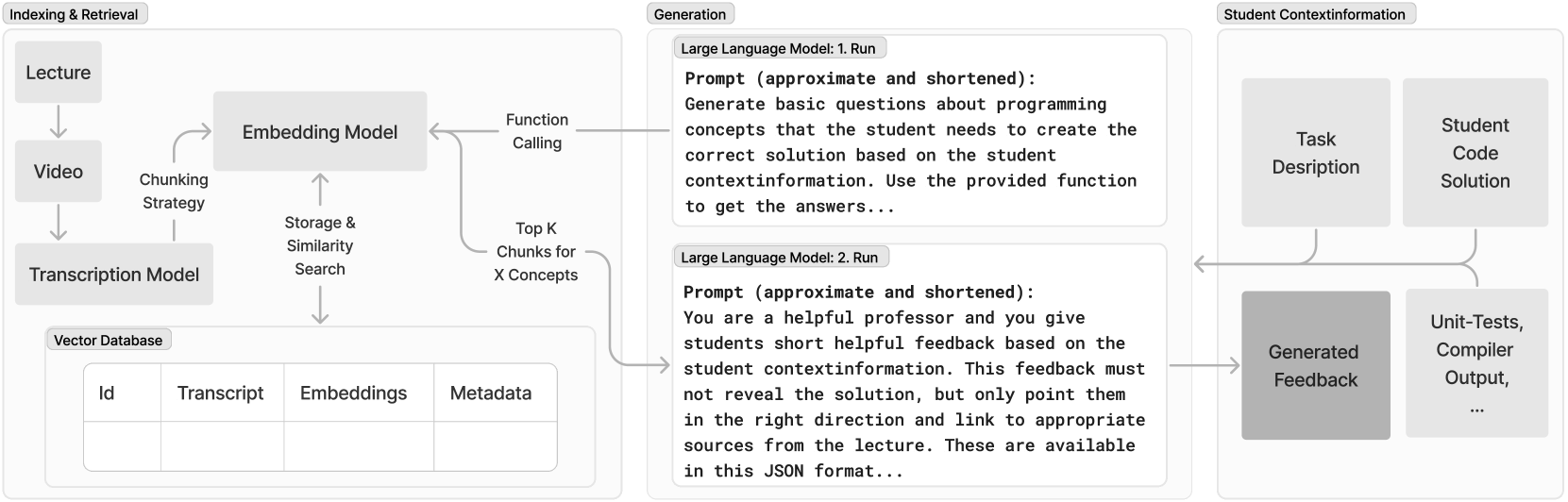
- 利用RAG将讲座内容(录音转录)注入GPT-4,使其生成更贴合课程、更准确的编程反馈。
- 实验表明,RAG增强的反馈在特定情况下更受学生欢迎,但反馈速度是需要考虑的因素。
📝 摘要(中文)
本文提出了一种利用检索增强生成(RAG)来改进大型语言模型为编程任务生成的反馈的方法。具体来说,通过转录相应的讲座录音,并使用RAG将这些录音作为外部知识源提供给大型语言模型GPT-4,同时附带时间戳作为元信息。这样做的目的是防止幻觉,并强制使用讲座中的技术术语和短语。在一个为介绍性编程讲座开发的编程问题练习平台上,学生可以请求GPT-4对其解决方案生成反馈。对于此任务,GPT-4接收学生的代码解决方案、编译器输出、单元测试结果以及通过RAG获得的讲座笔记的相关段落作为附加上下文。GPT-4生成的反馈应该引导学生独立解决问题,并链接到讲座内容,使用成绩单的时间戳作为元信息。通过这种方式,可以立即在相应位置观看相应的讲座视频。为了评估,学生在一个研讨会上使用了该工具,并决定对于每个反馈是否应该通过RAG进行扩展。基于问卷调查和收集的使用数据的初步结果表明,RAG的使用可以改进反馈生成,并且在某些情况下更受学生欢迎。由于反馈生成速度较慢,因此其优势取决于具体情况。
🔬 方法详解
问题定义:论文旨在解决编程学习中,学生获得的反馈不够具体、难以理解,以及与课程内容脱节的问题。现有的反馈机制往往无法有效引导学生独立解决问题,也难以将学生的错误与课堂知识联系起来。
核心思路:核心思路是利用检索增强生成(RAG)技术,将相关的讲座内容作为外部知识注入到GPT-4中,使其在生成反馈时能够参考这些知识。这样可以确保反馈的准确性、专业性,并使其与课程内容紧密相关。
技术框架:整体框架包括以下几个主要模块:1) 讲座录音转录模块,将讲座录音转换为文本;2) RAG模块,根据学生提交的代码和错误信息,检索相关的讲座内容;3) GPT-4反馈生成模块,利用检索到的讲座内容和学生的代码、错误信息,生成反馈;4) 练习平台,学生可以在平台上提交代码、查看反馈,并观看相关的讲座视频。
关键创新:关键创新在于将RAG技术应用于编程学习反馈生成,并利用讲座录音转录作为外部知识源。这使得生成的反馈更加贴合课程内容,也更容易被学生理解和接受。此外,通过时间戳将反馈与讲座视频关联,方便学生快速回顾相关知识点。
关键设计:论文中没有详细描述具体的参数设置、损失函数或网络结构等技术细节。RAG的具体实现方式(例如,使用哪种检索算法)以及GPT-4的prompt设计是影响反馈质量的关键因素,但论文中没有提供相关信息。这些细节可能需要进一步的研究才能确定。
🖼️ 关键图片


📊 实验亮点
实验结果表明,在某些情况下,学生更喜欢使用RAG增强的反馈。问卷调查和使用数据表明,RAG可以改进反馈生成。然而,由于反馈生成速度较慢,RAG的优势取决于具体情况。具体的性能数据(例如,反馈质量的提升幅度)没有在摘要中给出。
🎯 应用场景
该研究成果可应用于在线编程教育平台、智能辅导系统等领域,为学生提供更个性化、更有效的编程学习反馈。通过将反馈与课程内容关联,可以帮助学生更好地理解知识点,提高学习效率。未来,可以将该方法推广到其他学科,提升整体教学质量。
📄 摘要(原文)
This paper presents the use of Retrieval Augmented Generation (RAG) to improve the feedback generated by Large Language Models for programming tasks. For this purpose, corresponding lecture recordings were transcribed and made available to the Large Language Model GPT-4 as external knowledge source together with timestamps as metainformation by using RAG. The purpose of this is to prevent hallucinations and to enforce the use of the technical terms and phrases from the lecture. In an exercise platform developed to solve programming problems for an introductory programming lecture, students can request feedback on their solutions generated by GPT-4. For this task GPT-4 receives the students' code solution, the compiler output, the result of unit tests and the relevant passages from the lecture notes available through the use of RAG as additional context. The feedback generated by GPT-4 should guide students to solve problems independently and link to the lecture content, using the time stamps of the transcript as meta-information. In this way, the corresponding lecture videos can be viewed immediately at the corresponding positions. For the evaluation, students worked with the tool in a workshop and decided for each feedback whether it should be extended by RAG or not. First results based on a questionnaire and the collected usage data show that the use of RAG can improve feedback generation and is preferred by students in some situations. Due to the slower speed of feedback generation, the benefits are situation dependent.