Personality-affected Emotion Generation in Dialog Systems
作者: Zhiyuan Wen, Jiannong Cao, Jiaxing Shen, Ruosong Yang, Shuaiqi Liu, Maosong Sun
分类: cs.CL, cs.AI
发布日期: 2024-04-03
备注: Accepted by ACM Transactions on Information Systems
💡 一句话要点
提出个性化情感生成方法以解决对话系统情感一致性问题
🎯 匹配领域: 支柱四:生成式动作 (Generative Motion) 支柱七:动作重定向 (Motion Retargeting) 支柱八:物理动画 (Physics-based Animation)
关键词: 个性化情感生成 对话系统 情感计算 情绪转变 数据集构建 机器学习 自然语言处理
📋 核心要点
- 现有对话系统在生成情感响应时,往往缺乏一致性,导致用户参与度降低。
- 本文提出通过个性化情绪转变来生成情感,构建个性情感线数据集以支持研究。
- 实验结果显示,采用新方法后,情感生成性能在宏观F1和加权F1上分别提升了13%和5%。
📝 摘要(中文)
生成适当情感的响应对于对话系统在各种应用场景中提供类人交互至关重要。以往的对话系统主要通过从匿名对话数据中学习同理心来实现这一目标,但这些方法生成的情感响应可能不一致,从而降低用户参与度和服务质量。基于心理学研究,情感表达与个性特征密切相关。为此,本文提出了一个新任务——个性化情感生成,旨在根据对话系统的个性生成情感,并通过个性化情绪转变进行深入研究。我们构建了一个日常对话数据集——个性情感线数据集(PELD),并分析了该任务中的挑战。最后,我们通过模拟对话系统中的情绪转变过程,将个性建模为转变权重,从而解决上述挑战。实验结果表明,采用我们的方法后,情感生成性能在宏观F1和加权F1上分别提高了13%和5%。
🔬 方法详解
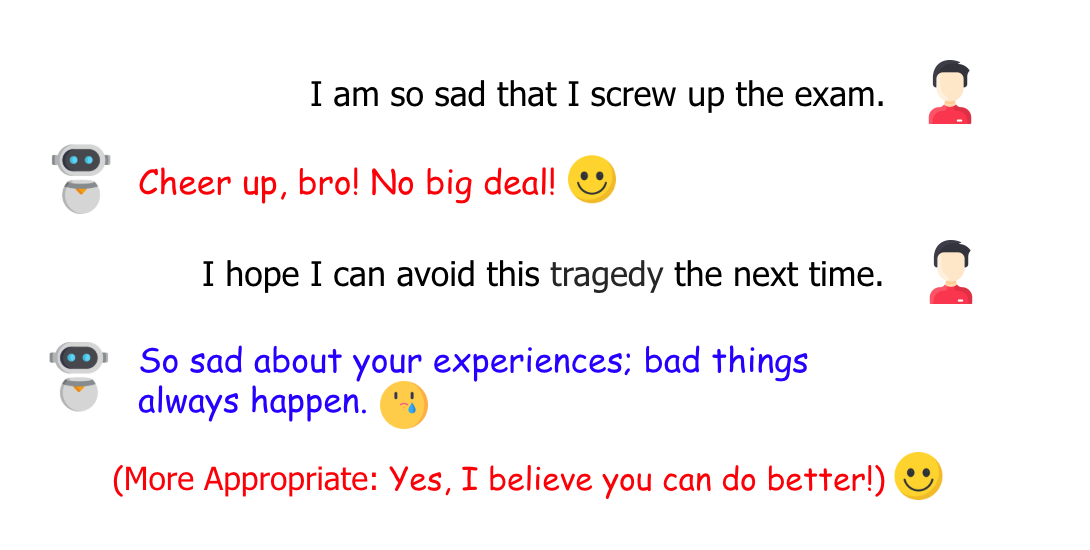
问题定义:本文旨在解决对话系统中情感生成的一致性问题,现有方法通常依赖于匿名对话数据,导致生成的情感响应缺乏个性化和一致性。
核心思路:我们提出个性化情感生成任务,通过个性特征影响情感生成,模拟情绪转变过程,以提高情感生成的质量和一致性。
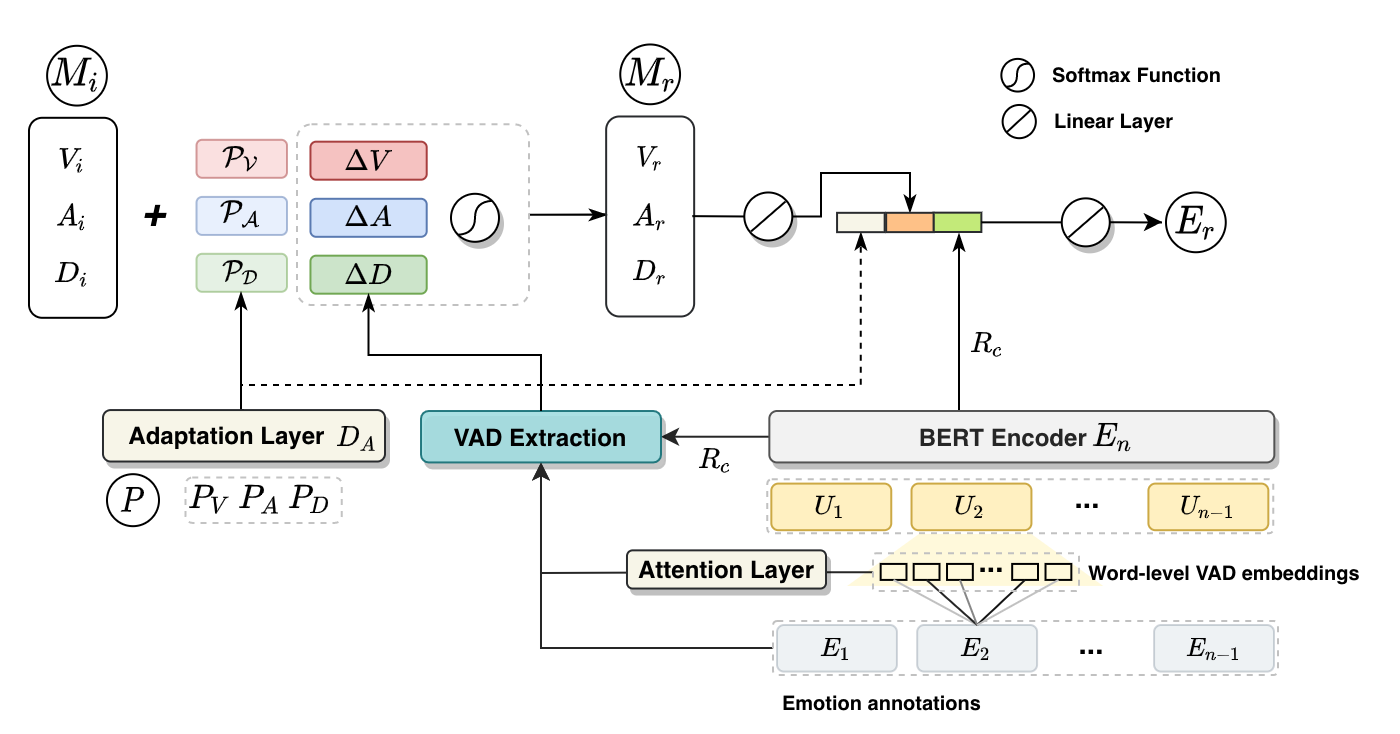
技术框架:整体架构包括数据集构建、个性与情感因素的异构整合、以及多粒度情感信息的提取。首先构建个性情感线数据集(PELD),然后设计模型以模拟情绪转变。
关键创新:最重要的创新在于将个性建模为情绪转变的权重,突破了传统方法的局限,使得情感生成更具个性化和一致性。
关键设计:在模型设计中,采用了多层次的情感信息提取机制,并设置了特定的损失函数以优化个性与情感的整合效果。
🖼️ 关键图片

📊 实验亮点
实验结果显示,采用本文提出的方法后,情感生成性能显著提升,宏观F1提高了13%,加权F1提高了5%。这些结果表明新方法在情感一致性和个性化方面的有效性,优于基于BERT-base模型的传统方法。
🎯 应用场景
该研究的潜在应用领域包括智能客服、虚拟助手和社交机器人等,能够提升人机交互的自然性和用户体验。通过个性化情感生成,系统能够更好地理解和响应用户情感,从而增强用户的参与感和满意度,未来可能在情感计算和人机交互领域产生深远影响。
📄 摘要(原文)
Generating appropriate emotions for responses is essential for dialog systems to provide human-like interaction in various application scenarios. Most previous dialog systems tried to achieve this goal by learning empathetic manners from anonymous conversational data. However, emotional responses generated by those methods may be inconsistent, which will decrease user engagement and service quality. Psychological findings suggest that the emotional expressions of humans are rooted in personality traits. Therefore, we propose a new task, Personality-affected Emotion Generation, to generate emotion based on the personality given to the dialog system and further investigate a solution through the personality-affected mood transition. Specifically, we first construct a daily dialog dataset, Personality EmotionLines Dataset (PELD), with emotion and personality annotations. Subsequently, we analyze the challenges in this task, i.e., (1) heterogeneously integrating personality and emotional factors and (2) extracting multi-granularity emotional information in the dialog context. Finally, we propose to model the personality as the transition weight by simulating the mood transition process in the dialog system and solve the challenges above. We conduct extensive experiments on PELD for evaluation. Results suggest that by adopting our method, the emotion generation performance is improved by 13% in macro-F1 and 5% in weighted-F1 from the BERT-base model.