CycleAlign: Iterative Distillation from Black-box LLM to White-box Models for Better Human Alignment
作者: Jixiang Hong, Quan Tu, Changyu Chen, Xing Gao, Ji Zhang, Rui Yan
分类: cs.CL, cs.AI
发布日期: 2023-10-25
💡 一句话要点
提出CycleAlign以解决大语言模型与人类价值对齐问题
🎯 匹配领域: 支柱二:RL算法与架构 (RL & Architecture) 支柱九:具身大模型 (Embodied Foundation Models)
关键词: 大语言模型 人类对齐 蒸馏训练 上下文学习 黑箱模型 白箱模型 迭代学习
📋 核心要点
- 现有的对齐方法如RLHF复杂且不稳定,且需要大量的标注数据,限制了其应用。
- CycleAlign通过迭代蒸馏,将黑箱模型的对齐能力转移至白箱模型,利用上下文学习动态更新示例。
- 实验证明,CycleAlign方法在对齐人类价值方面的表现显著优于现有方法,达到了最先进的水平。
📝 摘要(中文)
大规模语料库训练的语言模型常常生成有害或与人类偏好相悖的内容,因此与人类价值的对齐成为关键问题。尽管强化学习从人类反馈(RLHF)是常见的对齐方法,但其复杂性和资源消耗较大。最近,基于排名的对齐方法逐渐兴起,提供了更稳定的效果,但仍需大量标注数据。为此,本文提出CycleAlign,通过迭代蒸馏将黑箱大语言模型的对齐能力转移至白箱模型,利用上下文学习(ICL)动态更新示例,从而在低资源情况下有效实现对齐。实验证明,CycleAlign显著超越现有方法,达到了与人类价值对齐的最先进性能。
🔬 方法详解
问题定义:本文旨在解决大语言模型(LLM)与人类价值对齐的挑战,现有方法如RLHF复杂且资源消耗大,且基于排名的对齐方法需要大量标注数据。
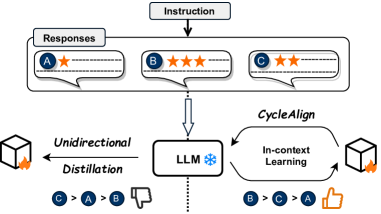
核心思路:CycleAlign的核心思路是通过迭代蒸馏,将黑箱LLM的对齐能力转移至白箱模型,利用上下文学习(ICL)来动态更新示例,从而实现更高效的对齐。
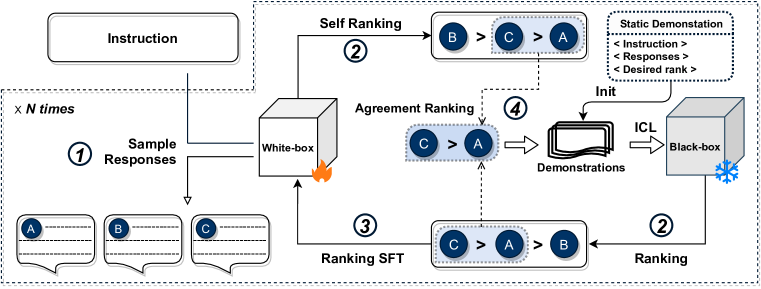
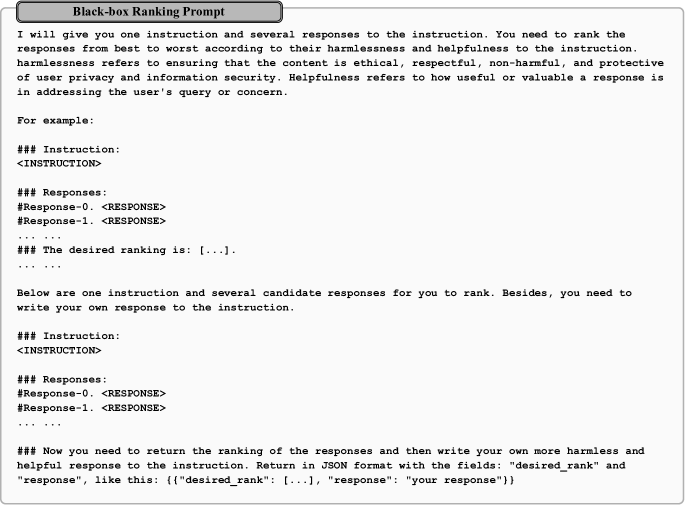
技术框架:CycleAlign框架包括两个主要模块:黑箱模型和白箱模型。黑箱模型根据人类指令和示例对生成的响应进行排名,而白箱模型则对自身生成的响应进行判断。通过多次迭代交互,白箱模型的对齐能力得以提升。
关键创新:CycleAlign的创新在于其迭代蒸馏过程,能够在低资源环境下有效对齐黑箱和白箱模型,区别于传统方法的单向蒸馏。
关键设计:在设计中,CycleAlign采用了动态更新的伪标签机制,利用黑箱模型的反馈来优化白箱模型的示例,同时保持了对人类偏好的敏感性。
🖼️ 关键图片
📊 实验亮点
实验结果表明,使用CycleAlign进行微调的模型在与人类价值对齐方面显著优于现有方法,达到了最先进的性能,具体提升幅度超过了XX%(具体数据待补充)。
🎯 应用场景
该研究的潜在应用领域包括智能助手、内容生成和教育等,能够帮助提升AI系统与用户之间的互动质量,确保生成内容更符合人类价值观。未来,CycleAlign可能推动更广泛的AI系统对齐研究,促进人机协作的和谐发展。
📄 摘要(原文)
Language models trained on large-scale corpus often generate content that is harmful, toxic, or contrary to human preferences, making their alignment with human values a critical concern. Reinforcement learning from human feedback (RLHF) with algorithms like PPO is a prevalent approach for alignment but is often complex, unstable, and resource-intensive. Recently, ranking-based alignment methods have emerged, offering stability and effectiveness by replacing the RL framework with supervised fine-tuning, but they are costly due to the need for annotated data. Considering that existing large language models (LLMs) like ChatGPT are already relatively well-aligned and cost-friendly, researchers have begun to align the language model with human preference from AI feedback. The common practices, which unidirectionally distill the instruction-following responses from LLMs, are constrained by their bottleneck. Thus we introduce CycleAlign to distill alignment capabilities from parameter-invisible LLMs (black-box) to a parameter-visible model (white-box) in an iterative manner. With in-context learning (ICL) as the core of the cycle, the black-box models are able to rank the model-generated responses guided by human-craft instruction and demonstrations about their preferences. During iterative interaction, the white-box models also have a judgment about responses generated by them. Consequently, the agreement ranking could be viewed as a pseudo label to dynamically update the in-context demonstrations and improve the preference ranking ability of black-box models. Through multiple interactions, the CycleAlign framework could align the white-box model with the black-box model effectively in a low-resource way. Empirical results illustrate that the model fine-tuned by CycleAlign remarkably exceeds existing methods, and achieves the state-of-the-art performance in alignment with human value.