Re-Temp: Relation-Aware Temporal Representation Learning for Temporal Knowledge Graph Completion
作者: Kunze Wang, Soyeon Caren Han, Josiah Poon
分类: cs.CL
发布日期: 2023-10-24
备注: Findings of EMNLP 2023
💡 一句话要点
提出Re-Temp以解决时序知识图谱补全中的信息忽略问题
🎯 匹配领域: 支柱二:RL算法与架构 (RL & Architecture)
关键词: 时序知识图谱 图神经网络 信息流优化 显式时间嵌入 预测模型 机器学习 信息过滤
📋 核心要点
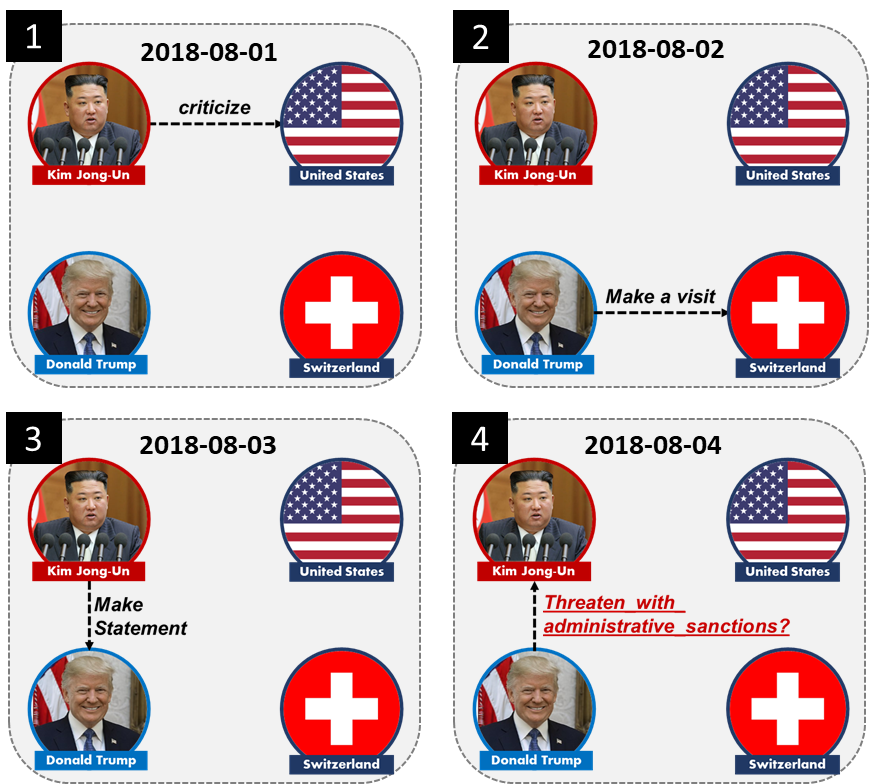
- 现有方法在时序知识图谱补全中往往忽视了根据实体相关关系跳过无关快照的能力,导致信息冗余。
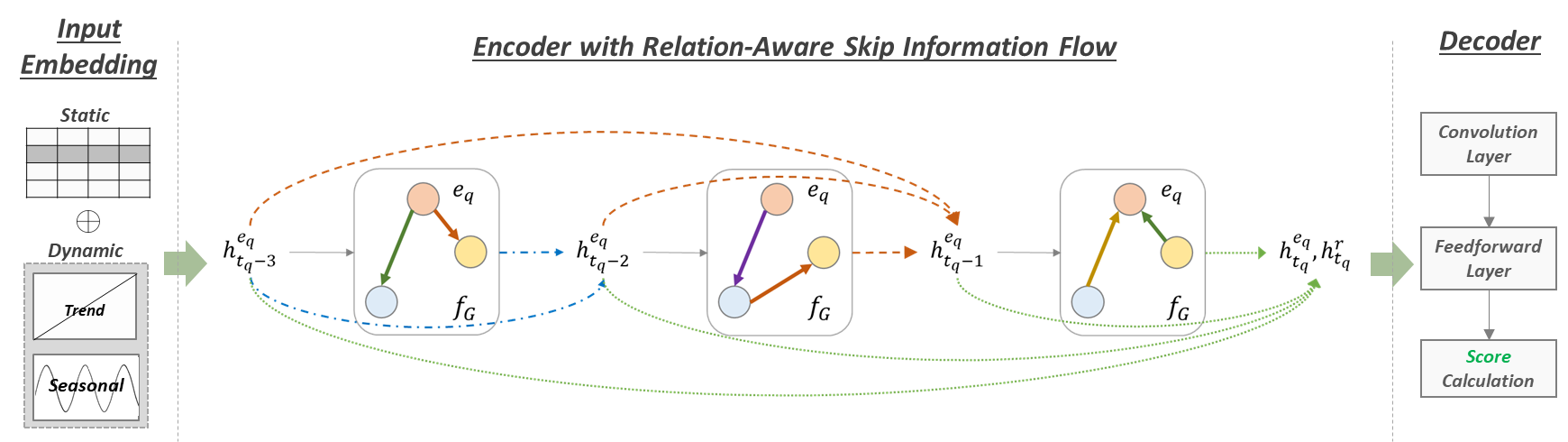
- Re-Temp模型通过引入显式时间嵌入和跳过信息流,优化了信息传递过程,提高了预测的准确性。
- 在六个TKGC外推数据集上的实验结果显示,Re-Temp模型显著优于八个最新的最先进模型,提升幅度明显。
📝 摘要(中文)
时序知识图谱补全(TKGC)在外推设置下旨在预测未来事实中的缺失实体,这一挑战更贴近现实预测问题。现有研究主要使用序列图神经网络编码实体和关系,但往往忽视了根据查询中的实体相关关系跳过无关快照的能力,并且未充分考虑显式时间信息的重要性。为此,本文提出了Re-Temp(关系感知时序表示学习)模型,利用显式时间嵌入作为输入,并在每个时间戳后引入跳过信息流,以跳过不必要的信息进行预测。此外,我们引入了两阶段前向传播方法以防止信息泄漏。通过在六个TKGC(外推)数据集上的评估,我们证明了该模型在性能上显著超越了八个最新的最先进模型。
🔬 方法详解
问题定义:本文旨在解决时序知识图谱补全中的信息冗余问题,现有方法未能有效利用实体相关关系跳过无关快照,导致预测性能下降。
核心思路:Re-Temp模型的核心思想是结合显式时间嵌入和跳过信息流,以优化信息传递过程,从而提高预测的准确性和效率。
技术框架:该模型的整体架构包括显式时间嵌入模块、跳过信息流模块和两阶段前向传播机制,确保信息的有效传递与利用。
关键创新:Re-Temp的主要创新在于引入了显式时间嵌入和跳过信息流,这与现有方法的静态快照处理方式形成了鲜明对比,显著提升了模型的预测能力。
关键设计:模型设计中采用了特定的损失函数以优化预测结果,并在网络结构中引入了跳过机制,以有效过滤不必要的信息,确保信息流的高效性。
🖼️ 关键图片
📊 实验亮点
在六个TKGC外推数据集上的实验结果显示,Re-Temp模型在预测准确性上超越了八个最新的最先进模型,提升幅度达到显著水平,验证了其有效性和优越性。
🎯 应用场景
该研究的潜在应用领域包括智能推荐系统、事件预测、社交网络分析等,能够为实际问题提供更准确的预测结果。未来,Re-Temp模型可能在动态环境下的知识图谱构建和更新中发挥重要作用,提升智能系统的决策能力。
📄 摘要(原文)
Temporal Knowledge Graph Completion (TKGC) under the extrapolation setting aims to predict the missing entity from a fact in the future, posing a challenge that aligns more closely with real-world prediction problems. Existing research mostly encodes entities and relations using sequential graph neural networks applied to recent snapshots. However, these approaches tend to overlook the ability to skip irrelevant snapshots according to entity-related relations in the query and disregard the importance of explicit temporal information. To address this, we propose our model, Re-Temp (Relation-Aware Temporal Representation Learning), which leverages explicit temporal embedding as input and incorporates skip information flow after each timestamp to skip unnecessary information for prediction. Additionally, we introduce a two-phase forward propagation method to prevent information leakage. Through the evaluation on six TKGC (extrapolation) datasets, we demonstrate that our model outperforms all eight recent state-of-the-art models by a significant margin.