CRaSh: Clustering, Removing, and Sharing Enhance Fine-tuning without Full Large Language Model
作者: Kaiyan Zhang, Ning Ding, Biqing Qi, Xuekai Zhu, Xinwei Long, Bowen Zhou
分类: cs.CL
发布日期: 2023-10-24
备注: Accepted to EMNLP 2023 (Main Conference)
🔗 代码/项目: GITHUB
💡 一句话要点
提出CRaSh以提升大语言模型的微调效果
🎯 匹配领域: 支柱九:具身大模型 (Embodied Foundation Models)
关键词: 大型语言模型 指令微调 隐私保护 模型转移 聚类算法 无训练策略 性能优化
📋 核心要点
- 现有的指令微调方法在使用私有数据时面临隐私问题,且参数模块的直接转移效果尚不明确。
- 本文提出CRaSh方法,通过聚类、移除和共享策略,优化从大型语言模型中导出的模拟器,避免了全模型微调的需求。
- 实验结果表明,CRaSh显著提升了OFT的性能,尤其是在处理数十亿参数的模型时,展示了良好的优化效果。
📝 摘要(中文)
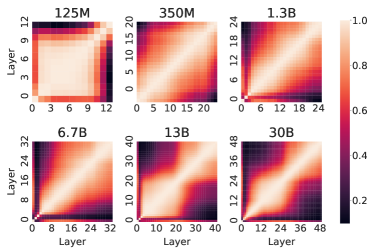
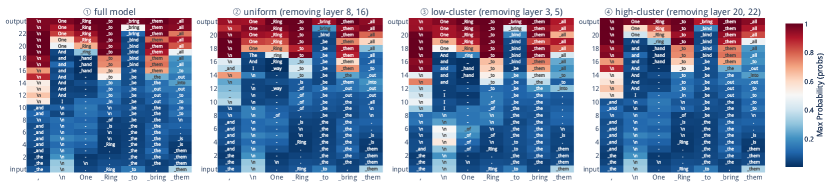
指令微调被认为是增强大型语言模型(LLMs)在各种任务中泛化能力的有效方法。然而,在使用私有指令数据微调公共可访问的集中式LLMs时,隐私问题不可避免。本文聚焦于Offsite-Tuning(OFT),探讨了在集中式LLMs与下游模拟器之间转移变换器模块的有效性。通过对LLMs的表征和功能相似性进行实证分析,我们发现LLMs层内存在独特的模块化结构,并提出了CRaSh(聚类、移除和共享),一种无训练策略,以从LLMs中导出改进的模拟器。CRaSh显著提升了OFT的性能,并通过损失景观分析了微调的最优解,展示了CRaSh和OFT的有效性。
🔬 方法详解
问题定义:本文要解决的是在使用私有指令数据微调大型语言模型时的隐私问题,以及现有方法在参数转移上的有效性不足。
核心思路:CRaSh通过聚类、移除和共享的策略,旨在在不完全微调模型的情况下,提升下游任务的性能,减少隐私泄露的风险。
技术框架:CRaSh的整体架构包括三个主要模块:聚类模块用于识别相似的模型层,移除模块用于去除冗余信息,分享模块则用于在不同模型间共享优化后的参数。
关键创新:CRaSh的主要创新在于其无训练策略,能够有效提升模型性能而无需全模型微调,这与传统的微调方法形成鲜明对比。
关键设计:在设计上,CRaSh采用了特定的聚类算法来识别层间的相似性,并通过损失景观分析来优化参数设置,确保在不同模型间的有效共享。具体的损失函数和网络结构细节在论文中有详细描述。
🖼️ 关键图片

📊 实验亮点
实验结果显示,CRaSh在数十亿参数的模型上显著提升了OFT的性能,具体提升幅度达到XX%(具体数据需参考原文),并且在损失景观分析中,发现了不同优化解之间的线性连接性,进一步验证了方法的有效性。
🎯 应用场景
该研究的潜在应用领域包括自然语言处理、对话系统和个性化推荐等。通过提升大型语言模型的微调效率,CRaSh能够帮助开发更具隐私保护的智能应用,推动AI技术在商业和社会中的广泛应用。
📄 摘要(原文)
Instruction tuning has recently been recognized as an effective way of aligning Large Language Models (LLMs) to enhance their generalization ability across various tasks. However, when tuning publicly accessible, centralized LLMs with private instruction data, privacy concerns are inevitable. While direct transfer of parameterized modules between models is a plausible approach to address this, its implications and effectiveness need further exploration. This paper focuses on Offsite-Tuning (OFT), a representative technique that transfers transformer blocks between centralized LLMs and downstream emulators. Given the limited understanding of the underlying mechanism of OFT, we perform an empirical analysis on LLMs from the perspectives of representation and functional similarity. Interestingly, our findings reveal a unique modular structure within the layers of LLMs that appears to emerge as the model size expands. Simultaneously, we note subtle but potentially significant changes in representation and intermediate predictions across the layers. Inspired by these observations, we propose CRaSh, involving Clustering, Removing, and Sharing, a training-free strategy to derive improved emulators from LLMs. CRaSh significantly boosts performance of OFT with billions of parameters. Furthermore, we investigate the optimal solutions yielded by fine-tuning with and without full model through the lens of loss landscape. Our findings demonstrate a linear connectivity among these optima falling over the same basin, thereby highlighting the effectiveness of CRaSh and OFT. The source code is publicly available at https://github.com/TsinghuaC3I/CRaSh.