Chainpoll: A high efficacy method for LLM hallucination detection
作者: Robert Friel, Atindriyo Sanyal
分类: cs.CL, cs.AI, cs.LG
发布日期: 2023-10-22
💡 一句话要点
提出ChainPoll以解决LLM幻觉检测问题
🎯 匹配领域: 支柱九:具身大模型 (Embodied Foundation Models)
关键词: 大型语言模型 幻觉检测 自动化指标 数据集 性能评估 自然语言处理 机器学习
📋 核心要点
- 现有的幻觉检测方法在准确性和适用性上存在不足,无法有效应对现代LLM的挑战。
- ChainPoll是一种新颖的幻觉检测方法,结合了多种评估指标,旨在提高检测的准确性和效率。
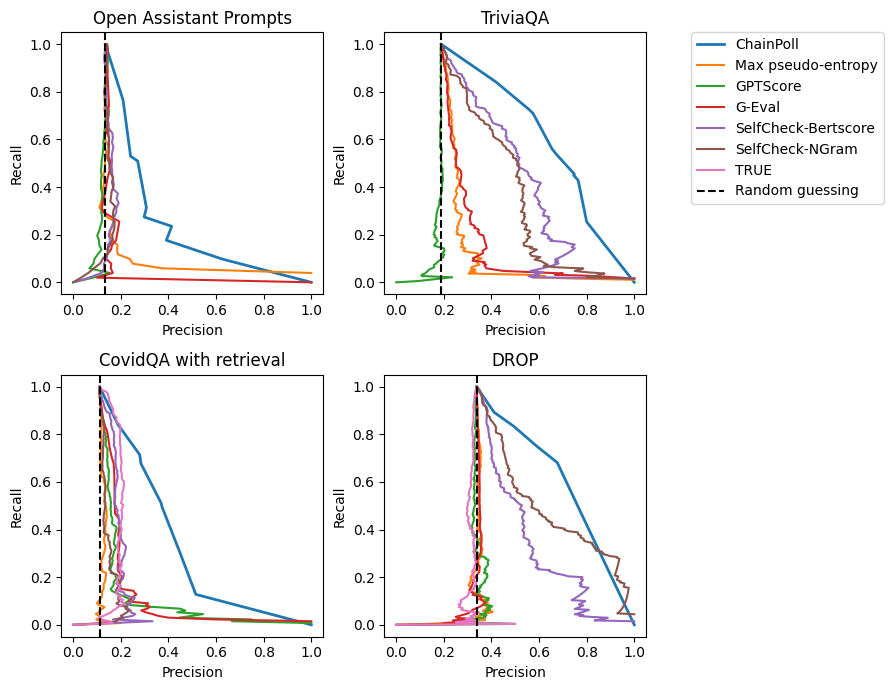
- 实验结果显示,ChainPoll在所有RealHall基准中均表现优异,AUROC达到0.781,显著超过其他方法。
📝 摘要(中文)
大型语言模型(LLMs)在生成连贯且上下文相关的响应方面取得了显著进展。然而,幻觉现象——即不正确或无根据的声明——仍然普遍存在,这促使我们创建自动化指标来检测LLM输出中的这些问题。我们的贡献包括:引入ChainPoll,一种创新的幻觉检测方法,表现优于其他方法;推出RealHall,一个经过精炼的基准数据集集合,用于评估近期研究中的幻觉检测指标。我们在创建RealHall时评估了以往研究中的任务和数据集,发现许多不适合当前强大的LLM。为此,我们选择了四个对现代LLM具有挑战性且与现实场景相关的数据集。使用RealHall,我们对ChainPoll与众多近期研究中的幻觉检测指标进行了全面比较,结果表明ChainPoll在所有RealHall基准中表现优异,整体AUROC达到0.781,超出下一个最佳理论方法11%,并超过行业标准23%以上。此外,ChainPoll具有成本效益高和透明度高的优势。我们还引入了两个新的指标来评估LLM幻觉:遵循性和正确性。
🔬 方法详解
问题定义:本论文旨在解决大型语言模型(LLMs)输出中的幻觉现象,即生成不准确或无根据的内容。现有方法在检测这些幻觉时存在准确性不足和适用性差的问题。
核心思路:论文提出ChainPoll作为一种创新的幻觉检测方法,旨在通过引入新的评估指标(如遵循性和正确性)来提高检测的准确性和透明度。该方法特别关注LLM在特定上下文中的表现。
技术框架:ChainPoll的整体架构包括数据集选择、指标设计和性能评估三个主要模块。首先,选择适合现代LLM的挑战性数据集;其次,设计新的评估指标;最后,通过RealHall基准进行全面的性能比较。
关键创新:ChainPoll的主要创新在于其引入的两个新指标:遵循性和正确性,前者评估LLM在特定文档和上下文中的分析能力,后者则识别逻辑和推理错误。这些创新使得ChainPoll在检测幻觉方面具有更高的准确性。
关键设计:在设计中,ChainPoll采用了特定的参数设置和损失函数,以优化模型在幻觉检测任务中的表现。具体的网络结构和训练流程未在摘要中详细说明,可能需要参考完整论文以获取更多技术细节。
🖼️ 关键图片


📊 实验亮点
实验结果表明,ChainPoll在所有RealHall基准中均表现优异,整体AUROC达到0.781,超出下一个最佳理论方法11%,并超过行业标准23%以上。这一显著提升展示了ChainPoll在幻觉检测领域的领先地位。
🎯 应用场景
ChainPoll的研究成果具有广泛的应用潜力,尤其是在需要高准确性和可靠性的自然语言处理任务中,如智能客服、内容生成和信息检索等领域。通过提高幻觉检测的效率,该方法能够增强LLM在实际应用中的可信度和用户体验。
📄 摘要(原文)
Large language models (LLMs) have experienced notable advancements in generating coherent and contextually relevant responses. However, hallucinations - incorrect or unfounded claims - are still prevalent, prompting the creation of automated metrics to detect these in LLM outputs. Our contributions include: introducing ChainPoll, an innovative hallucination detection method that excels compared to its counterparts, and unveiling RealHall, a refined collection of benchmark datasets to assess hallucination detection metrics from recent studies. While creating RealHall, we assessed tasks and datasets from previous hallucination detection studies and observed that many are not suitable for the potent LLMs currently in use. Overcoming this, we opted for four datasets challenging for modern LLMs and pertinent to real-world scenarios. Using RealHall, we conducted a comprehensive comparison of ChainPoll with numerous hallucination metrics from recent studies. Our findings indicate that ChainPoll outperforms in all RealHall benchmarks, achieving an overall AUROC of 0.781. This surpasses the next best theoretical method by 11% and exceeds industry standards by over 23%. Additionally, ChainPoll is cost-effective and offers greater transparency than other metrics. We introduce two novel metrics to assess LLM hallucinations: Adherence and Correctness. Adherence is relevant to Retrieval Augmented Generation workflows, evaluating an LLM's analytical capabilities within given documents and contexts. In contrast, Correctness identifies logical and reasoning errors.