Watermarking LLMs with Weight Quantization
作者: Linyang Li, Botian Jiang, Pengyu Wang, Ke Ren, Hang Yan, Xipeng Qiu
分类: cs.CL
发布日期: 2023-10-17
备注: Accepted by Findings of EMNLP2023
💡 一句话要点
提出一种水印策略以保护大型语言模型权重
🎯 匹配领域: 支柱九:具身大模型 (Embodied Foundation Models)
关键词: 水印技术 大型语言模型 量化 模型保护 开源模型 安全性 版权管理
📋 核心要点
- 现有方法在保护大型语言模型权重方面存在不足,容易被恶意使用,导致版权和安全问题。
- 本文提出的水印策略通过在量化过程中植入水印,避免了在推理时需要预定义触发器的限制。
- 实验表明,该方法成功地将水印植入多个开源大型语言模型,且在量化后仍能有效保护模型权重。
📝 摘要(中文)
随着大型语言模型的快速部署,其滥用带来了高风险,因此保护模型权重以避免恶意使用显得尤为重要。本文提出了一种新颖的水印策略,在大型语言模型的量化过程中植入水印,无需在推理时预定义触发器。该水印在模型以fp32模式使用时有效,而在量化为int8时保持隐藏,从而用户只能在不进行进一步监督微调的情况下推理模型。我们成功地将水印植入开源大型语言模型的权重中,包括GPT-Neo和LLaMA。希望我们提出的方法能够为保护模型权重提供潜在方向。
🔬 方法详解
问题定义:本文旨在解决大型语言模型权重保护的问题,现有方法容易被滥用,缺乏有效的水印机制以防止恶意使用。
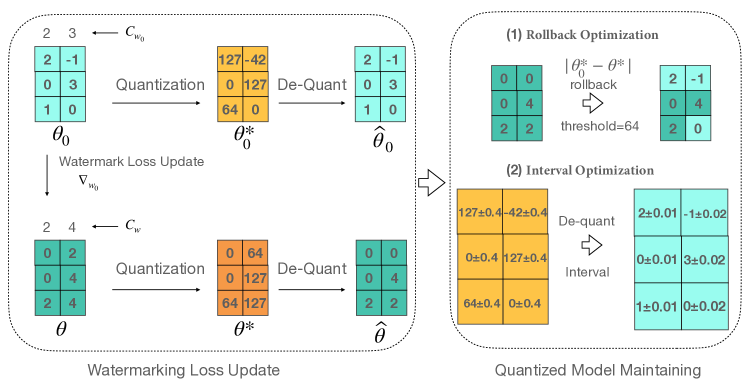
核心思路:提出在量化过程中植入水印的策略,水印在模型以fp32模式使用时有效,而在int8模式下保持隐藏,从而确保用户无法轻易去除水印。
技术框架:整体架构包括水印生成、量化过程和模型推理三个主要阶段。水印在量化阶段被嵌入模型权重中,确保在推理时的隐蔽性。
关键创新:最重要的创新在于水印的隐蔽性和有效性,尤其是在量化后的模型中仍能保持水印的存在,这与现有方法的显性水印形成鲜明对比。
关键设计:在设计中,采用了特定的量化参数设置和损失函数,以确保水印的有效植入,同时不影响模型的推理性能。
🖼️ 关键图片

📊 实验亮点
实验结果显示,所提出的水印策略在多个开源大型语言模型中成功植入,且在量化为int8后仍能有效识别水印,证明了其隐蔽性和有效性。与传统方法相比,提升了模型权重的安全性和版权保护能力。
🎯 应用场景
该研究的潜在应用领域包括开源大型语言模型的保护、版权管理以及安全审计等。通过有效的水印策略,可以降低模型被恶意使用的风险,维护开发者的权益,促进开源生态的健康发展。
📄 摘要(原文)
Abuse of large language models reveals high risks as large language models are being deployed at an astonishing speed. It is important to protect the model weights to avoid malicious usage that violates licenses of open-source large language models. This paper proposes a novel watermarking strategy that plants watermarks in the quantization process of large language models without pre-defined triggers during inference. The watermark works when the model is used in the fp32 mode and remains hidden when the model is quantized to int8, in this way, the users can only inference the model without further supervised fine-tuning of the model. We successfully plant the watermark into open-source large language model weights including GPT-Neo and LLaMA. We hope our proposed method can provide a potential direction for protecting model weights in the era of large language model applications.