From Large Language Models to Knowledge Graphs for Biomarker Discovery in Cancer
作者: Md. Rezaul Karim, Lina Molinas Comet, Md Shajalal, Oya Deniz Beyan, Dietrich Rebholz-Schuhmann, Stefan Decker
分类: cs.CL
发布日期: 2023-10-12 (更新: 2023-11-19)
备注: arXiv admin note: substantial text overlap with arXiv:2302.04737
💡 一句话要点
构建癌症生物标志物发现的知识图谱以解决信息整合问题
🎯 匹配领域: 支柱九:具身大模型 (Embodied Foundation Models)
关键词: 知识图谱 生物标志物 癌症研究 信息提取 大型语言模型 本体构建 临床决策支持
📋 核心要点
- 现有方法在整合分散的生物医学数据时面临挑战,导致非领域用户难以有效探索和查询知识图谱。
- 本文提出构建OncoNet本体并整合多种生物医学概念,以支持癌症生物标志物的发现和互动问答。
- 通过微调知识图谱,结合最新的科学发现,显著提高了AI系统在癌症诊断和治疗推荐中的准确性。
📝 摘要(中文)
领域专家通常依赖最新知识来理解和传播特定生物过程,以设计预防和治疗决策策略。人工智能在利用生物医学数据(如文本、影像、组学和临床数据)提供癌症诊断和治疗建议方面面临挑战。生物医学实体(如癌症、药物、基因、蛋白质及其机制)的数据和知识分散在结构化和非结构化来源中。本文开发了一种领域知识图谱,旨在促进癌症特定生物标志物的发现和互动问答。通过构建OncoNet本体,整合多种生物医学概念,利用大型语言模型对知识图谱进行微调,以应对生物医学领域的快速演变。
🔬 方法详解
问题定义:本文旨在解决生物医学数据分散导致的知识整合困难,现有方法无法有效支持非领域用户进行知识探索和问答。
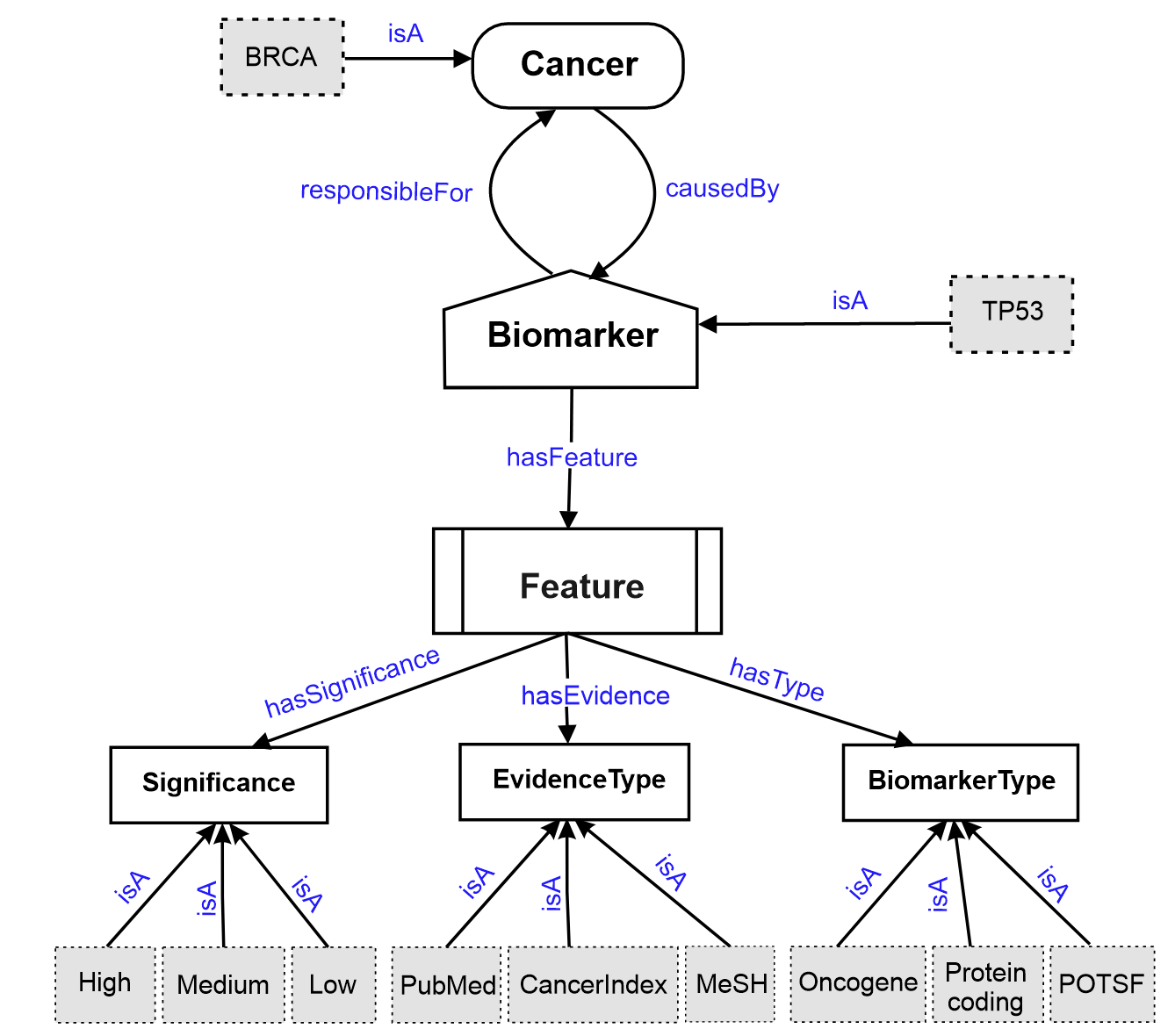
核心思路:通过构建OncoNet本体,整合癌症相关的生物医学概念和关系,形成一个领域知识图谱,以支持生物标志物的发现和互动问答。
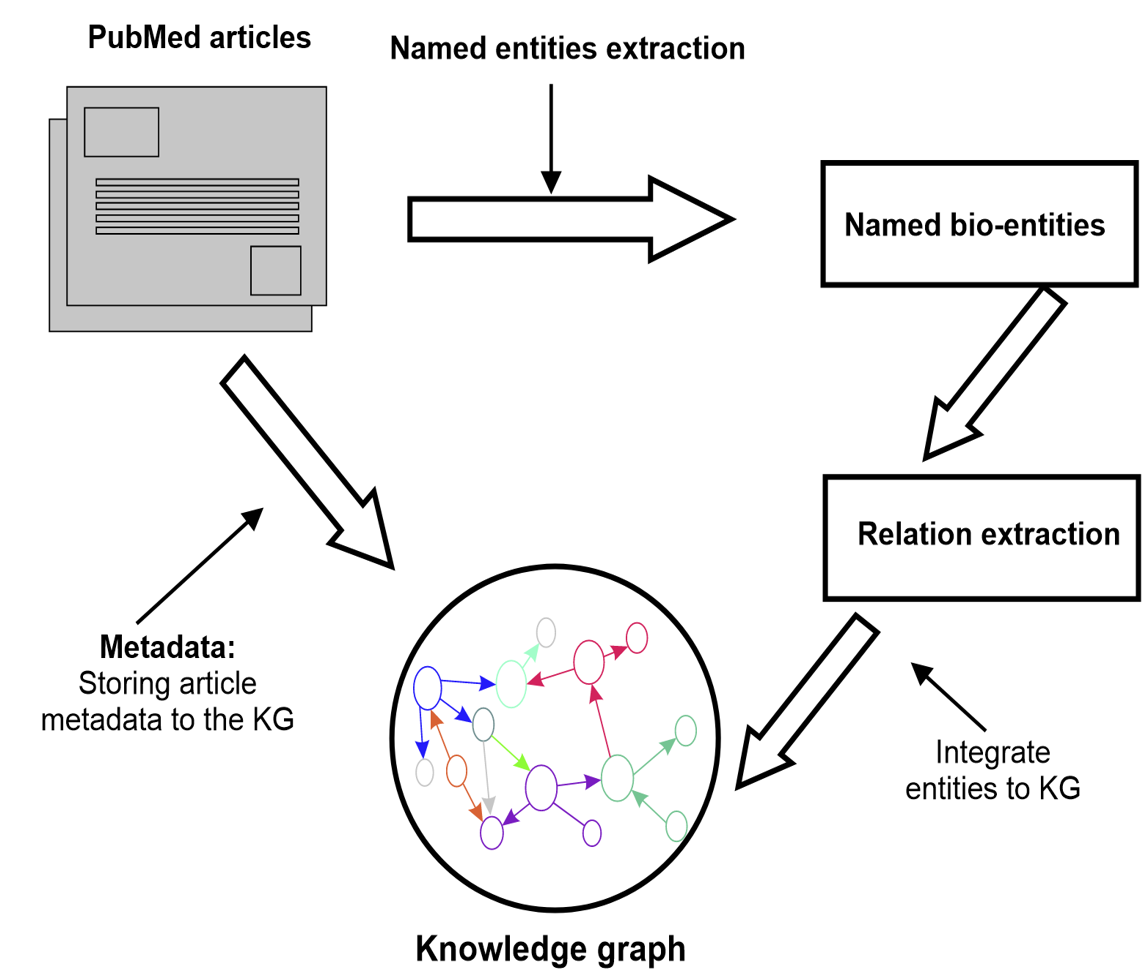
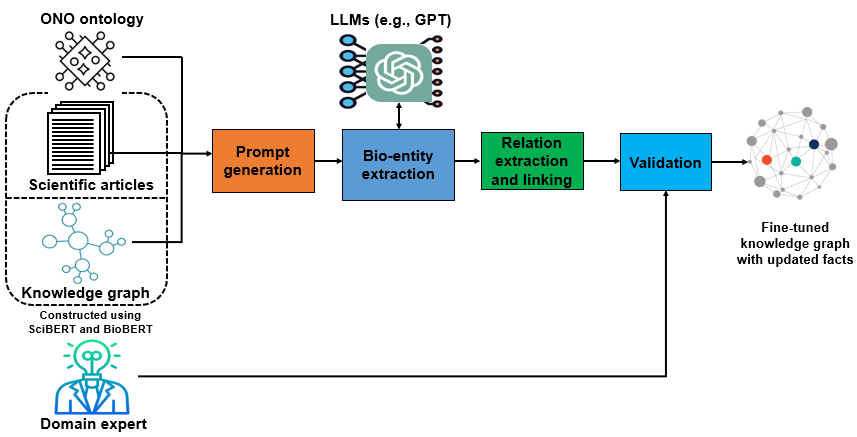
技术框架:整体架构包括数据收集、OncoNet本体构建、信息提取(使用BioBERT和SciBERT)、知识图谱构建及微调阶段。主要模块包括本体设计、数据整合和知识更新。
关键创新:最重要的创新在于结合大型语言模型对知识图谱进行微调,以应对生物医学领域的快速变化,确保AI系统提供最新的诊断和治疗建议。
关键设计:在本体设计中,采用了控制词汇和元数据的标准化,信息提取过程中使用了BioBERT和SciBERT模型,以提高信息提取的准确性和效率。知识图谱的更新机制确保了系统能够及时反映最新的科学发现。
🖼️ 关键图片
📊 实验亮点
实验结果表明,微调后的知识图谱在癌症诊断和治疗推荐中的准确性显著提高,具体性能数据尚未披露,但与传统方法相比,提升幅度明显,表明该方法在实际应用中具有较高的价值。
🎯 应用场景
该研究的潜在应用领域包括癌症研究、临床决策支持和个性化医疗。通过提供一个集成的知识图谱,领域专家可以更高效地发现生物标志物,进而改善癌症的预防和治疗策略。未来,该方法有望扩展到其他疾病领域,推动生物医学研究的进步。
📄 摘要(原文)
Domain experts often rely on most recent knowledge for apprehending and disseminating specific biological processes that help them design strategies for developing prevention and therapeutic decision-making in various disease scenarios. A challenging scenarios for artificial intelligence (AI) is using biomedical data (e.g., texts, imaging, omics, and clinical) to provide diagnosis and treatment recommendations for cancerous conditions.~Data and knowledge about biomedical entities like cancer, drugs, genes, proteins, and their mechanism is spread across structured (knowledge bases (KBs)) and unstructured (e.g., scientific articles) sources. A large-scale knowledge graph (KG) can be constructed by integrating and extracting facts about semantically interrelated entities and relations. Such a KG not only allows exploration and question answering (QA) but also enables domain experts to deduce new knowledge. However, exploring and querying large-scale KGs is tedious for non-domain users due to their lack of understanding of the data assets and semantic technologies. In this paper, we develop a domain KG to leverage cancer-specific biomarker discovery and interactive QA. For this, we constructed a domain ontology called OncoNet Ontology (ONO), which enables semantic reasoning for validating gene-disease (different types of cancer) relations. The KG is further enriched by harmonizing the ONO, metadata, controlled vocabularies, and biomedical concepts from scientific articles by employing BioBERT- and SciBERT-based information extractors. Further, since the biomedical domain is evolving, where new findings often replace old ones, without having access to up-to-date scientific findings, there is a high chance an AI system exhibits concept drift while providing diagnosis and treatment. Therefore, we fine-tune the KG using large language models (LLMs) based on more recent articles and KBs.