$\mathcal{B}$-Coder: Value-Based Deep Reinforcement Learning for Program Synthesis
作者: Zishun Yu, Yunzhe Tao, Liyu Chen, Tao Sun, Hongxia Yang
分类: cs.CL
发布日期: 2023-10-04 (更新: 2024-03-18)
💡 一句话要点
提出$ ext{B}$-Coder以解决程序合成中的价值优化问题
🎯 匹配领域: 支柱二:RL算法与架构 (RL & Architecture) 支柱九:具身大模型 (Embodied Foundation Models)
关键词: 程序合成 强化学习 价值优化 代码生成 自动化编程
📋 核心要点
- 现有的程序合成方法主要依赖于基于策略的强化学习,存在训练复杂度高和奖励设计困难的问题。
- 本文提出的$ ext{B}$-Coder利用预训练语言模型和保守贝尔曼算子,探索基于价值的强化学习在程序合成中的应用。
- 实验结果显示,$ ext{B}$-Coder在性能上达到了最先进水平,相较于基于策略的方法,提升显著且无需复杂的奖励工程。
📝 摘要(中文)
程序合成旨在根据问题规范生成准确且可执行的程序,尤其是自然语言描述。近年来,强化学习(RL)与大型语言模型(LLMs)的结合显著提升了代码生成能力。尽管现有研究主要集中在基于策略的RL方法上,但程序合成任务与基于价值的方法更为契合。本文提出了$ ext{B}$-Coder,探索了基于价值的RL在程序合成中的可行性,并通过引入预训练语言模型的初始化协议和保守的贝尔曼算子来简化训练过程。实验结果表明,$ ext{B}$-Coder在性能上超越了基于策略的方法,且在奖励设计上几乎无需额外努力,突显了基于价值的RL的有效性。
🔬 方法详解
问题定义:本文解决的是程序合成中的价值优化问题,现有的基于策略的强化学习方法在训练复杂度和奖励设计上存在显著挑战。
核心思路:论文提出的$ ext{B}$-Coder探索基于价值的强化学习,利用丰富的离线程序样本和自动化单元测试的简单奖励获取机制,旨在优化功能正确性。
技术框架:整体架构包括初始化协议、基于价值的训练模块和后处理策略。初始化协议使用预训练的语言模型,训练模块采用保守的贝尔曼算子,后处理策略利用学习到的价值函数进行程序优化。
关键创新:最重要的创新在于将基于价值的强化学习应用于程序合成,显著降低了训练复杂度,并通过简单的奖励机制实现了有效的功能优化。
关键设计:关键设计包括使用预训练语言模型进行初始化,保守贝尔曼算子的引入,以及对生成程序的后处理策略,这些设计共同提升了训练效率和生成程序的质量。
🖼️ 关键图片


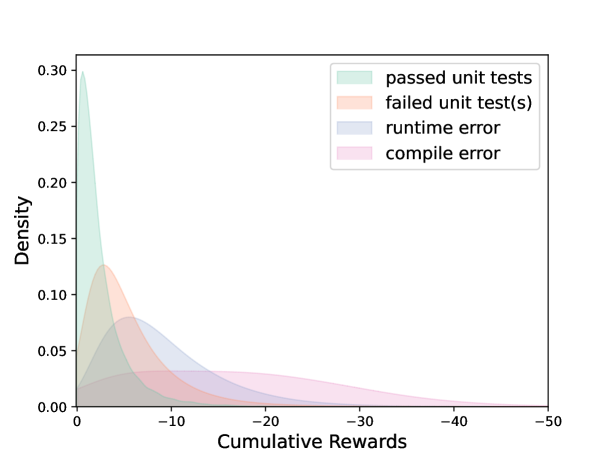
📊 实验亮点
实验结果表明,$ ext{B}$-Coder在程序合成任务中达到了最先进的性能,相较于传统的基于策略的方法,性能提升幅度显著,且在奖励设计上几乎无需额外努力,展示了基于价值的强化学习的强大潜力。
🎯 应用场景
该研究在程序合成领域具有广泛的应用潜力,能够为自动化编程、代码生成工具和软件开发辅助系统提供支持。未来,随着技术的进一步发展,$ ext{B}$-Coder可能会在智能编程助手和代码审查等领域发挥重要作用。
📄 摘要(原文)
Program synthesis aims to create accurate, executable programs from problem specifications, specifically from natural language descriptions in our context. Recent studies have leveraged the power of reinforcement learning (RL) in conjunction with large language models (LLMs), significantly enhancing code generation capabilities. The application of RL focuses on directly optimizing for functional correctness, offering an advantage over conventional supervised methods. Despite policy-based RL methods dominating the literature on RL for program synthesis, the nature of program synthesis tasks hints at a natural alignment with value-based methods. This stems from the rich collection of off-policy programs, including those developed by human programmers and also historical samples, coupled with the straightforward verification of generated programs through automated unit testing, meaning rewards are easy to obtain. Diverging from the dominant use of policy-based algorithms, our work explores the feasibility of value-based approaches, leading to the development of our $\mathcal{B}$-Coder (pronounced Bellman coder). Yet, training value-based methods presents challenges due to the enormous search space inherent to program synthesis. To this end, we introduce an initialization protocol for RL agents utilizing pre-trained LMs and a conservative Bellman operator to reduce training complexities. Moreover, we demonstrate how to leverage the learned value functions as a dual strategy to post-process generated programs. Our empirical evaluations demonstrated $\mathcal{B}$-Coder's capability in achieving state-of-the-art performance when compared to policy-based methods. Remarkably, this achievement is reached with minimal reward engineering effort, highlighting the effectiveness of value-based RL, independent of reward designs.