OceanGPT: A Large Language Model for Ocean Science Tasks
作者: Zhen Bi, Ningyu Zhang, Yida Xue, Yixin Ou, Daxiong Ji, Guozhou Zheng, Huajun Chen
分类: cs.CL, cs.AI, cs.CE, cs.LG, cs.RO
发布日期: 2023-10-03 (更新: 2024-09-03)
备注: ACL2024. Project Website: http://oceangpt.zjukg.cn/
💡 一句话要点
提出OceanGPT以解决海洋科学领域的语言模型不足问题
🎯 匹配领域: 支柱九:具身大模型 (Embodied Foundation Models)
关键词: 海洋科学 大型语言模型 多智能体协作 知识专业性 具身智能 海洋数据分析 海洋生态监测
📋 核心要点
- 现有的语言模型在海洋科学领域的应用不足,无法满足海洋学家的专业需求,尤其是在处理复杂的海洋数据时。
- 本文提出OceanGPT,通过多智能体协作自动生成海洋领域的指令数据,填补了海洋科学任务中的知识空白。
- 实验表明,OceanGPT在海洋科学任务中展现出更高的知识专业性,并在海洋技术中具备初步的具身智能能力。
📝 摘要(中文)
海洋科学研究涉及生命和生物多样性的宝贵资源,海洋覆盖了地球表面的70%以上。尽管大型语言模型(LLMs)在多个领域取得了成功,但现有的LLMs在满足海洋学家等领域专家的需求方面仍显不足。为了解决这一问题,本文提出了OceanGPT,这是首个专注于海洋科学任务的大型语言模型。此外,论文还提出了一种新颖的框架,通过多智能体协作自动获取大量海洋领域的指令数据,并构建了首个海洋学基准OceanBench,以评估LLMs在海洋领域的能力。实验结果表明,OceanGPT在海洋科学任务中展现出更高的知识专业性,并在海洋技术中获得了初步的具身智能能力。
🔬 方法详解
问题定义:本文旨在解决现有大型语言模型在海洋科学领域应用不足的问题,特别是面对复杂的海洋数据和专业知识的缺乏。
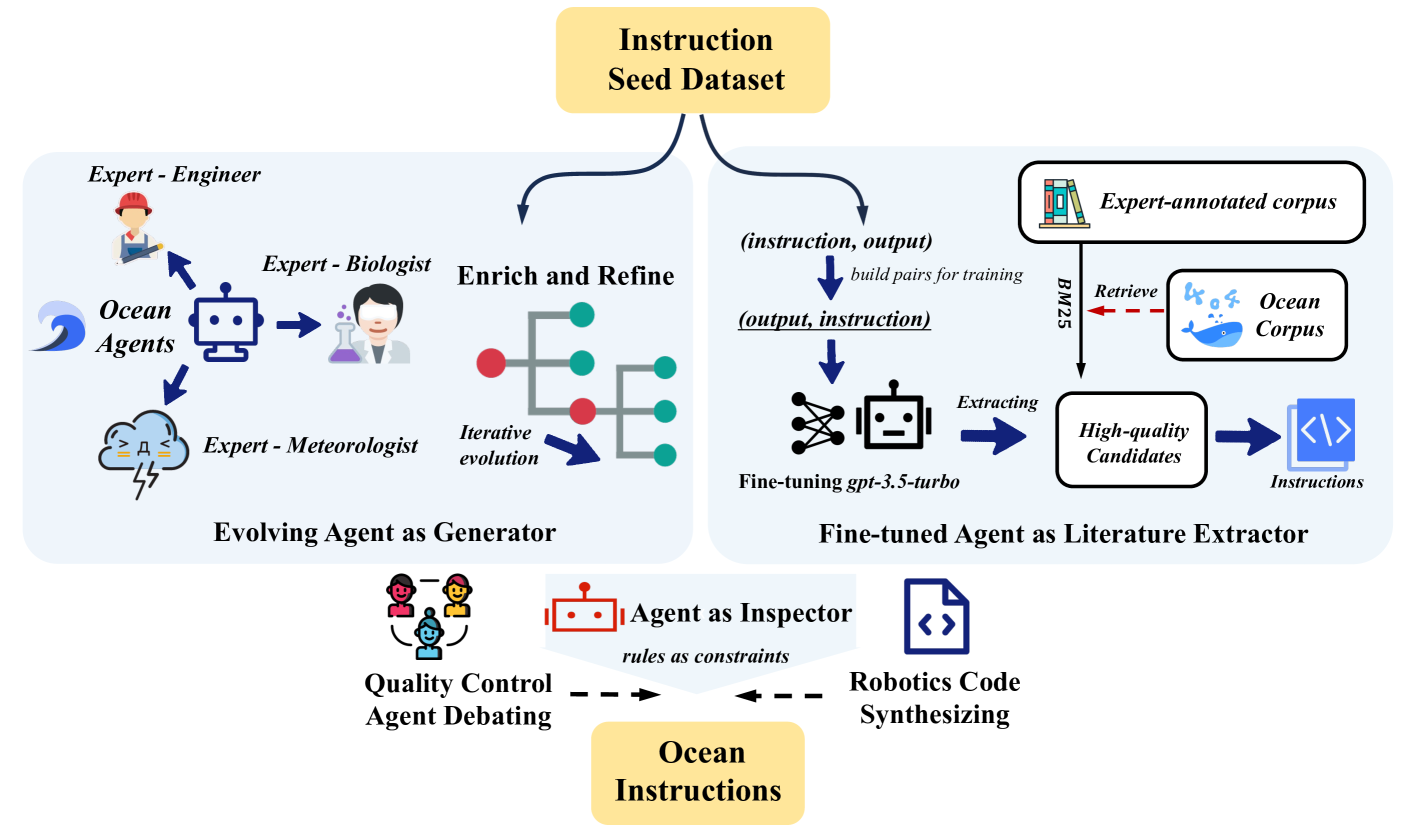
核心思路:OceanGPT通过多智能体协作生成海洋领域的指令数据,旨在提高模型在海洋科学任务中的表现和专业性。
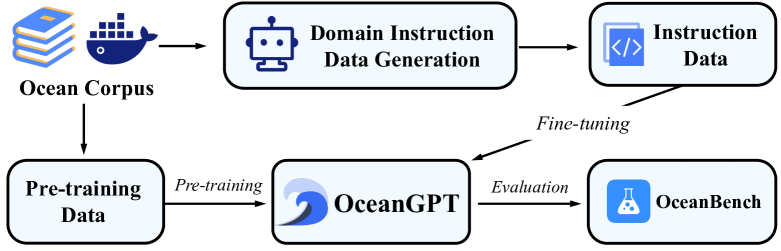
技术框架:OceanGPT的整体架构包括数据收集、指令生成和模型训练三个主要模块。首先,通过多智能体协作获取海洋领域的指令数据,然后利用这些数据训练模型,最后进行性能评估。
关键创新:OceanGPT是首个针对海洋科学任务的大型语言模型,具有更高的知识专业性和初步的具身智能能力,这与现有模型的通用性形成鲜明对比。
关键设计:在模型设计中,采用了特定的损失函数和网络结构,以适应海洋科学领域的复杂数据特性,并通过精细的参数设置优化模型性能。
🖼️ 关键图片

📊 实验亮点
实验结果显示,OceanGPT在多个海洋科学任务中表现优异,相较于基线模型,其知识专业性提升显著,并在具身智能能力方面取得初步进展,展现出更强的应用潜力。
🎯 应用场景
OceanGPT的潜在应用场景包括海洋数据分析、海洋生态监测、海洋资源管理等领域。其实际价值在于为海洋科学研究提供更为精准的工具,推动海洋科学的进步与发展,未来可能对海洋保护和可持续发展产生深远影响。
📄 摘要(原文)
Ocean science, which delves into the oceans that are reservoirs of life and biodiversity, is of great significance given that oceans cover over 70% of our planet's surface. Recently, advances in Large Language Models (LLMs) have transformed the paradigm in science. Despite the success in other domains, current LLMs often fall short in catering to the needs of domain experts like oceanographers, and the potential of LLMs for ocean science is under-explored. The intrinsic reasons are the immense and intricate nature of ocean data as well as the necessity for higher granularity and richness in knowledge. To alleviate these issues, we introduce OceanGPT, the first-ever large language model in the ocean domain, which is expert in various ocean science tasks. We also propose OceanGPT, a novel framework to automatically obtain a large volume of ocean domain instruction data, which generates instructions based on multi-agent collaboration. Additionally, we construct the first oceanography benchmark, OceanBench, to evaluate the capabilities of LLMs in the ocean domain. Though comprehensive experiments, OceanGPT not only shows a higher level of knowledge expertise for oceans science tasks but also gains preliminary embodied intelligence capabilities in ocean technology.