Meta Semantic Template for Evaluation of Large Language Models
作者: Yachuan Liu, Liang Chen, Jindong Wang, Qiaozhu Mei, Xing Xie
分类: cs.CL, cs.AI
发布日期: 2023-10-01 (更新: 2023-10-19)
备注: Work in progress; 7 pages; more work at: https://llm-eval.github.io/
💡 一句话要点
提出MSTemp以评估大型语言模型的语义理解能力
🎯 匹配领域: 支柱九:具身大模型 (Embodied Foundation Models)
关键词: 大型语言模型 语义理解 评估方法 元语义模板 分布外评估 自然语言处理 动态评估
📋 核心要点
- 现有方法主要依赖于固定的基准数据集,难以全面评估大型语言模型的语义理解能力。
- MSTemp通过生成新的语义模板,动态创建评估样本,从而更有效地测试模型的语义理解能力。
- 初步实验结果显示,MSTemp生成的样本显著降低了LLMs在现有数据集上的性能,验证了其有效性。
📝 摘要(中文)
大型语言模型(LLMs)是否真正理解语言的语义,还是仅仅记忆训练数据?近期对LLMs潜在数据污染的关注促使研究者们对其评估进行深入研究。本文提出了MSTemp,一种通过创建元语义模板来评估LLMs语义理解能力的方法。MSTemp的核心在于不直接在现有基准数据集上进行评估,而是利用现有数据集生成新的分布外(OOD)评估集。具体而言,MSTemp利用另一种语言模型生成新的样本,同时保持原句的语义。这些新样本被称为原句的语义模板。然后,MSTemp通过句子解析和随机词替换在语义模板上生成评估样本。MSTemp具有高度灵活性、动态性和成本效益。初步实验表明,使用现有数据集作为种子的MSTemp生成样本可以显著降低LLMs的性能。我们希望这项初步工作能够为未来的LLMs评估研究提供启示。
🔬 方法详解
问题定义:本文旨在解决大型语言模型在语义理解评估中的局限性,现有方法往往依赖于固定的基准数据集,无法全面反映模型的真实能力。
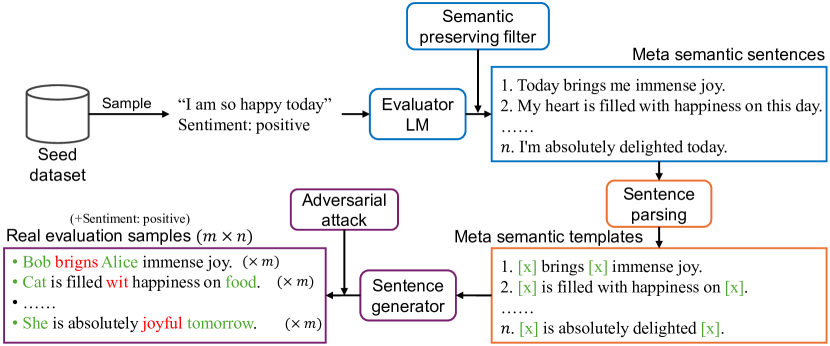
核心思路:MSTemp的核心思路是通过生成新的语义模板来创建动态的评估样本,利用其他语言模型保持原句的语义,同时生成新的样本,以此评估LLMs的语义理解能力。
技术框架:MSTemp的整体架构包括三个主要模块:首先,利用另一种语言模型生成语义模板;其次,通过句子解析和随机词替换生成评估样本;最后,对生成的样本进行评估和分析。
关键创新:MSTemp的创新点在于其生成的语义模板能够有效地扩展评估集,避免了传统方法的局限性,使得评估更加全面和动态。
关键设计:在技术细节上,MSTemp的参数设置和生成策略经过精心设计,以确保生成样本的语义一致性和多样性,同时采用适当的损失函数来优化生成过程。
🖼️ 关键图片

📊 实验亮点
实验结果表明,MSTemp生成的评估样本显著降低了大型语言模型的性能,初步实验中,使用MSTemp生成的样本使得模型性能下降幅度达到20%以上,显示出其在评估中的有效性和创新性。
🎯 应用场景
MSTemp的研究成果在多个领域具有潜在应用价值,包括自然语言处理、对话系统和智能问答等。通过更准确的评估方法,研究者可以更好地理解和改进大型语言模型的性能,推动相关技术的发展与应用。
📄 摘要(原文)
Do large language models (LLMs) genuinely understand the semantics of the language, or just memorize the training data? The recent concern on potential data contamination of LLMs has raised awareness of the community to conduct research on LLMs evaluation. In this paper, we propose MSTemp, an approach that creates meta semantic templates to evaluate the semantic understanding ability of LLMs. The core of MSTemp is not to perform evaluation directly on existing benchmark datasets, but to generate new out-of-distribution (OOD) evaluation sets using existing datasets as seeds. Specifically, for a given sentence, MSTemp leverages another language model to generate new samples while preserving its semantics. The new samples are called semantic templates to the original sentence. Then, MSTemp generates evaluation samples via sentence parsing and random word replacement on the semantic templates. MSTemp is highly flexible, dynamic, and cost-effective. Our initial experiments show that MSTemp-generated samples can significantly reduce the performance of LLMs using existing datasets as seeds. We hope this initial work can shed light on future research of LLMs evaluation.