Agentic Problem Frames: A Systematic Approach to Engineering Reliable Domain Agents
作者: Chanjin Park
分类: cs.AI
发布日期: 2026-02-22
备注: 18 pages, 2 figures
💡 一句话要点
提出Agentic Problem Frames框架,提升领域Agent的可靠性与可验证性
🎯 匹配领域: 支柱九:具身大模型 (Embodied Foundation Models)
关键词: Agentic Problem Frames 大型语言模型 自主Agent 可靠性工程 闭环控制
📋 核心要点
- 现有Agent开发方法缺乏结构化工程蓝图,依赖模糊自然语言,导致Agent行为不可控和可靠性问题。
- Agentic Problem Frames (APF) 框架通过结构化Agent与环境的交互,实现运行时意图具体化和闭环控制。
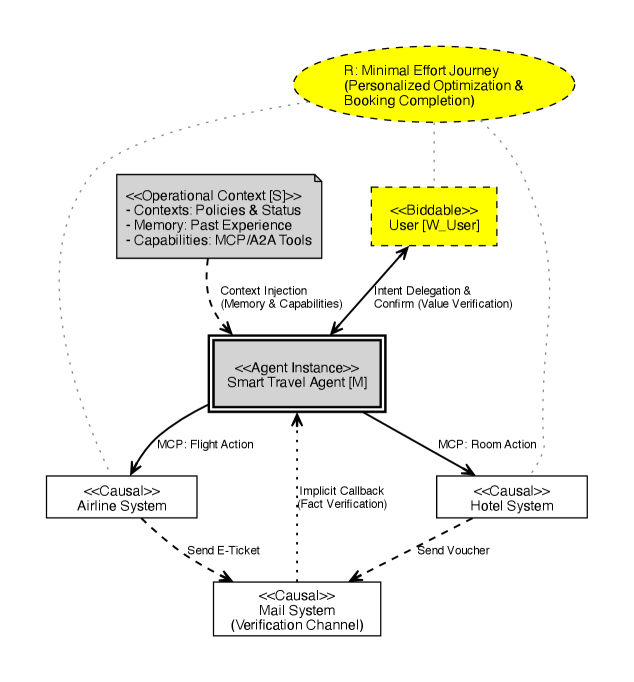
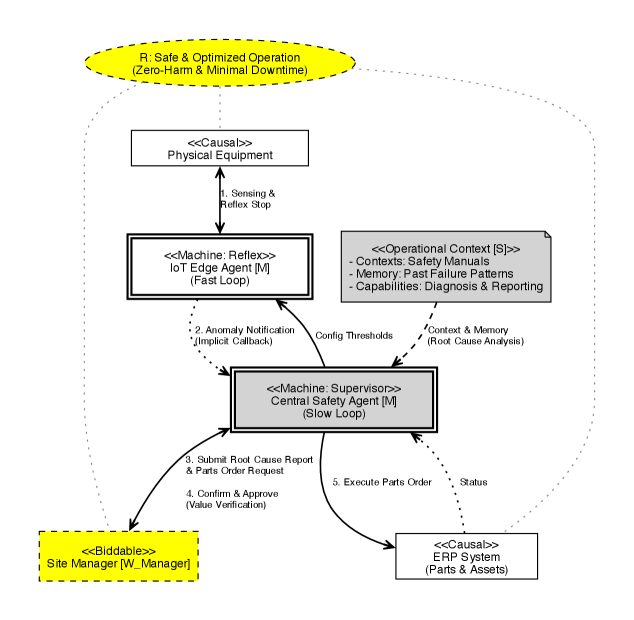
- 通过商务旅行代理和工业设备管理案例研究,验证了APF框架在提升Agent可靠性和可控性方面的有效性。
📝 摘要(中文)
大型语言模型(LLM)正发展为自主Agent,但当前“无框架”开发依赖于模糊的自然语言,缺乏工程蓝图,导致范围蔓延和开环失效等严重风险。为确保工业级可靠性,本研究提出Agentic Problem Frames(APF),一种系统工程框架,将重点从内部模型智能转移到Agent与环境之间的结构化交互。APF建立了一种动态规范范式,通过领域知识注入在运行时具体化意图。核心的Act-Verify-Refine(AVR)循环作为一个闭环控制系统,将执行结果转化为经过验证的知识资产,驱动系统行为渐近收敛于任务需求(R)。为实现这一点,本研究引入Agentic Job Description(AJD),一种形式化规范工具,用于定义管辖边界、操作上下文和认知评估标准。通过两个对比案例研究验证了该框架的有效性:一个是商务旅行的委托代理模型,另一个是工业设备管理的自主监督模型。通过将基于AJD的规范和APF建模应用于这些场景,分析表明操作场景如何在定义的边界内得到系统控制。这些案例提供了一个概念证明,即Agent的可靠性并非仅源于模型的内部推理,而是源于将随机AI锚定在确定性业务流程中的严格工程结构,从而能够开发可验证和可靠的领域Agent。
🔬 方法详解
问题定义:当前基于大型语言模型的Agent开发面临可靠性问题,主要原因是缺乏结构化的工程方法。现有方法依赖自然语言描述,导致Agent行为难以预测和验证,容易出现范围蔓延和开环失效等问题。因此,需要一种系统化的方法来规范Agent的行为,确保其在特定领域内的可靠性和可控性。
核心思路:论文的核心思路是将Agent的开发从关注模型内部智能转移到关注Agent与环境之间的结构化交互。通过引入Agentic Problem Frames (APF) 框架,将Agent的行为置于明确的边界和规范之下,实现运行时意图具体化和闭环控制。这种方法强调Agent与环境的互动,并通过反馈机制不断优化Agent的行为,使其逐渐收敛于任务需求。
技术框架:APF框架包含以下几个关键组成部分:Agentic Job Description (AJD) 用于形式化描述Agent的任务、边界和评估标准;Act-Verify-Refine (AVR) 循环作为闭环控制系统,驱动Agent的行为优化;领域知识注入机制,用于在运行时将领域知识融入Agent的行为中。整体流程是,首先使用AJD定义Agent的任务,然后Agent执行任务(Act),对执行结果进行验证(Verify),并根据验证结果进行优化(Refine),不断循环直到Agent的行为满足任务需求。
关键创新:APF框架的关键创新在于其系统化的工程方法,将Agent的开发从黑盒模型训练转变为可控的工程过程。通过引入AJD和AVR循环,实现了Agent行为的规范化和优化,从而提高了Agent的可靠性和可验证性。与现有方法相比,APF框架更加注重Agent与环境的交互,并通过反馈机制不断优化Agent的行为,使其更加适应特定领域的需求。
关键设计:Agentic Job Description (AJD) 包含管辖边界、操作上下文和认知评估标准等关键要素,用于明确Agent的任务范围和评估标准。Act-Verify-Refine (AVR) 循环的具体实现方式取决于具体的应用场景,但其核心思想是通过反馈机制不断优化Agent的行为。领域知识注入机制可以通过多种方式实现,例如使用知识图谱、规则引擎等。
🖼️ 关键图片
📊 实验亮点
通过商务旅行代理和工业设备管理两个案例研究,验证了APF框架的有效性。在这些案例中,通过应用AJD规范和APF建模,实现了对Agent行为的系统控制,证明了Agent的可靠性并非仅源于模型内部推理,而是源于严格的工程结构。虽然论文中没有给出具体的性能数据,但案例研究表明APF框架可以显著提高Agent的可靠性和可控性。
🎯 应用场景
该研究成果可应用于各种需要可靠和可控Agent的领域,例如智能客服、自动化流程管理、工业设备监控等。通过APF框架,可以开发出在特定领域内表现稳定、行为可预测的Agent,从而提高工作效率和降低风险。未来,该框架可以进一步扩展到更复杂的场景,例如多Agent协作、跨领域知识迁移等。
📄 摘要(原文)
Large Language Models (LLMs) are evolving into autonomous agents, yet current "frameless" development--relying on ambiguous natural language without engineering blueprints--leads to critical risks such as scope creep and open-loop failures. To ensure industrial-grade reliability, this study proposes Agentic Problem Frames (APF), a systematic engineering framework that shifts focus from internal model intelligence to the structured interaction between the agent and its environment. The APF establishes a dynamic specification paradigm where intent is concretized at runtime through domain knowledge injection. At its core, the Act-Verify-Refine (AVR) loop functions as a closed-loop control system that transforms execution results into verified knowledge assets, driving system behavior toward asymptotic convergence to mission requirements (R). To operationalize this, this study introduces the Agentic Job Description (AJD), a formal specification tool that defines jurisdictional boundaries, operational contexts, and epistemic evaluation criteria. The efficacy of this framework is validated through two contrasting case studies: a delegated proxy model for business travel and an autonomous supervisor model for industrial equipment management. By applying AJD-based specification and APF modeling to these scenarios, the analysis demonstrates how operational scenarios are systematically controlled within defined boundaries. These cases provide a conceptual proof that agent reliability stems not from a model's internal reasoning alone, but from the rigorous engineering structures that anchor stochastic AI within deterministic business processes, thereby enabling the development of verifiable and dependable domain agents.