AgriWorld:A World Tools Protocol Framework for Verifiable Agricultural Reasoning with Code-Executing LLM Agents
作者: Zhixing Zhang, Jesen Zhang, Hao Liu, Qinhan Lv, Jing Yang, Kaitong Cai, Keze Wang
分类: cs.AI
发布日期: 2026-02-17
💡 一句话要点
提出AgriWorld框架以解决农业推理与交互能力不足的问题
🎯 匹配领域: 支柱八:物理动画 (Physics-based Animation) 支柱九:具身大模型 (Embodied Foundation Models)
关键词: 农业推理 大语言模型 执行驱动反思 多轮交互 精准农业 数据分析 智能农业
📋 核心要点
- 现有农业模型在语言推理和交互能力上存在不足,限制了其在实际应用中的有效性。
- 提出AgriWorld框架,结合Python执行环境与多轮LLM代理Agro-Reflective,增强农业数据的推理与交互能力。
- 实验结果显示,Agro-Reflective在农业问答任务中超越了文本和直接工具使用的基线,验证了其有效性。
📝 摘要(中文)
农业基础模型在处理大规模时空数据(如多光谱遥感、土壤网格和田间管理日志)方面表现出色,但缺乏语言推理和交互能力,限制了其在实际农业工作流中的应用。本文提出了一个农业科学的代理框架AgriWorld,提供Python执行环境,统一了地理空间查询、遥感时间序列分析、作物生长模拟等工具。基于该环境,设计了多轮LLM代理Agro-Reflective,通过执行-观察-反思循环迭代生成代码并优化分析。此外,构建了AgroBench,支持多样化的农业问答任务。实验结果表明,该方法在文本和直接工具使用基线之上具有显著优势,验证了执行驱动的反思在可靠农业推理中的有效性。
🔬 方法详解
问题定义:本文旨在解决现有农业基础模型在语言推理和交互能力上的不足,导致其在实际农业工作流中的应用受限。
核心思路:通过构建AgriWorld框架,结合Python执行环境与多轮LLM代理Agro-Reflective,实现对高维异构农业数据的有效推理与交互。该设计使得模型能够在执行代码的同时进行反思与优化。
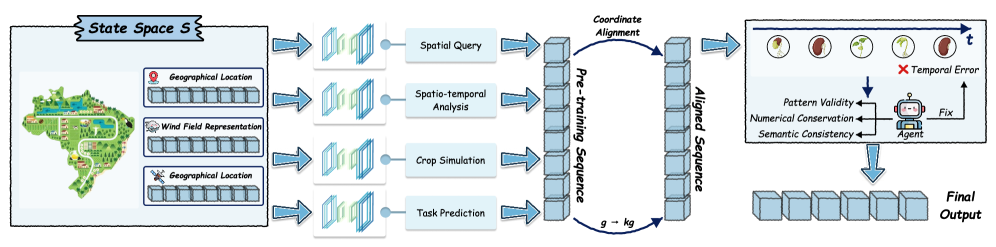
技术框架:整体架构包括AgriWorld执行环境、统一工具集、Agro-Reflective代理和AgroBench数据生成模块。AgriWorld提供地理空间查询、遥感分析等功能,Agro-Reflective通过执行-观察-反思循环进行多轮交互。
关键创新:最重要的创新在于将代码执行与语言推理结合,形成执行驱动的反思机制,显著提升了农业推理的可靠性和有效性。
关键设计:在设计中,Agro-Reflective代理采用多轮交互策略,能够根据执行结果不断优化分析过程,关键参数设置和损失函数设计旨在提高推理的准确性与效率。
🖼️ 关键图片
📊 实验亮点
实验结果表明,Agro-Reflective在农业问答任务中表现优异,超越了文本基础和直接工具使用的基线,验证了执行驱动反思的有效性,提升幅度显著,具体性能数据未知。
🎯 应用场景
该研究的潜在应用领域包括精准农业、作物管理和农业决策支持系统。通过增强农业模型的推理与交互能力,AgriWorld框架能够帮助农民和农业专家更有效地进行数据分析和决策,推动农业生产的智能化与可持续发展。
📄 摘要(原文)
Foundation models for agriculture are increasingly trained on massive spatiotemporal data (e.g., multi-spectral remote sensing, soil grids, and field-level management logs) and achieve strong performance on forecasting and monitoring. However, these models lack language-based reasoning and interactive capabilities, limiting their usefulness in real-world agronomic workflows. Meanwhile, large language models (LLMs) excel at interpreting and generating text, but cannot directly reason over high-dimensional, heterogeneous agricultural datasets. We bridge this gap with an agentic framework for agricultural science. It provides a Python execution environment, AgriWorld, exposing unified tools for geospatial queries over field parcels, remote-sensing time-series analytics, crop growth simulation, and task-specific predictors (e.g., yield, stress, and disease risk). On top of this environment, we design a multi-turn LLM agent, Agro-Reflective, that iteratively writes code, observes execution results, and refines its analysis via an execute-observe-refine loop. We introduce AgroBench, with scalable data generation for diverse agricultural QA spanning lookups, forecasting, anomaly detection, and counterfactual "what-if" analysis. Experiments outperform text-only and direct tool-use baselines, validating execution-driven reflection for reliable agricultural reasoning.