SemaPop: Semantic-Persona Conditioned Population Synthesis
作者: Zhenlin Qin, Yancheng Ling, Leizhen Wang, Francisco Câmara Pereira, Zhenliang Ma
分类: cs.AI
发布日期: 2026-02-12
💡 一句话要点
SemaPop:提出一种语义-角色条件的人口合成方法,融合LLM与生成模型。
🎯 匹配领域: 支柱九:具身大模型 (Embodied Foundation Models)
关键词: 人口合成 生成对抗网络 大型语言模型 语义建模 社会经济模拟
📋 核心要点
- 现有的人口合成方法难以捕捉调查数据中隐含的抽象行为模式,缺乏语义信息的有效利用。
- SemaPop模型利用大型语言模型提取个体调查记录中的高级角色表示,作为语义条件信号指导人口生成。
- 实验表明,SemaPop-GAN在保持样本可行性和多样性的同时,能更好地对齐目标边际和联合分布。
📝 摘要(中文)
人口合成是个体层面社会经济模拟的关键组成部分,但由于需要联合表示统计结构和潜在行为语义,因此仍然具有挑战性。现有的人口合成方法主要依赖于结构化属性和统计约束,在语义条件人口生成方面存在空白,无法捕捉调查数据中隐含的抽象行为模式。本研究提出了SemaPop,一种语义-统计人口合成模型,它将大型语言模型(LLM)与生成人口建模相结合。SemaPop从个体调查记录中提取高级角色表示,并将其作为人口生成的语义条件信号,同时引入边际正则化以强制与目标人口边际对齐。在本研究中,该框架使用带有梯度惩罚的Wasserstein GAN(WGAN-GP)骨干来实现,称为SemaPop-GAN。大量实验表明,SemaPop-GAN实现了改进的生成性能,在语义条件下产生与目标边际和联合分布更紧密的对齐,同时保持样本层面的可行性和多样性。消融研究进一步证实了语义角色条件和架构设计选择对平衡边际一致性和结构真实性的贡献。这些结果表明,SemaPop-GAN通过有效的语义-统计信息融合,实现了可控和可解释的人口合成。SemaPop-GAN还为开发生成人口预测系统提供了一个有希望的模块化基础,该系统将个体层面的行为语义与人口层面的统计约束相结合。
🔬 方法详解
问题定义:人口合成旨在生成一个与真实人口统计特征相似的合成人口,用于社会经济模拟等应用。现有方法主要依赖结构化属性和统计约束,忽略了调查数据中蕴含的个体行为语义信息,导致合成人口的行为模式不够真实。
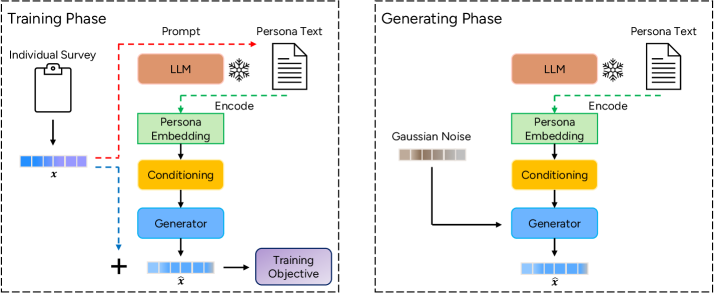
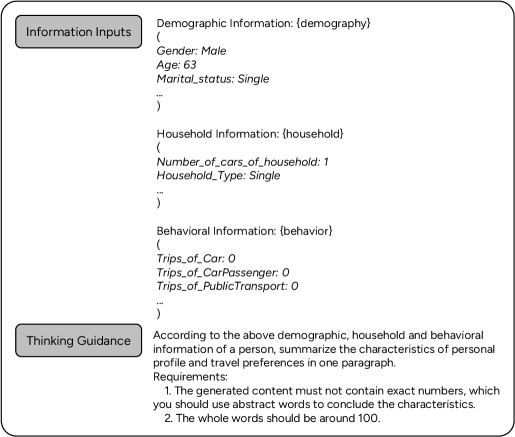
核心思路:SemaPop的核心思路是将大型语言模型(LLM)提取的个体行为语义信息融入到人口生成过程中。通过LLM将个体调查记录转换为高级角色表示,作为生成模型的条件输入,从而引导生成具有特定行为模式的人口。
技术框架:SemaPop采用生成对抗网络(GAN)框架,具体使用了Wasserstein GAN with gradient penalty (WGAN-GP) 作为骨干网络,命名为SemaPop-GAN。整体流程包括:1) 使用LLM从个体调查记录中提取语义角色表示;2) 将角色表示作为条件输入,输入到WGAN-GP的生成器中;3) 使用边际正则化损失函数,确保生成的人口与目标人口的边际分布对齐。
关键创新:SemaPop的关键创新在于将大型语言模型与生成人口建模相结合,实现了语义条件的人口合成。通过LLM提取个体行为语义,并将其作为生成模型的条件输入,从而生成更真实、更具行为模式的人口。这是与现有方法仅依赖统计约束的本质区别。
关键设计:SemaPop-GAN的关键设计包括:1) 使用LLM(具体使用细节未知)进行语义角色提取;2) 使用WGAN-GP作为生成模型,以提高生成样本的质量和稳定性;3) 引入边际正则化损失函数,以确保生成的人口与目标人口的边际分布对齐。边际正则化损失函数的具体形式未知。
🖼️ 关键图片

📊 实验亮点
实验结果表明,SemaPop-GAN在生成性能上优于现有方法,能够更好地对齐目标边际和联合分布,同时保持样本层面的可行性和多样性。消融实验证实了语义角色条件和架构设计选择对平衡边际一致性和结构真实性的贡献。具体的性能提升数据未知。
🎯 应用场景
SemaPop可应用于社会经济模拟、城市规划、公共卫生政策制定等领域。通过生成更真实、更具行为模式的人口,可以提高模拟结果的准确性和可靠性,为决策者提供更有效的支持。未来可用于构建生成式人口预测系统,结合个体行为语义和人口统计约束,进行更精细化的人口预测。
📄 摘要(原文)
Population synthesis is a critical component of individual-level socio-economic simulation, yet remains challenging due to the need to jointly represent statistical structure and latent behavioral semantics. Existing population synthesis approaches predominantly rely on structured attributes and statistical constraints, leaving a gap in semantic-conditioned population generation that can capture abstract behavioral patterns implicitly in survey data. This study proposes SemaPop, a semantic-statistical population synthesis model that integrates large language models (LLMs) with generative population modeling. SemaPop derives high-level persona representations from individual survey records and incorporates them as semantic conditioning signals for population generation, while marginal regularization is introduced to enforce alignment with target population marginals. In this study, the framework is instantiated using a Wasserstein GAN with gradient penalty (WGAN-GP) backbone, referred to as SemaPop-GAN. Extensive experiments demonstrate that SemaPop-GAN achieves improved generative performance, yielding closer alignment with target marginal and joint distributions while maintaining sample-level feasibility and diversity under semantic conditioning. Ablation studies further confirm the contribution of semantic persona conditioning and architectural design choices to balancing marginal consistency and structural realism. These results demonstrate that SemaPop-GAN enables controllable and interpretable population synthesis through effective semantic-statistical information fusion. SemaPop-GAN also provides a promising modular foundation for developing generative population projection systems that integrate individual-level behavioral semantics with population-level statistical constraints.