Lemon Agent Technical Report
作者: Haipeng Jiang, Kailong Ren, Zimo Yin, Zhetao Sun, Xin Gan, Guangyi Lv, Ming He, Peng Wang, Congli Yin, Hong Pan, Changwen Zhang, Shan Tong, Zhengyu Xu, Zeping Chen, Yubin Huangfu, Yanzhi Xu, Xing Su, Qin Feng, Dong An, Jianping Fan
分类: cs.MA, cs.AI
发布日期: 2026-02-06
💡 一句话要点
Lemon Agent:基于AgentCortex框架的多智能体协同系统,提升复杂任务处理效率。
🎯 匹配领域: 支柱九:具身大模型 (Embodied Foundation Models)
关键词: 多智能体系统 AgentCortex框架 自适应调度 上下文管理 自进化记忆 LLM驱动 复杂任务处理
📋 核心要点
- 现有LLM驱动的Agent系统在资源效率、上下文管理和多模态感知方面存在局限性,难以高效处理复杂任务。
- Lemon Agent基于AgentCortex框架,采用分层自适应调度机制和自进化记忆系统,优化资源利用和任务处理效率。
- 实验表明,Lemon Agent在GAIA和xbench-DeepSearch等权威基准测试中取得了领先的性能,验证了其有效性。
📝 摘要(中文)
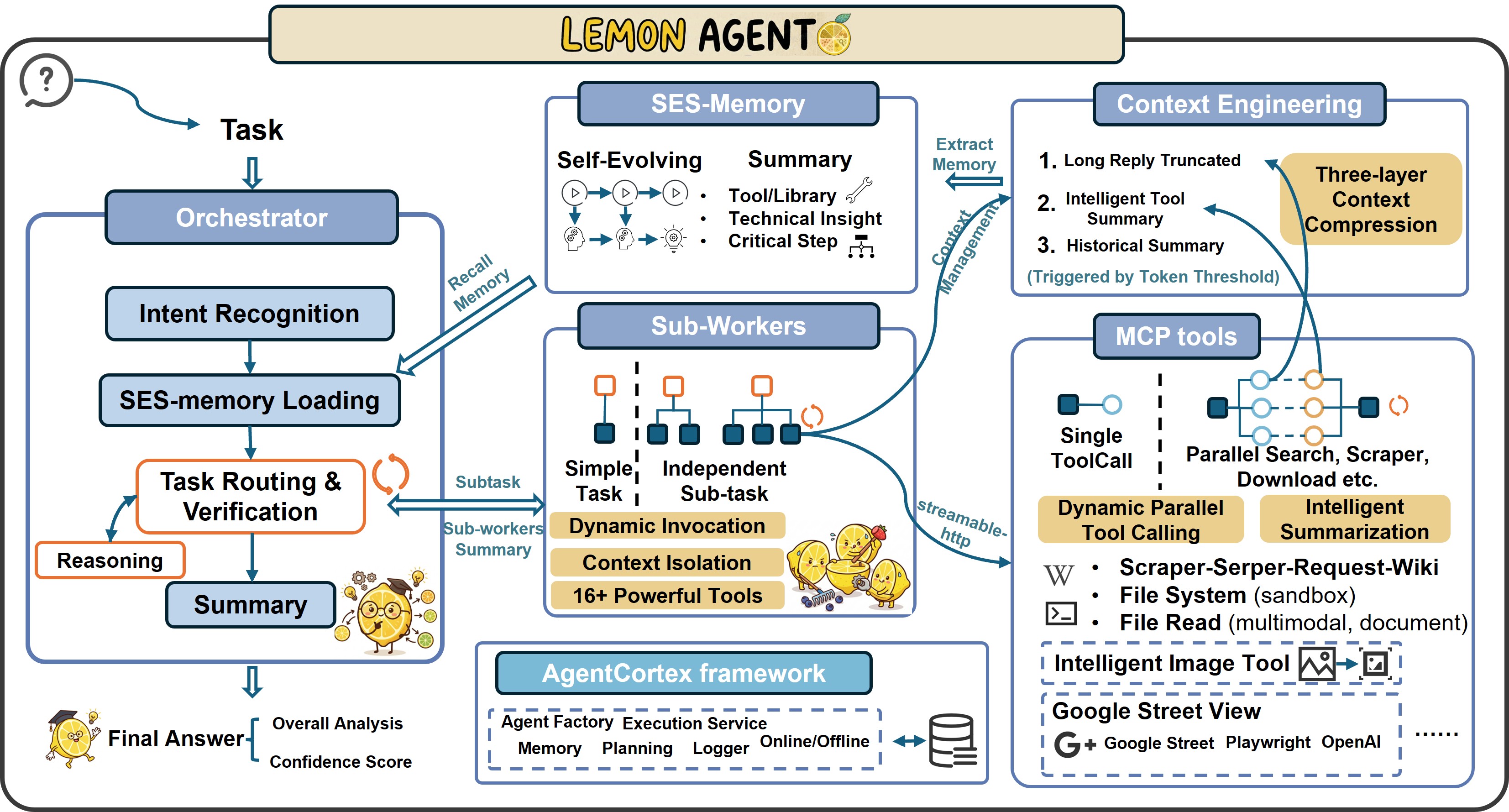
本文介绍了Lemon Agent,一个基于AgentCortex框架的多智能体协同系统,旨在解决现有LLM驱动的Agent系统在资源效率、上下文管理和多模态感知方面的局限性。该系统采用自适应任务执行机制,集成了分层自适应调度机制,在协调器和工作器层面动态调整计算强度。协调器可分配多个工作器并行执行子任务,工作器则通过并发调用工具提高效率。系统采用三层渐进式上下文管理策略,减少冗余并提高信息密度。自进化记忆系统从历史经验中提取多维信息,辅助完成类似任务。增强的MCP工具集进一步提升了系统性能。实验结果表明,Lemon Agent在GAIA上取得了91.36%的总体准确率,并在xbench-DeepSearch排行榜上以77+的得分位居榜首。
🔬 方法详解
问题定义:现有基于LLM的Agent系统在处理复杂、长程任务时,面临资源效率低、上下文管理不佳以及多模态感知能力不足等问题。这些问题限制了Agent系统在实际应用中的性能和可扩展性。
核心思路:Lemon Agent的核心思路是构建一个多智能体协同系统,通过分层调度和自适应执行机制,实现全局任务协调和局部任务执行的平衡。AgentCortex框架将经典的Planner-Executor-Memory范式形式化,并引入自适应任务执行机制,从而优化资源利用率和任务处理效率。
技术框架:Lemon Agent的整体架构是一个多智能体协同系统,包含一个协调器(Orchestrator)和多个工作器(Workers)。协调器负责任务分解和调度,工作器负责执行具体的子任务。系统采用分层自适应调度机制,协调器和工作器都可以根据任务复杂度动态调整计算强度。此外,系统还包括一个三层渐进式上下文管理模块和一个自进化记忆系统。
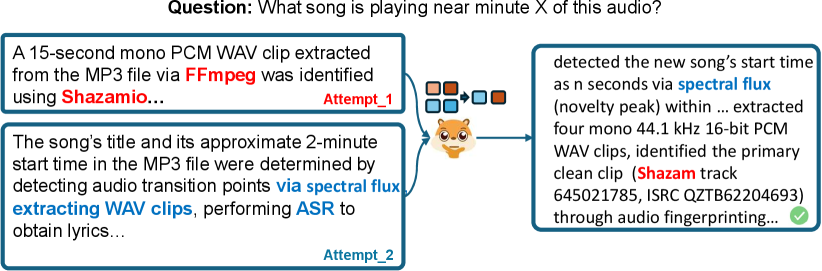
关键创新:Lemon Agent的关键创新点在于AgentCortex框架和分层自适应调度机制。AgentCortex框架形式化了Planner-Executor-Memory范式,并引入自适应任务执行机制。分层自适应调度机制允许协调器和工作器根据任务复杂度动态调整计算强度,从而优化资源利用率。此外,自进化记忆系统能够从历史经验中提取多维信息,辅助完成类似任务。
关键设计:Lemon Agent的关键设计包括:1) 分层自适应调度机制的具体实现,包括如何根据任务复杂度动态调整计算强度;2) 三层渐进式上下文管理策略,如何减少冗余并提高信息密度;3) 自进化记忆系统的设计,包括如何提取和利用历史经验;4) 增强的MCP工具集,具体包含哪些工具以及如何提升性能。
🖼️ 关键图片

📊 实验亮点
Lemon Agent在GAIA基准测试中取得了91.36%的总体准确率,达到了state-of-the-art水平。在xbench-DeepSearch排行榜上,Lemon Agent以77+的得分位居榜首,显著优于其他Agent系统。这些实验结果充分证明了Lemon Agent在复杂任务处理方面的优越性能。
🎯 应用场景
Lemon Agent具有广泛的应用前景,可应用于智能客服、自动化办公、智能家居、机器人控制等领域。通过高效的任务分解、调度和执行,Lemon Agent能够显著提升复杂任务的处理效率,降低资源消耗,并为用户提供更智能、更便捷的服务。未来,Lemon Agent有望成为构建通用人工智能系统的关键组成部分。
📄 摘要(原文)
Recent advanced LLM-powered agent systems have exhibited their remarkable capabilities in tackling complex, long-horizon tasks. Nevertheless, they still suffer from inherent limitations in resource efficiency, context management, and multimodal perception. Based on these observations, Lemon Agent is introduced, a multi-agent orchestrator-worker system built on a newly proposed AgentCortex framework, which formalizes the classic Planner-Executor-Memory paradigm through an adaptive task execution mechanism. Our system integrates a hierarchical self-adaptive scheduling mechanism that operates at both the overall orchestrator layer and workers layer. This mechanism can dynamically adjust computational intensity based on task complexity. It enables orchestrator to allocate one or more workers for parallel subtask execution, while workers can further improve operational efficiency by invoking tools concurrently. By virtue of this two-tier architecture, the system achieves synergistic balance between global task coordination and local task execution, thereby optimizing resource utilization and task processing efficiency in complex scenarios. To reduce context redundancy and increase information density during parallel steps, we adopt a three-tier progressive context management strategy. To make fuller use of historical information, we propose a self-evolving memory system, which can extract multi-dimensional valid information from all historical experiences to assist in completing similar tasks. Furthermore, we provide an enhanced MCP toolset. Empirical evaluations on authoritative benchmarks demonstrate that our Lemon Agent can achieve a state-of-the-art 91.36% overall accuracy on GAIA and secures the top position on the xbench-DeepSearch leaderboard with a score of 77+.