Graph-based Agent Memory: Taxonomy, Techniques, and Applications
作者: Chang Yang, Chuang Zhou, Yilin Xiao, Su Dong, Luyao Zhuang, Yujing Zhang, Zhu Wang, Zijin Hong, Zheng Yuan, Zhishang Xiang, Shengyuan Chen, Huachi Zhou, Qinggang Zhang, Ninghao Liu, Jinsong Su, Xinrun Wang, Yi Chang, Xiao Huang
分类: cs.AI
发布日期: 2026-02-05
🔗 代码/项目: GITHUB
💡 一句话要点
综述:基于图结构的Agent记忆,实现知识积累、迭代推理和自我进化。
🎯 匹配领域: 支柱九:具身大模型 (Embodied Foundation Models)
关键词: Agent记忆 图结构 知识图谱 长期记忆 迭代推理 自我进化 LLM Agent
📋 核心要点
- 基于LLM的Agent在长程复杂任务中依赖记忆模块,但现有记忆方法在关系建模和高效检索方面存在不足。
- 论文聚焦图结构Agent记忆,利用图的天然优势建模关系依赖、组织层级信息和支持高效检索。
- 综述涵盖Agent记忆的分类、关键技术(提取、存储、检索、进化)、开源资源、应用场景和未来方向。
📝 摘要(中文)
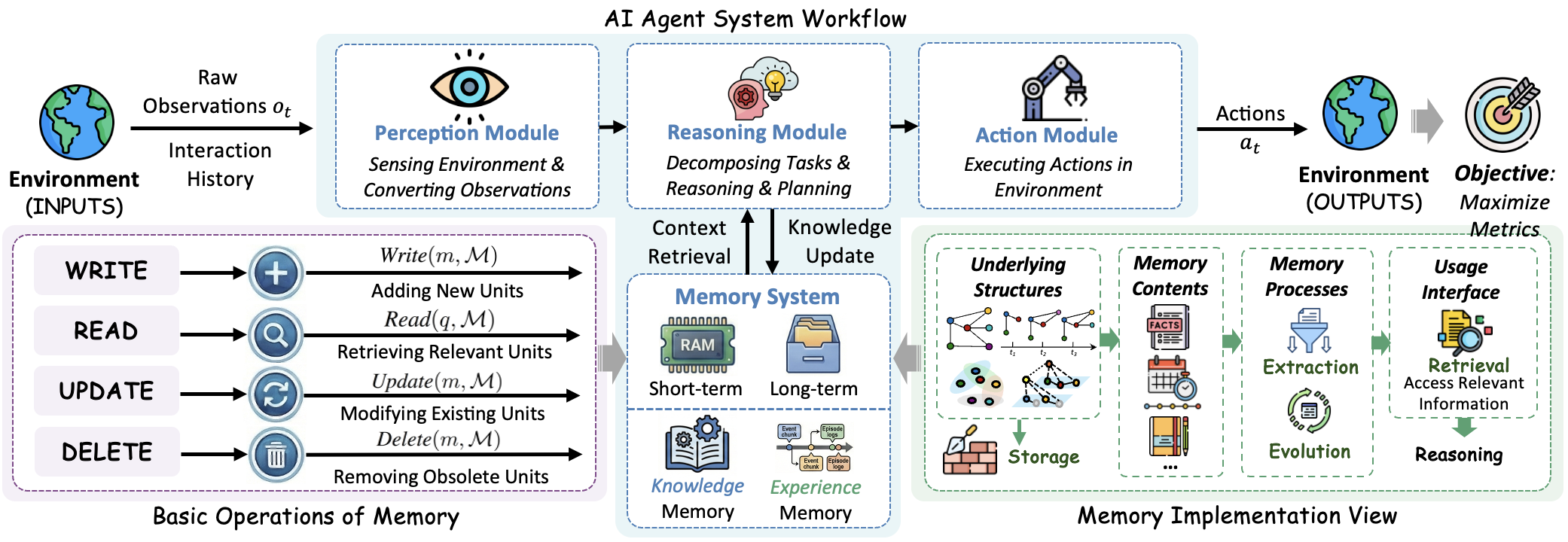
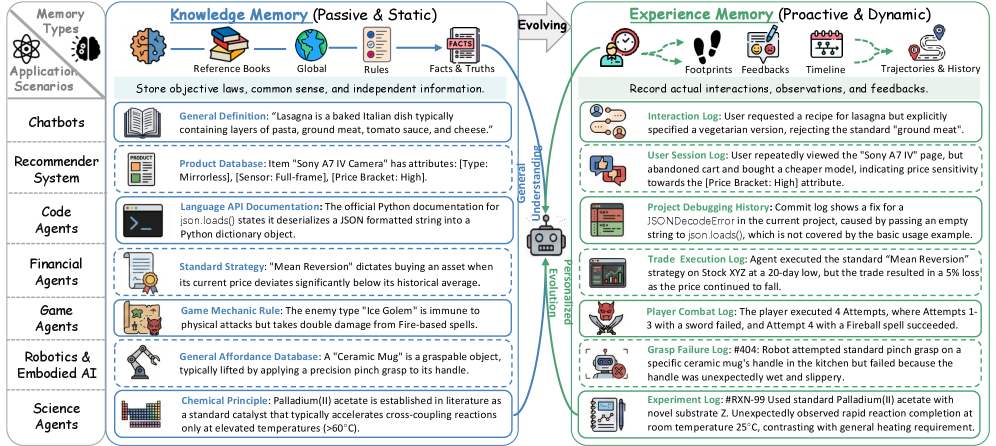
本文全面综述了基于图结构的Agent记忆。首先,提出了Agent记忆的分类法,包括短期与长期记忆、知识与经验记忆、非结构化与结构化记忆,并从图结构视角给出了实现方案。其次,根据Agent记忆的生命周期,系统地分析了基于图结构的Agent记忆的关键技术,涵盖了用于将数据转换为内容的记忆提取、用于高效组织数据的存储、用于从记忆中检索相关内容以支持推理的检索以及用于更新记忆中内容的发展。第三,总结了支持自进化Agent记忆开发和评估的开源库和基准。此外,还探讨了各种应用场景。最后,指出了关键挑战和未来的研究方向。本综述旨在为推进更高效、更可靠的基于图结构的Agent记忆系统的发展提供可操作的见解。所有相关资源,包括研究论文、开源数据和项目,都收集在https://github.com/DEEP-PolyU/Awesome-GraphMemory。
🔬 方法详解
问题定义:现有基于LLM的Agent在处理长程复杂任务时,需要有效的记忆机制来积累知识、进行迭代推理和自我进化。然而,传统的记忆方法在建模复杂关系依赖、组织层级信息以及支持高效检索方面存在局限性,无法充分满足Agent对记忆的需求。
核心思路:论文的核心思路是利用图结构作为Agent记忆的载体,因为图具有天然的优势来建模实体之间的关系,组织层级信息,并支持高效的检索。通过将知识和经验表示为图中的节点和边,Agent可以更好地理解和利用记忆中的信息。
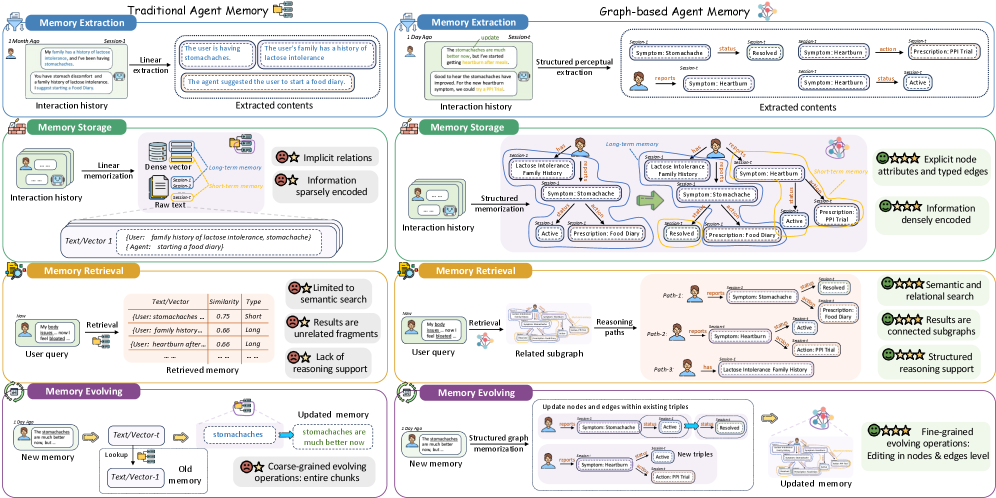
技术框架:该综述按照Agent记忆的生命周期,将图结构Agent记忆的技术框架分为四个主要模块:记忆提取、记忆存储、记忆检索和记忆进化。记忆提取负责将原始数据转换为图结构表示;记忆存储负责高效地组织和存储图结构数据;记忆检索负责从记忆中检索相关信息以支持推理;记忆进化负责更新和维护记忆中的内容。
关键创新:该综述的关键创新在于系统性地总结和分析了基于图结构的Agent记忆的各个方面,包括分类、技术、资源和应用。它提供了一个全面的视角,帮助研究人员和开发者更好地理解和利用图结构来构建更高效和可靠的Agent记忆系统。
关键设计:综述中讨论了各种图结构Agent记忆的关键设计,例如:如何选择合适的图结构(如知识图谱、场景图等)来表示不同的知识和经验;如何设计有效的图嵌入方法来学习节点和边的表示;如何利用图神经网络(GNN)来进行推理和预测;如何设计合适的检索算法来高效地从图中检索相关信息;以及如何设计有效的进化机制来更新和维护图结构记忆。
🖼️ 关键图片
📊 实验亮点
该综述总结了多个开源库和基准,为图结构Agent记忆的开发和评估提供了便利。同时,论文还探讨了多种应用场景,并指出了当前研究面临的挑战和未来的研究方向,为该领域的研究提供了有价值的参考。
🎯 应用场景
该研究成果可广泛应用于多轮对话、游戏博弈、科学发现等需要长期记忆和复杂推理的Agent应用场景。通过构建更高效、更可靠的图结构Agent记忆系统,可以提升Agent的智能水平和解决复杂问题的能力,具有重要的实际价值和广阔的应用前景。
📄 摘要(原文)
Memory emerges as the core module in the Large Language Model (LLM)-based agents for long-horizon complex tasks (e.g., multi-turn dialogue, game playing, scientific discovery), where memory can enable knowledge accumulation, iterative reasoning and self-evolution. Among diverse paradigms, graph stands out as a powerful structure for agent memory due to the intrinsic capabilities to model relational dependencies, organize hierarchical information, and support efficient retrieval. This survey presents a comprehensive review of agent memory from the graph-based perspective. First, we introduce a taxonomy of agent memory, including short-term vs. long-term memory, knowledge vs. experience memory, non-structural vs. structural memory, with an implementation view of graph-based memory. Second, according to the life cycle of agent memory, we systematically analyze the key techniques in graph-based agent memory, covering memory extraction for transforming the data into the contents, storage for organizing the data efficiently, retrieval for retrieving the relevant contents from memory to support reasoning, and evolution for updating the contents in the memory. Third, we summarize the open-sourced libraries and benchmarks that support the development and evaluation of self-evolving agent memory. We also explore diverse application scenarios. Finally, we identify critical challenges and future research directions. This survey aims to offer actionable insights to advance the development of more efficient and reliable graph-based agent memory systems. All the related resources, including research papers, open-source data, and projects, are collected for the community in https://github.com/DEEP-PolyU/Awesome-GraphMemory.