CI4A: Semantic Component Interfaces for Agents Empowering Web Automation
作者: Zhi Qiu, Jiazheng Sun, Chenxiao Xia, Jun Zheng, Xin Peng
分类: cs.AI
发布日期: 2026-01-21
备注: 9 pages, 5 figures
💡 一句话要点
提出CI4A以解决Web组件操作的低效问题
🎯 匹配领域: 支柱一:机器人控制 (Robot Control) 支柱二:RL算法与架构 (RL & Architecture) 支柱九:具身大模型 (Embodied Foundation Models)
关键词: Web自动化 智能体 组件接口 语义封装 Ant Design 执行效率 任务成功率
📋 核心要点
- 现有方法在处理低层Web组件操作时效率低下,无法满足人机交互的需求。
- 本文提出CI4A,优化智能体与Web组件的交互接口,简化操作逻辑。
- 实验表明,CI4A智能体在任务成功率和执行效率上均显著优于现有方法。
📝 摘要(中文)
尽管大型语言模型在高层语义规划方面表现出色,但在处理细粒度的低层Web组件操作时仍然存在局限性。为了解决这一问题,本文提出了组件接口(CI4A),一种语义封装机制,将复杂的UI组件交互逻辑抽象为一组统一的工具原语,供智能体使用。我们在Ant Design框架中实现了CI4A,涵盖23类常用UI组件,并开发了一个混合智能体,其动作空间根据页面状态动态更新,从而灵活调用可用的CI4A工具。实验结果表明,基于CI4A的智能体在任务成功率上达到了86.3%,并显著提升了执行效率。
🔬 方法详解
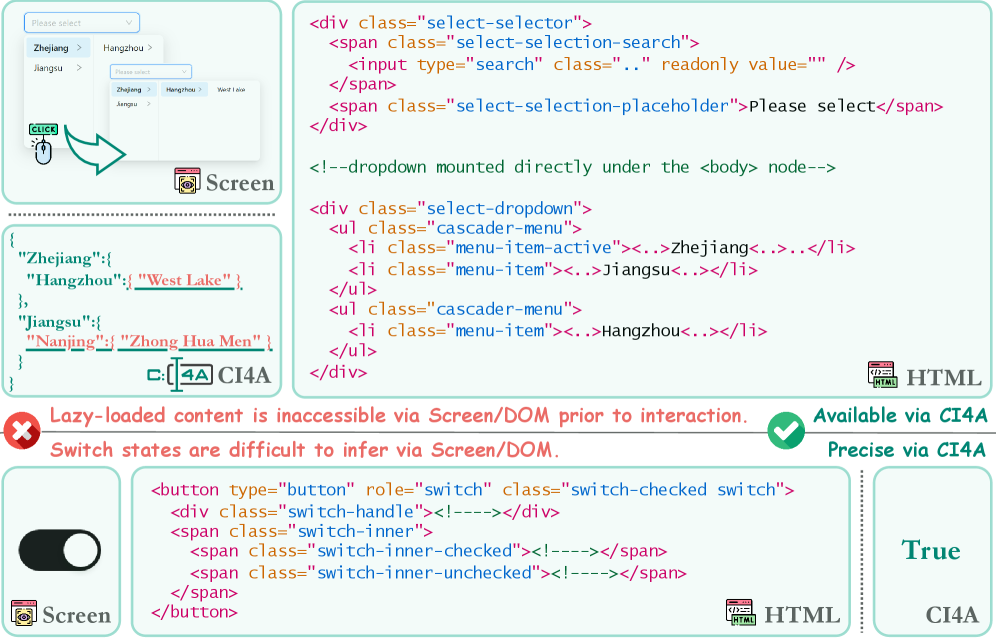
问题定义:本文旨在解决大型语言模型在低层Web组件操作中的局限性,现有方法往往无法有效适应人机交互界面,导致操作效率低下。
核心思路:提出组件接口(CI4A),通过语义封装将复杂的UI组件交互逻辑简化为统一的工具原语,使智能体能够更高效地进行操作。
技术框架:CI4A的实现基于Ant Design框架,涵盖23类常用UI组件。混合智能体的动作空间根据页面状态动态更新,允许灵活调用CI4A工具。
关键创新:CI4A的最大创新在于其语义封装机制,使得智能体能够直接使用高层次的工具原语进行低层次的组件操作,显著提高了操作的灵活性和效率。
关键设计:在CI4A的实现中,设计了动态更新的动作空间,确保智能体能够根据当前页面状态选择最合适的操作工具,提升了执行效率。
🖼️ 关键图片


📊 实验亮点
实验结果显示,基于CI4A的智能体在任务成功率上达到了86.3%,相比于现有方法有显著提升。此外,执行效率也得到了大幅改善,展示了CI4A在Web自动化中的有效性。
🎯 应用场景
该研究的潜在应用领域包括自动化Web测试、智能客服系统和在线教育平台等。通过优化智能体与Web组件的交互,CI4A能够提高用户体验和操作效率,具有广泛的实际价值和未来影响。
📄 摘要(原文)
While Large Language Models demonstrate remarkable proficiency in high-level semantic planning, they remain limited in handling fine-grained, low-level web component manipulations. To address this limitation, extensive research has focused on enhancing model grounding capabilities through techniques such as Reinforcement Learning. However, rather than compelling agents to adapt to human-centric interfaces, we propose constructing interaction interfaces specifically optimized for agents. This paper introduces Component Interface for Agent (CI4A), a semantic encapsulation mechanism that abstracts the complex interaction logic of UI components into a set of unified tool primitives accessible to agents. We implemented CI4A within Ant Design, an industrial-grade front-end framework, covering 23 categories of commonly used UI components. Furthermore, we developed a hybrid agent featuring an action space that dynamically updates according to the page state, enabling flexible invocation of available CI4A tools. Leveraging the CI4A-integrated Ant Design, we refactored and upgraded the WebArena benchmark to evaluate existing SoTA methods. Experimental results demonstrate that the CI4A-based agent significantly outperforms existing approaches, achieving a new SoTA task success rate of 86.3%, alongside substantial improvements in execution efficiency.