A Lightweight Modular Framework for Constructing Autonomous Agents Driven by Large Language Models: Design, Implementation, and Applications in AgentForge
作者: Akbar Anbar Jafari, Cagri Ozcinar, Gholamreza Anbarjafari
分类: cs.AI
发布日期: 2026-01-19
备注: 15 pages, 3 figures
💡 一句话要点
AgentForge:轻量级模块化框架,赋能大语言模型驱动的自主Agent构建
🎯 匹配领域: 支柱九:具身大模型 (Embodied Foundation Models)
关键词: 自主Agent 大语言模型 模块化框架 任务编排 技能抽象
📋 核心要点
- 现有Agent框架存在架构僵化、厂商锁定和复杂度高等问题,限制了LLM驱动的自主Agent的快速开发和部署。
- AgentForge通过模块化架构、可组合技能抽象、统一LLM后端接口和声明式配置系统,简化了自主Agent的构建。
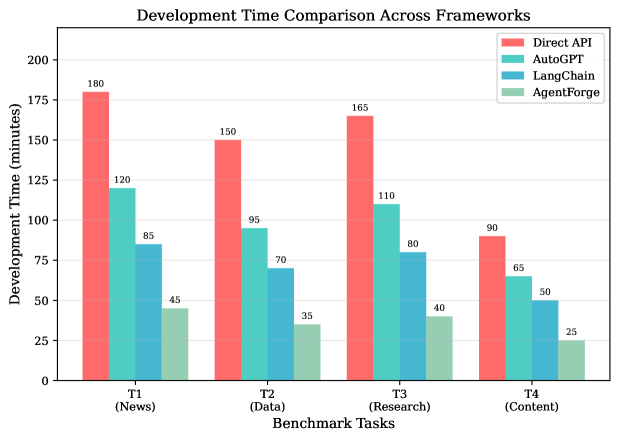
- 实验表明,AgentForge在保持竞争力的任务完成率的同时,显著降低了开发时间,并具有较低的编排开销。
📝 摘要(中文)
大语言模型(LLM)的出现催化了自主Agent开发中的范式转变,使系统能够进行推理、规划和执行复杂的多步骤任务。然而,现有的Agent框架通常存在架构僵化、厂商锁定以及复杂度过高等问题,阻碍了快速原型设计和部署。本文提出了AgentForge,一个轻量级的开源Python框架,旨在通过原则性的模块化架构,普及LLM驱动的自主Agent构建。AgentForge引入了三个关键创新:(1) 可组合的技能抽象,通过形式化定义的输入输出契约实现细粒度的任务分解;(2) 统一的LLM后端接口,支持在云API和本地推理引擎之间无缝切换;(3) 基于YAML的声明式配置系统,将Agent逻辑与实现细节分离。我们将技能组合机制形式化为有向无环图(DAG),并证明了其在表示任意顺序和并行任务工作流方面的表达能力。在四个基准场景下的综合实验评估表明,AgentForge实现了具有竞争力的任务完成率,同时与LangChain相比,开发时间减少了62%,与直接API集成相比,减少了78%。延迟测量证实了亚100毫秒的编排开销,使该框架适用于实时应用。模块化设计便于扩展:我们演示了六个内置技能的集成,并提供了用于自定义技能开发的全面文档。AgentForge通过为研究人员和从业者提供一个生产就绪的基础,用于构建、评估和部署自主Agent,而无需牺牲灵活性或性能,从而解决了LLM Agent生态系统中的一个关键缺口。
🔬 方法详解
问题定义:现有自主Agent框架存在架构僵化、厂商锁定和复杂度过高等问题,导致开发周期长、难以定制和扩展。直接使用LLM API进行Agent开发则缺乏结构化和可维护性。因此,需要一个轻量级、灵活且易于使用的框架,以加速LLM驱动的自主Agent的构建和部署。
核心思路:AgentForge的核心思路是将Agent的构建过程分解为可组合的技能模块,每个技能模块具有明确的输入输出接口。通过将Agent逻辑与底层LLM实现解耦,实现灵活的LLM后端切换。采用声明式配置,简化Agent的配置和管理。
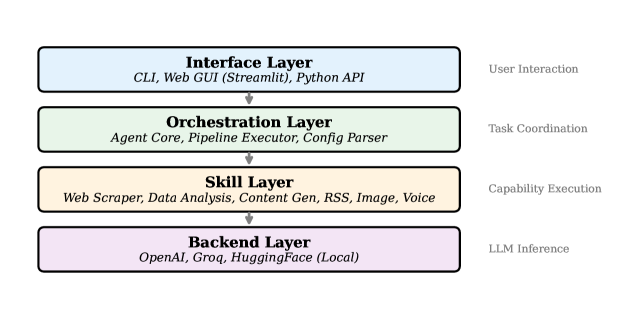
技术框架:AgentForge的整体架构包括以下几个主要模块:1) 技能模块:定义Agent可以执行的原子操作,例如搜索、阅读、写作等。每个技能模块包含输入输出契约和执行逻辑。2) LLM后端接口:提供统一的接口,用于与不同的LLM API或本地推理引擎进行交互。3) 任务编排器:根据Agent的目标,将技能模块组合成任务执行流程。任务执行流程可以表示为有向无环图(DAG)。4) 配置管理器:负责加载和管理Agent的配置信息,例如技能模块的参数、LLM后端设置等。
关键创新:AgentForge的关键创新在于其模块化的技能抽象和统一的LLM后端接口。模块化的技能抽象使得Agent的构建过程更加灵活和可重用。统一的LLM后端接口使得Agent可以轻松地切换不同的LLM,而无需修改Agent的逻辑。此外,基于YAML的声明式配置系统也简化了Agent的配置和管理。
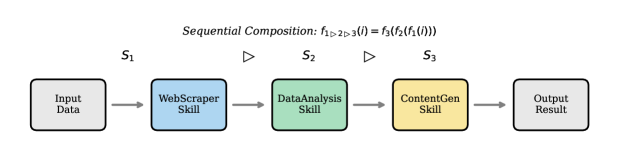
关键设计:AgentForge使用YAML文件来定义Agent的配置信息,包括技能模块的参数、LLM后端设置、任务执行流程等。技能模块的输入输出契约使用JSON Schema进行定义。任务编排器使用有向无环图(DAG)来表示任务执行流程。AgentForge还提供了一组内置的技能模块,例如搜索、阅读、写作等。开发者可以根据自己的需求,自定义新的技能模块。
🖼️ 关键图片
📊 实验亮点
实验结果表明,AgentForge在四个基准场景下实现了具有竞争力的任务完成率,同时与LangChain相比,开发时间减少了62%,与直接API集成相比,减少了78%。延迟测量证实了亚100毫秒的编排开销,表明该框架适用于实时应用。
🎯 应用场景
AgentForge可应用于各种需要自主Agent的场景,例如智能客服、自动化办公、智能家居、机器人控制等。该框架的轻量级和模块化设计使其易于部署和定制,可以加速LLM驱动的自主Agent在各个领域的应用。
📄 摘要(原文)
The emergence of LLMs has catalyzed a paradigm shift in autonomous agent development, enabling systems capable of reasoning, planning, and executing complex multi-step tasks. However, existing agent frameworks often suffer from architectural rigidity, vendor lock-in, and prohibitive complexity that impedes rapid prototyping and deployment. This paper presents AgentForge, a lightweight, open-source Python framework designed to democratize the construction of LLM-driven autonomous agents through a principled modular architecture. AgentForge introduces three key innovations: (1) a composable skill abstraction that enables fine-grained task decomposition with formally defined input-output contracts, (2) a unified LLM backend interface supporting seamless switching between cloud-based APIs and local inference engines, and (3) a declarative YAML-based configuration system that separates agent logic from implementation details. We formalize the skill composition mechanism as a directed acyclic graph (DAG) and prove its expressiveness for representing arbitrary sequential and parallel task workflows. Comprehensive experimental evaluation across four benchmark scenarios demonstrates that AgentForge achieves competitive task completion rates while reducing development time by 62% compared to LangChain and 78% compared to direct API integration. Latency measurements confirm sub-100ms orchestration overhead, rendering the framework suitable for real-time applications. The modular design facilitates extension: we demonstrate the integration of six built-in skills and provide comprehensive documentation for custom skill development. AgentForge addresses a critical gap in the LLM agent ecosystem by providing researchers and practitioners with a production-ready foundation for constructing, evaluating, and deploying autonomous agents without sacrificing flexibility or performance.