Learner-Tailored Program Repair: A Solution Generator with Iterative Edit-Driven Retrieval Enhancement
作者: Zhenlong Dai, Zhuoluo Zhao, Hengning Wang, Xiu Tang, Sai Wu, Chang Yao, Zhipeng Gao, Jingyuan Chen
分类: cs.AI, cs.CL, cs.SE
发布日期: 2026-01-13
💡 一句话要点
提出学习者定制程序修复方法以解决编程学习者的代码错误问题
🎯 匹配领域: 支柱九:具身大模型 (Embodied Foundation Models)
关键词: 程序修复 学习者定制 智能辅导 代码检索 迭代优化 大型语言模型 编程教育
📋 核心要点
- 现有方法主要集中在修复代码错误,但缺乏对错误原因的深入分析,导致学习者难以理解问题所在。
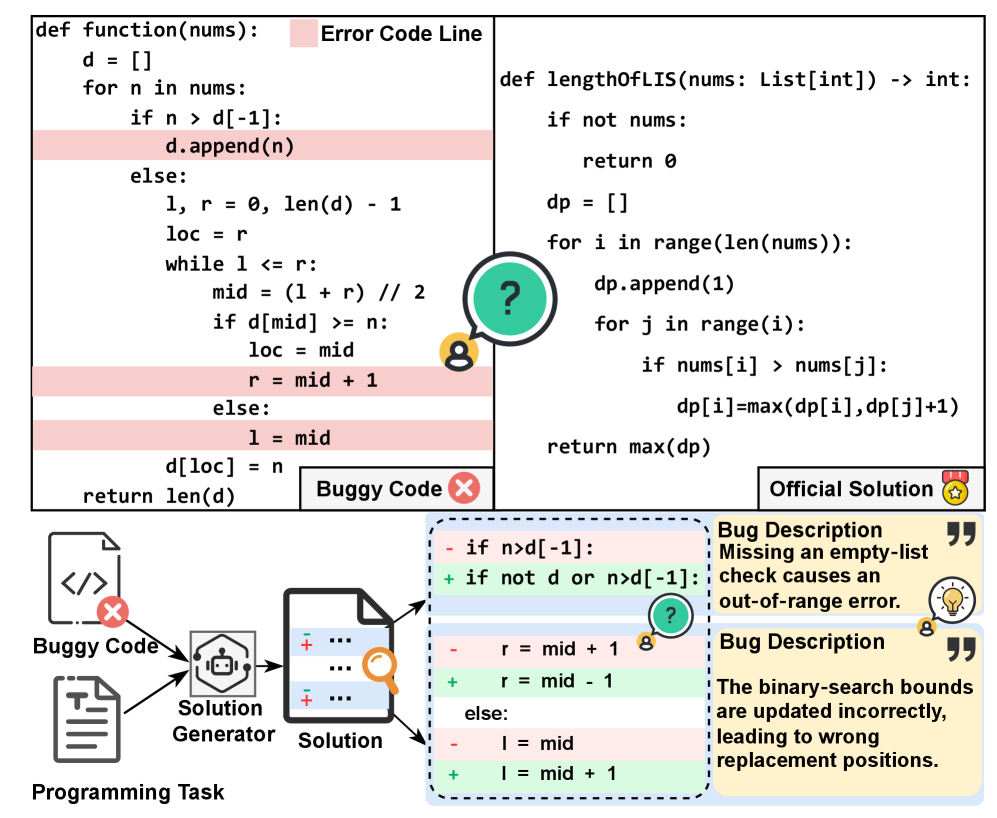
- 论文提出了一种学习者定制程序修复(LPR)任务,并设计了学习者定制解决方案生成器,通过检索和引导修复过程来提升代码修复效果。
- 实验结果显示,该方法在多个基线模型上显著提升了修复准确性,验证了其在编程辅导中的有效性。
📝 摘要(中文)
随着大型语言模型(LLMs)在编程领域的发展,智能编程辅导系统受到广泛关注。然而,大多数研究集中在修复编程学习者的错误代码上,而未提供错误的根本原因。为了解决这一问题,我们引入了一项新任务,即学习者定制程序修复(LPR)。我们提出了一种新颖有效的框架——学习者定制解决方案生成器( extsc{LPR}),以增强程序修复并提供错误代码的描述。在第一阶段,我们利用修复解决方案检索框架构建解决方案数据库,并采用基于编辑的代码检索方法来获取有价值的解决方案,指导LLMs识别和修复错误代码。在第二阶段,我们提出了一种解决方案引导的程序修复方法,在检索解决方案的指导下修复代码并提供解释。此外,我们提出了一种迭代检索增强方法,利用生成代码的评估结果迭代优化检索方向,探索更合适的修复策略,提高实际编程辅导场景中的表现。实验结果表明,我们的方法在一系列基线模型中表现优异,验证了框架在新提出的LPR任务中的有效性。
🔬 方法详解
问题定义:本论文旨在解决编程学习者在代码修复过程中缺乏对错误原因理解的问题。现有方法往往只关注修复结果,而忽略了提供错误的根本原因,导致学习者无法有效学习和改进。
核心思路:我们提出的学习者定制程序修复(LPR)任务,结合了修复解决方案的检索与引导,旨在通过提供详细的错误描述和修复建议,帮助学习者更好地理解和修复代码错误。
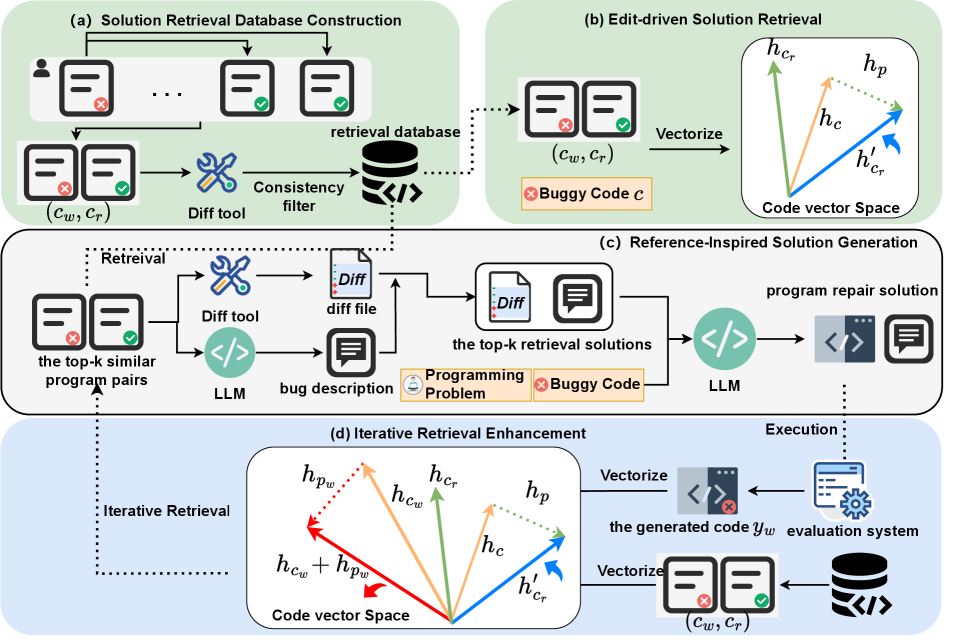
技术框架:整体框架分为两个主要阶段:第一阶段是构建修复解决方案检索数据库,并通过编辑驱动的代码检索方法获取有价值的解决方案;第二阶段是基于检索结果进行代码修复,并提供相应的解释。
关键创新:本研究的创新点在于引入了迭代检索增强方法,通过利用生成代码的评估结果,动态优化检索方向,从而探索更合适的修复策略。这一方法显著提升了修复的准确性和效率。
关键设计:在技术细节方面,我们设计了特定的损失函数来评估修复效果,并采用了基于编辑的检索算法来提高解决方案的相关性和有效性。
🖼️ 关键图片
📊 实验亮点
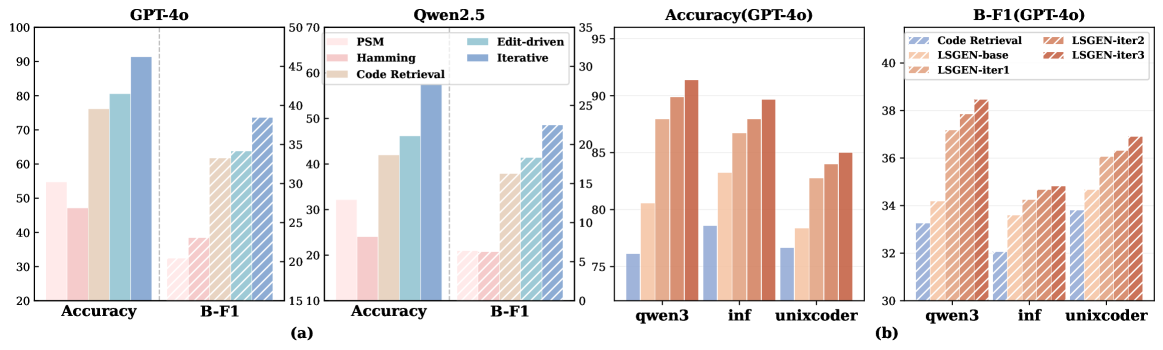
实验结果表明,提出的方法在多个基线模型上表现优异,修复准确率提高了显著幅度,验证了学习者定制解决方案生成器在实际编程辅导场景中的有效性。
🎯 应用场景
该研究的潜在应用领域包括编程教育、智能编程辅导系统以及自动代码修复工具。通过提供更深入的错误分析和修复建议,能够有效提升学习者的编程能力和理解水平,具有重要的实际价值和未来影响。
📄 摘要(原文)
With the development of large language models (LLMs) in the field of programming, intelligent programming coaching systems have gained widespread attention. However, most research focuses on repairing the buggy code of programming learners without providing the underlying causes of the bugs. To address this gap, we introduce a novel task, namely \textbf{LPR} (\textbf{L}earner-Tailored \textbf{P}rogram \textbf{R}epair). We then propose a novel and effective framework, \textbf{\textsc{\MethodName{}}} (\textbf{L}earner-Tailored \textbf{S}olution \textbf{G}enerator), to enhance program repair while offering the bug descriptions for the buggy code. In the first stage, we utilize a repair solution retrieval framework to construct a solution retrieval database and then employ an edit-driven code retrieval approach to retrieve valuable solutions, guiding LLMs in identifying and fixing the bugs in buggy code. In the second stage, we propose a solution-guided program repair method, which fixes the code and provides explanations under the guidance of retrieval solutions. Moreover, we propose an Iterative Retrieval Enhancement method that utilizes evaluation results of the generated code to iteratively optimize the retrieval direction and explore more suitable repair strategies, improving performance in practical programming coaching scenarios. The experimental results show that our approach outperforms a set of baselines by a large margin, validating the effectiveness of our framework for the newly proposed LPR task.