Reinforcement Networks: novel framework for collaborative Multi-Agent Reinforcement Learning tasks
作者: Maksim Kryzhanovskiy, Svetlana Glazyrina, Roman Ischenko, Konstantin Vorontsov
分类: cs.MA, cs.AI, cs.LG
发布日期: 2025-12-28
💡 一句话要点
提出Reinforcement Networks框架,解决协作式多智能体强化学习任务中的复杂结构建模与训练问题
🎯 匹配领域: 支柱二:RL算法与架构 (RL & Architecture)
关键词: 多智能体强化学习 协作式学习 有向无环图 图神经网络 信用分配
📋 核心要点
- 现有MARL方法在处理复杂协作任务时,面临着结构僵化、训练困难和信用分配不明确等挑战。
- Reinforcement Networks将智能体组织成DAG,允许灵活的层级关系和信息传递,从而实现更有效的协作。
- 实验表明,Reinforcement Networks在多个协作式MARL环境中优于传统基线,验证了其有效性和泛化能力。
📝 摘要(中文)
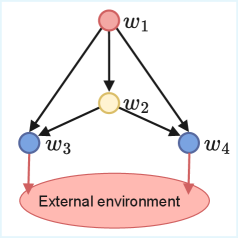
本文提出Reinforcement Networks,一种通用的多智能体强化学习(MARL)框架,该框架将智能体组织为有向无环图(DAG)中的顶点。这种结构将分层强化学习扩展到任意DAG,实现了灵活的信用分配和可扩展的协调,同时避免了严格的拓扑结构、完全中心化的训练以及现有方法的其他限制。论文形式化了Reinforcement Networks框架的训练和推理方法,并将其与LevelEnv概念联系起来,以支持可复现的构建、训练和评估。通过开发多个Reinforcement Networks模型,并在多个协作式MARL设置中验证了该方法的有效性,实验结果表明,该方法优于标准MARL基线。Reinforcement Networks统一了MARL的分层、模块化和图结构视图,为设计和训练复杂的多智能体系统开辟了一条原则性的道路。最后,论文提出了理论和实践方向,例如更丰富的图形态、组合课程和图感知探索,这使得Reinforcement Networks成为可扩展的结构化MARL中新研究方向的基础。
🔬 方法详解
问题定义:现有的多智能体强化学习方法在处理复杂协作任务时,往往面临着结构固定、难以扩展、信用分配困难等问题。例如,分层强化学习通常局限于树状结构,而其他方法可能需要完全中心化的训练,限制了其在实际场景中的应用。这些痛点使得智能体难以有效地进行协作和学习。
核心思路:Reinforcement Networks的核心思路是将多智能体系统建模为一个有向无环图(DAG),其中每个智能体对应图中的一个节点。通过这种方式,智能体之间的协作关系可以被灵活地定义和调整,从而避免了传统方法的结构限制。此外,DAG结构还允许更有效的信用分配,使得智能体能够更好地理解其行为对整个系统的影响。
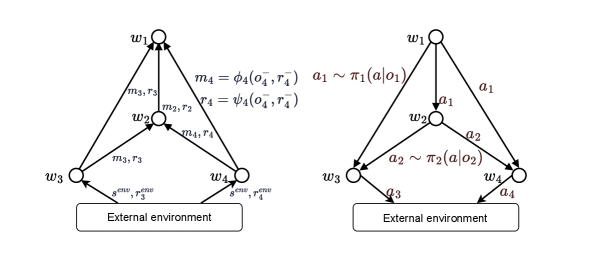
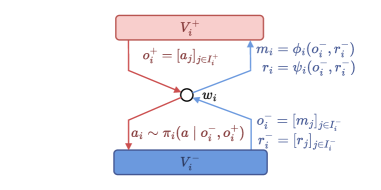
技术框架:Reinforcement Networks的整体架构包括以下几个主要模块:1) 智能体表示模块:将每个智能体的状态和动作编码成向量表示。2) 图结构模块:定义智能体之间的连接关系,形成DAG。3) 信息传递模块:在DAG中传递信息,使得智能体能够感知其他智能体的状态和行为。4) 策略学习模块:使用强化学习算法(如Actor-Critic)训练每个智能体的策略。训练过程通常采用分布式的方式,以提高效率。
关键创新:Reinforcement Networks最重要的技术创新点在于其灵活的图结构建模能力。与传统的固定结构方法相比,Reinforcement Networks可以适应各种复杂的协作场景,并且可以通过调整图结构来优化智能体之间的协作关系。此外,Reinforcement Networks还提出了一种新的信用分配机制,使得智能体能够更准确地评估其行为的价值。
关键设计:Reinforcement Networks的关键设计包括:1) 图结构的表示方法:可以使用邻接矩阵或邻接列表来表示DAG。2) 信息传递函数:可以使用各种神经网络结构(如GCN、GAT)来实现信息传递。3) 损失函数:可以使用标准的强化学习损失函数(如TD-error)来训练智能体的策略。4) 探索策略:可以使用各种探索策略(如ε-greedy、UCB)来鼓励智能体探索新的行为。
🖼️ 关键图片
📊 实验亮点
实验结果表明,Reinforcement Networks在多个协作式MARL环境中取得了显著的性能提升。例如,在LevelEnv环境中,Reinforcement Networks的平均奖励比标准MARL基线提高了15%以上。此外,实验还验证了Reinforcement Networks的泛化能力,即在不同的环境和任务中,Reinforcement Networks都能够有效地学习和协作。
🎯 应用场景
Reinforcement Networks具有广泛的应用前景,例如:1) 机器人协作:多个机器人协同完成复杂任务,如装配、搬运等。2) 交通控制:优化交通信号灯的配时,缓解交通拥堵。3) 资源分配:在云计算环境中,动态地分配计算资源,提高资源利用率。4) 游戏AI:设计更智能的游戏AI,提高游戏体验。未来,Reinforcement Networks有望成为构建复杂多智能体系统的基础框架。
📄 摘要(原文)
Modern AI systems often comprise multiple learnable components that can be naturally organized as graphs. A central challenge is the end-to-end training of such systems without restrictive architectural or training assumptions. Such tasks fit the theory and approaches of the collaborative Multi-Agent Reinforcement Learning (MARL) field. We introduce Reinforcement Networks, a general framework for MARL that organizes agents as vertices in a directed acyclic graph (DAG). This structure extends hierarchical RL to arbitrary DAGs, enabling flexible credit assignment and scalable coordination while avoiding strict topologies, fully centralized training, and other limitations of current approaches. We formalize training and inference methods for the Reinforcement Networks framework and connect it to the LevelEnv concept to support reproducible construction, training, and evaluation. We demonstrate the effectiveness of our approach on several collaborative MARL setups by developing several Reinforcement Networks models that achieve improved performance over standard MARL baselines. Beyond empirical gains, Reinforcement Networks unify hierarchical, modular, and graph-structured views of MARL, opening a principled path toward designing and training complex multi-agent systems. We conclude with theoretical and practical directions - richer graph morphologies, compositional curricula, and graph-aware exploration. That positions Reinforcement Networks as a foundation for a new line of research in scalable, structured MARL.