A Modular Reference Architecture for MCP-Servers Enabling Agentic BIM Interaction
作者: Tobias Heimig-Elschner, Changyu Du, Anna Scheuvens, André Borrmann, Jakob Beetz
分类: cs.OH, cs.AI, cs.MA
发布日期: 2025-12-21
备注: Submitted to the GNI Symposium on Artificial Intelligence for the Built World (Technical University of Munich, May 18--20, 2026)
💡 一句话要点
提出模块化参考架构以解决BIM交互中的工具调用问题
🎯 匹配领域: 支柱九:具身大模型 (Embodied Foundation Models)
关键词: 建筑信息建模 大型语言模型 模型上下文协议 微服务架构 API解耦 自动化交互 系统重用性
📋 核心要点
- 现有BIM交互方法在工具调用上存在特定性,限制了重用和工作流的可移植性。
- 本文提出了一种模块化参考架构,通过显式适配器契约解耦MCP接口与BIM API,支持API无关的交互。
- 实验结果表明,该架构在多个代表性场景中实现了可靠的工作流,显著降低了系统耦合性。
📝 摘要(中文)
随着大型语言模型(LLMs)在建筑信息建模(BIM)中的应用日益增加,基于自然语言的IFC模型检索、修改和生成变得可行。尽管现有的模型上下文协议(MCP)为LLMs提供了统一的工具调用接口,但当前BIM侧的实现仍然是特定于工具的,限制了重用性和工作流的可移植性。本文提出了一种模块化参考架构,旨在实现API无关、隔离和可重现的代理BIM交互。通过对文献中重复出现的能力进行系统分析,本文推导出一组核心需求,构建了一个以显式适配器契约为中心的微服务架构,从而将MCP接口与特定BIM API解耦。使用IfcOpenShell的原型实现展示了在常见修改和生成任务中的可行性,评估结果表明该架构能够实现可靠的工作流,减少耦合,并为系统研究提供可重用的基础。
🔬 方法详解
问题定义:本文旨在解决当前BIM交互中工具调用的特定性问题,现有方法往往依赖于特定工具,导致重用性差和工作流不可移植。
核心思路:通过引入模块化参考架构,利用显式适配器契约将MCP接口与具体BIM API解耦,从而实现API无关的交互,增强系统的灵活性和可重用性。
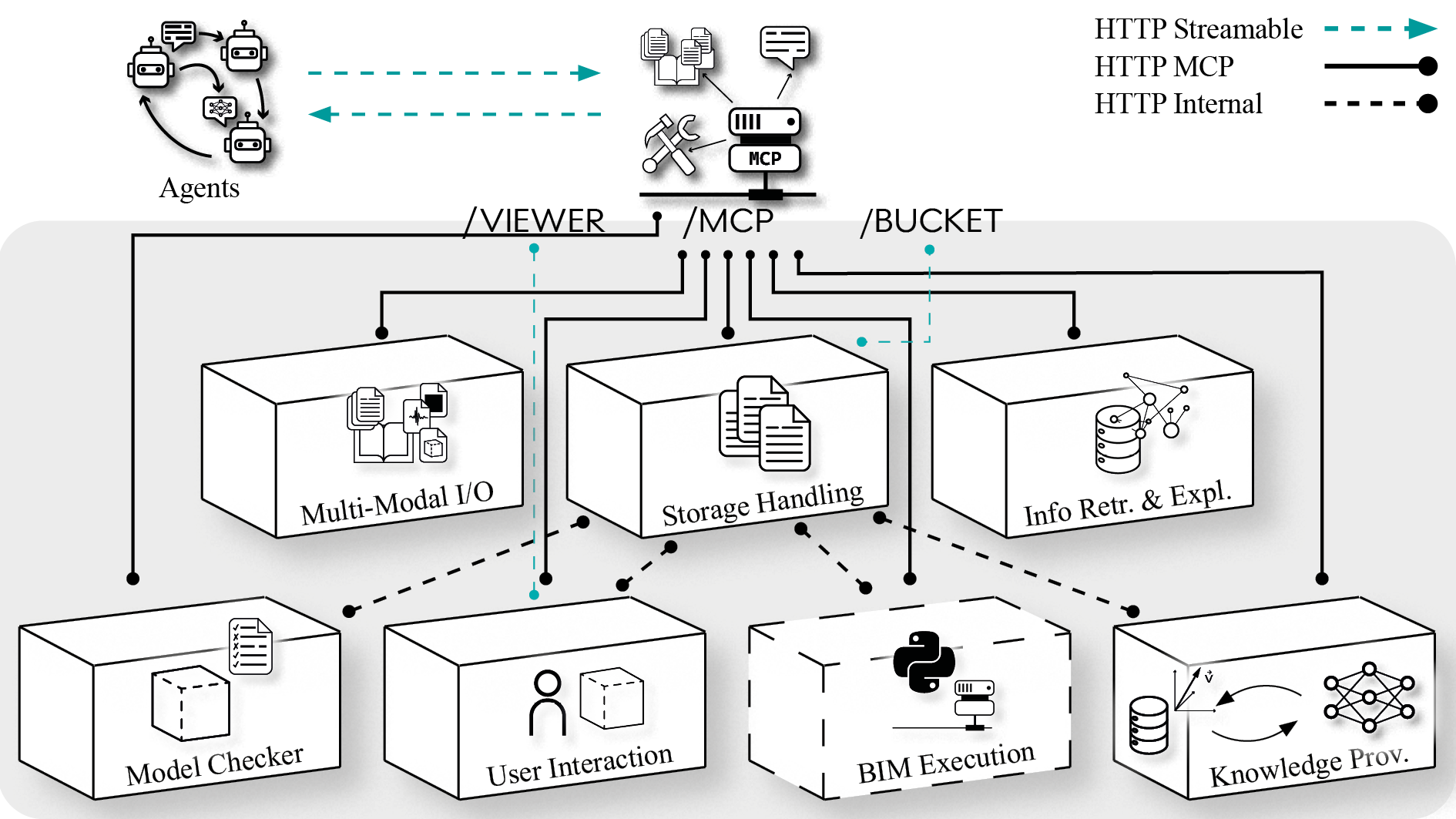
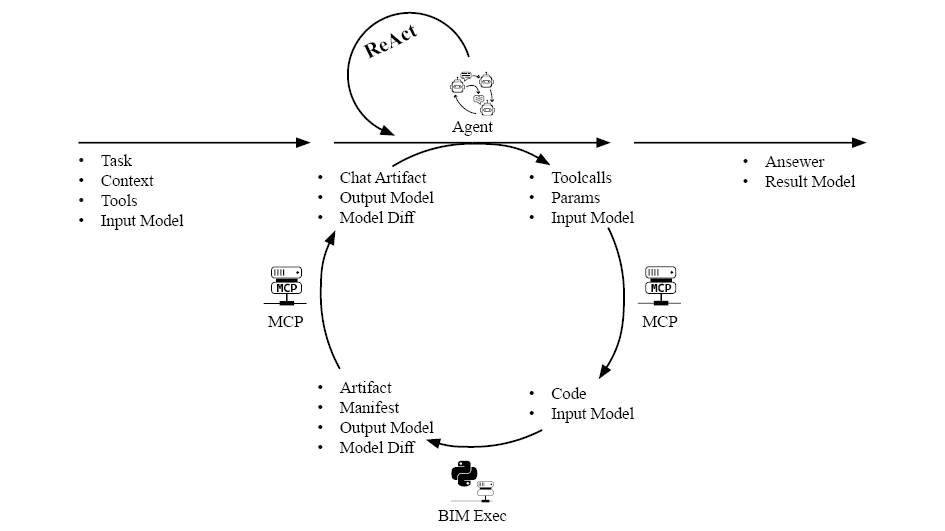
技术框架:整体架构采用微服务设计,主要模块包括MCP接口、适配器层和BIM API层。适配器层负责将MCP调用转换为具体的BIM API调用,确保不同工具间的兼容性。
关键创新:最重要的创新在于引入了显式适配器契约,这一设计使得MCP接口与具体工具的实现相互独立,显著提升了系统的可重用性和可维护性。
关键设计:在实现过程中,采用了微服务架构,确保各模块的独立性;适配器的设计遵循契约编程原则,确保接口的一致性和可扩展性。
🖼️ 关键图片
📊 实验亮点
实验结果表明,所提出的架构在多个代表性场景中实现了可靠的工作流,减少了系统耦合性,并提供了可重用的基础。具体而言,架构在修改和生成任务中的表现优于传统方法,显示出显著的性能提升。
🎯 应用场景
该研究的潜在应用领域包括建筑设计、施工管理和设施维护等,能够为建筑行业提供更灵活和高效的BIM交互方式。未来,该架构有望推动BIM技术的标准化和自动化,提升行业整体效率。
📄 摘要(原文)
Agentic workflows driven by large language models (LLMs) are increasingly applied to Building Information Modelling (BIM), enabling natural-language retrieval, modification and generation of IFC models. Recent work has begun adopting the emerging Model Context Protocol (MCP) as a uniform tool-calling interface for LLMs, simplifying the agent side of BIM interaction. While MCP standardises how LLMs invoke tools, current BIM-side implementations are still authoring tool-specific and ad hoc, limiting reuse, evaluation, and workflow portability across environments. This paper addresses this gap by introducing a modular reference architecture for MCP servers that enables API-agnostic, isolated and reproducible agentic BIM interactions. From a systematic analysis of recurring capabilities in recent literature, we derive a core set of requirements. These inform a microservice architecture centred on an explicit adapter contract that decouples the MCP interface from specific BIM-APIs. A prototype implementation using IfcOpenShell demonstrates feasibility across common modification and generation tasks. Evaluation across representative scenarios shows that the architecture enables reliable workflows, reduces coupling, and provides a reusable foundation for systematic research.