A probabilistic foundation model for crystal structure denoising, phase classification, and order parameters
作者: Hyuna Kwon, Babak Sadigh, Sebastien Hamel, Vincenzo Lordi, John Klepeis, Fei Zhou
分类: cond-mat.mtrl-sci, cs.AI
发布日期: 2025-12-11 (更新: 2025-12-21)
💡 一句话要点
提出一种概率基础模型以解决晶体结构去噪与相分类问题
🎯 匹配领域: 支柱九:具身大模型 (Embodied Foundation Models)
关键词: 晶体结构 去噪 相分类 序参量 概率模型 材料科学 机器学习
📋 核心要点
- 现有方法在提取晶体结构的相标签和序参量时,普适性和稳健性不足,且无法处理强热扰动和缺陷。
- 本文提出了一种对数概率基础模型,将去噪、相分类和序参量提取整合在一个统一的概率框架中。
- 实验结果表明,该模型在数百个原型上表现出良好的普适性和稳健性,并能准确处理复杂系统。
📝 摘要(中文)
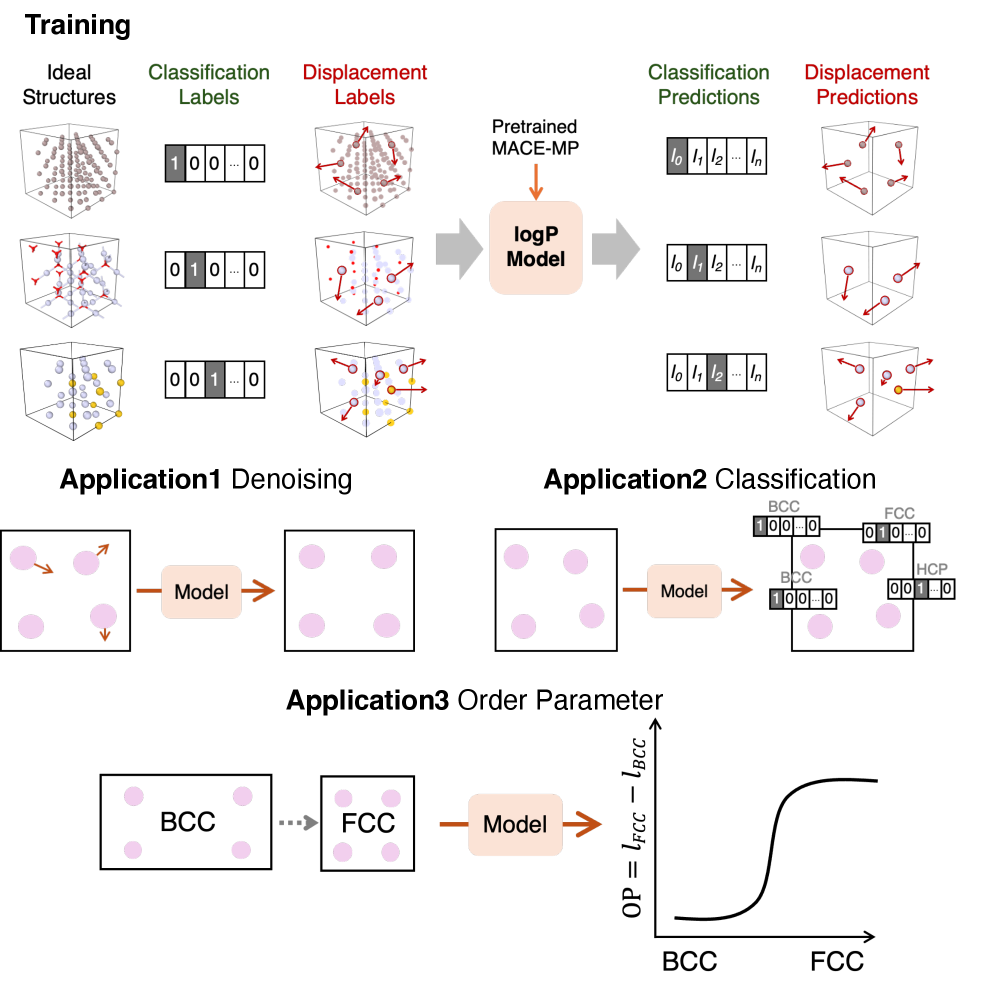
原子模拟生成大量噪声结构数据,但以普适、稳健和可解释的方式提取相标签、序参量(OPs)和缺陷信息仍然具有挑战性。现有工具如PTM和CNA仅限于少量手工设计的晶格,且在强热扰动或缺陷下表现不佳,无法提供每个原子的概率或置信度分数。本文提出了一种对数概率基础模型,将去噪、相分类和OP提取统一在一个概率框架内。我们重用MACE-MP基础原子间势,训练其预测每个原子、每个相的logits,并将其聚合为全局对数密度,进而定义保守的评分场。去噪对应于在学习的对数密度上进行梯度上升,相标签通过最大化logits获得,logits值作为连续、缺陷敏感且可解释的OP,量化理想相的欧几里得距离。我们展示了该方法在数百个原型上的普适性、在强热和缺陷引起的扰动下的稳健性,以及对复杂系统如冰多晶型、冰-水界面和冲击压缩钛的准确处理。
🔬 方法详解
问题定义:本文旨在解决在原子模拟中提取晶体结构的相标签、序参量和缺陷信息的挑战。现有方法如PTM和CNA在强热扰动和缺陷情况下表现不佳,且无法提供每个原子的概率或置信度分数。
核心思路:论文提出了一种对数概率基础模型,通过重用MACE-MP基础原子间势,训练模型以预测每个原子和每个相的logits,并将其聚合为全局对数密度。该设计使得去噪、相分类和序参量提取可以在同一框架下进行。
技术框架:整体架构包括三个主要模块:去噪、相分类和序参量提取。去噪通过在学习的对数密度上进行梯度上升实现,相标签通过最大化logits获得,而logits值则作为可解释的序参量。
关键创新:最重要的创新在于将去噪、相分类和序参量提取统一在一个概率框架中,克服了现有方法的局限性,提供了每个原子的概率分数。
关键设计:模型通过训练预测每个原子、每个相的logits,并聚合为全局对数密度,采用的损失函数和网络结构设计旨在提高模型的稳健性和普适性。
🖼️ 关键图片


📊 实验亮点
实验结果显示,该模型在数百个原型上展现出良好的普适性和稳健性,能够有效处理强热扰动和缺陷引起的复杂情况。与现有方法相比,模型在相分类和序参量提取的准确性上有显著提升,具体性能数据未提供。
🎯 应用场景
该研究的潜在应用领域包括材料科学、化学和物理等领域,能够帮助科学家更准确地分析和理解复杂晶体结构的性质与行为。未来,该模型有望推动新材料的发现与优化,提升材料设计的效率与准确性。
📄 摘要(原文)
Atomistic simulations generate large volumes of noisy structural data, but extracting phase labels, order parameters (OPs), and defect information in a way that is universal, robust, and interpretable remains challenging. Existing tools such as PTM and CNA are restricted to a small set of hand-crafted lattices (e.g.\ FCC/BCC/HCP), degrade under strong thermal disorder or defects, and produce hard, template-based labels without per-atom probability or confidence scores. Here we introduce a log-probability foundation model that unifies denoising, phase classification, and OP extraction within a single probabilistic framework. We reuse the MACE-MP foundation interatomic potential on crystal structures mapped to AFLOW prototypes, training it to predict per-atom, per-phase logits $l$ and to aggregate them into a global log-density $\log \hat{P}θ(\boldsymbol{r})$ whose gradient defines a conservative score field. Denoising corresponds to gradient ascent on this learned log-density, phase labels follow from $\arg\max_c l{ac}$, and the $l$ values act as continuous, defect-sensitive and interpretable OPs quantifying the Euclidean distance to ideal phases. We demonstrate universality across hundreds of prototypes, robustness under strong thermal and defect-induced disorder, and accurate treatment of complex systems such as ice polymorphs, ice--water interfaces, and shock-compressed Ti.