TimeOmni-1: Incentivizing Complex Reasoning with Time Series in Large Language Models
作者: Tong Guan, Zijie Meng, Dianqi Li, Shiyu Wang, Chao-Han Huck Yang, Qingsong Wen, Zuozhu Liu, Sabato Marco Siniscalchi, Ming Jin, Shirui Pan
分类: cs.AI, cs.CL
发布日期: 2025-09-29
💡 一句话要点
TimeOmni-1:通过时间序列激励大语言模型进行复杂推理
🎯 匹配领域: 支柱九:具身大模型 (Embodied Foundation Models)
关键词: 时间序列推理 大语言模型 多模态学习 因果发现 事件预测 强化学习 多任务学习
📋 核心要点
- 现有时间序列数据集缺乏深度推理能力,主要集中在表面对齐和简单问答,限制了时间序列推理模型的发展。
- 论文提出TimeOmni-1,一个统一的推理模型,通过多阶段训练、任务场景混合、奖励函数和优化,解决复杂时间序列推理问题。
- 实验表明TimeOmni-1在分布外泛化能力强,因果发现准确率显著提升,事件感知预测的有效响应率也得到提高。
📝 摘要(中文)
多模态时间序列学习的最新进展标志着分析范式从基本模式转向高级时间序列理解和推理。然而,现有的多模态时间序列数据集大多停留在表面对齐和问答的层面,未能达到真正的推理深度。缺乏明确定义的、真正需要时间序列推理的任务,以及高质量数据的匮乏,限制了构建实用的时间序列推理模型(TSRM)的进展。为此,我们引入了时间序列推理套件(TSR-Suite),它形式化了四个原子任务,涵盖了时间序列推理的三个基本能力:(1)通过场景理解和因果发现获得的感知;(2)通过事件感知预测实现的推断;(3)通过对感知和推断的审议而形成的决策。TSR-Suite是第一个全面的时间序列推理套件,不仅支持彻底的评估,还支持TSRM的数据管道和训练。它包含超过2.3万个样本,其中2.3千个是通过人工指导的分层注释过程精心策划的。在此基础上,我们推出了TimeOmni-1,这是第一个旨在解决需要时间序列推理的各种实际问题的统一推理模型。该模型经过多阶段训练,集成了混合任务场景、新颖的奖励函数和定制的优化。实验表明,TimeOmni-1在所有任务中都具有强大的分布外泛化能力,并实现了很高的有效响应率。与GPT-4.1相比,它显著提高了因果发现的准确率(64.0% vs. 35.9%),并且在事件感知预测任务上,有效响应率提高了6%以上。
🔬 方法详解
问题定义:现有时间序列推理模型缺乏在复杂场景下的推理能力,数据集也主要集中于表面对齐和简单问答,无法满足实际应用的需求。现有方法难以进行深度的因果关系发现、事件预测和决策制定。
核心思路:论文的核心思路是构建一个统一的时间序列推理模型TimeOmni-1,通过多任务学习和强化学习的方式,让模型学习到时间序列数据的深层表示和推理能力。通过精心设计的奖励函数,激励模型生成更准确、有效的推理结果。
技术框架:TimeOmni-1的训练过程包含多个阶段,首先使用大量时间序列数据进行预训练,学习时间序列数据的基本特征。然后,在TSR-Suite上进行多任务微调,TSR-Suite包含四个原子任务:场景理解、因果发现、事件感知预测和决策制定。在微调过程中,使用强化学习方法,根据模型的推理结果给予奖励,引导模型学习更有效的推理策略。
关键创新:TimeOmni-1的关键创新在于其统一的架构和多任务学习框架,能够同时处理多种时间序列推理任务。此外,论文还提出了TSR-Suite,一个包含高质量标注数据的时间序列推理数据集,为模型的训练和评估提供了基础。奖励函数的设计也至关重要,它能够有效地引导模型学习到正确的推理策略。
关键设计:TimeOmni-1的具体网络结构未知,但可以推测其使用了Transformer或类似的模型结构,以捕捉时间序列数据中的长期依赖关系。奖励函数的设计需要根据不同的任务进行调整,例如,在因果发现任务中,奖励函数可以根据模型预测的因果关系与真实因果关系的匹配程度进行设计。具体的损失函数和优化算法未知。
🖼️ 关键图片
📊 实验亮点
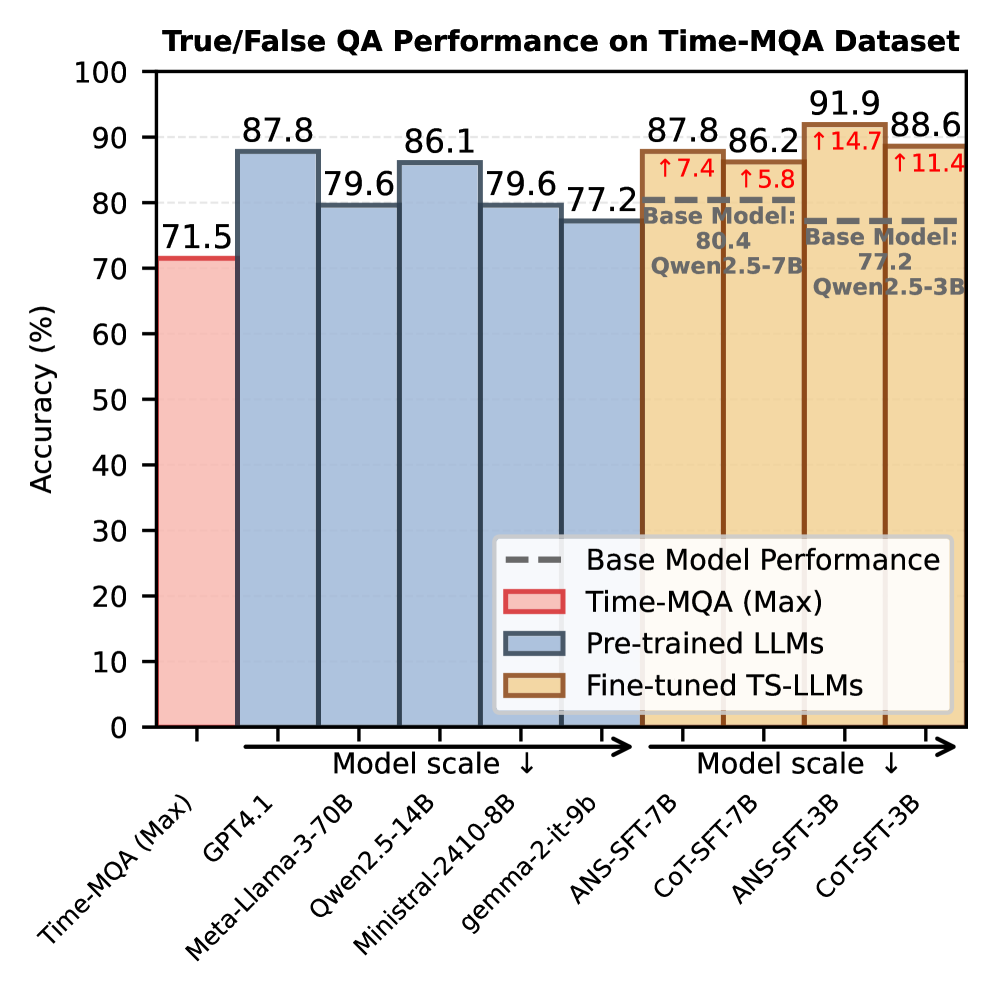
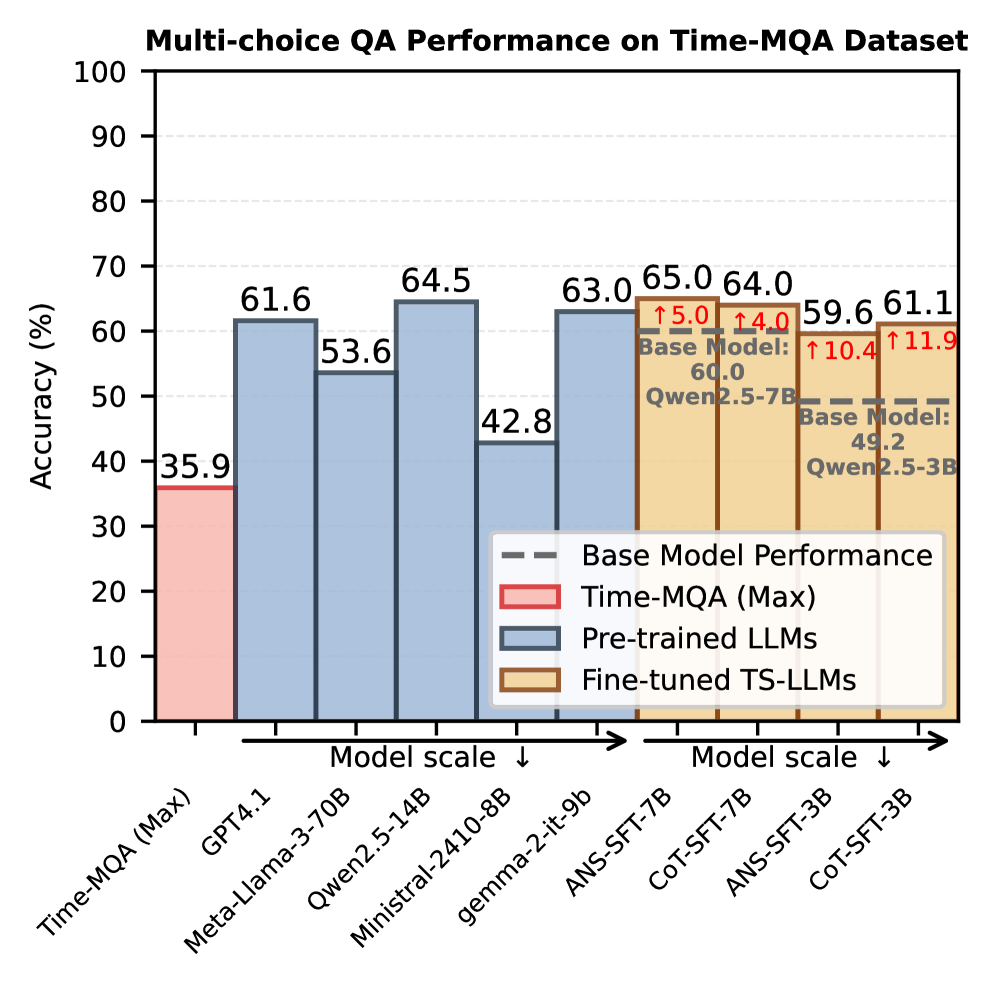
TimeOmni-1在TSR-Suite上进行了实验,结果表明其在所有任务中都具有强大的分布外泛化能力。在因果发现任务中,TimeOmni-1的准确率达到了64.0%,而GPT-4.1的准确率仅为35.9%。在事件感知预测任务中,TimeOmni-1的有效响应率比GPT-4.1提高了6%以上。这些结果表明TimeOmni-1在时间序列推理方面具有显著的优势。
🎯 应用场景
该研究成果可应用于金融风险预测、智能交通管理、工业生产优化、医疗健康监测等领域。TimeOmni-1能够帮助人们更好地理解时间序列数据,发现潜在的规律和趋势,从而做出更明智的决策,具有重要的实际应用价值和广阔的未来发展前景。
📄 摘要(原文)
Recent advances in multimodal time series learning underscore a paradigm shift from analytics centered on basic patterns toward advanced time series understanding and reasoning. However, existing multimodal time series datasets mostly remain at the level of surface alignment and question answering, without reaching the depth of genuine reasoning. The absence of well-defined tasks that genuinely require time series reasoning, along with the scarcity of high-quality data, has limited progress in building practical time series reasoning models (TSRMs). To this end, we introduce Time Series Reasoning Suite (TSR-Suite), which formalizes four atomic tasks that span three fundamental capabilities for reasoning with time series: (1) perception, acquired through scenario understanding and causality discovery; (2) extrapolation, realized via event-aware forecasting; and (3) decision-making, developed through deliberation over perception and extrapolation. TSR-Suite is the first comprehensive time series reasoning suite that supports not only thorough evaluation but also the data pipeline and training of TSRMs. It contains more than 23K samples, of which 2.3K are carefully curated through a human-guided hierarchical annotation process. Building on this foundation, we introduce TimeOmni-1, the first unified reasoning model designed to address diverse real-world problems demanding time series reasoning. The model is trained in multiple stages, integrating a mixture of task scenarios, novel reward functions, and tailored optimizations. Experiments show that TimeOmni-1 delivers strong out-of-distribution generalization across all tasks and achieves a high rate of valid responses. It significantly improves causality discovery accuracy (64.0% vs. 35.9% with GPT-4.1) and raises the valid response rate by over 6% compared to GPT-4.1 on the event-aware forecasting task.