AdaptiveGuard: Towards Adaptive Runtime Safety for LLM-Powered Software
作者: Rui Yang, Michael Fu, Chakkrit Tantithamthavorn, Chetan Arora, Gunel Gulmammadova, Joey Chua
分类: cs.CR, cs.AI, cs.SE
发布日期: 2025-09-21
备注: Accepted to the ASE 2025 International Conference on Automated Software Engineering, Industry Showcase Track
🔗 代码/项目: GITHUB
💡 一句话要点
AdaptiveGuard:面向LLM软件的自适应运行时安全防护
🎯 匹配领域: 支柱九:具身大模型 (Embodied Foundation Models)
关键词: 大型语言模型安全 越狱攻击防御 自适应学习 运行时安全 分布外检测
📋 核心要点
- 现有LLM guardrails面对新型越狱攻击时性能显著下降,无法有效应对不断演进的威胁。
- AdaptiveGuard通过持续学习框架,将新型攻击识别为分布外数据,并自适应地学习防御策略。
- 实验表明,AdaptiveGuard在OOD检测、快速适应和性能保持方面均优于现有方法。
📝 摘要(中文)
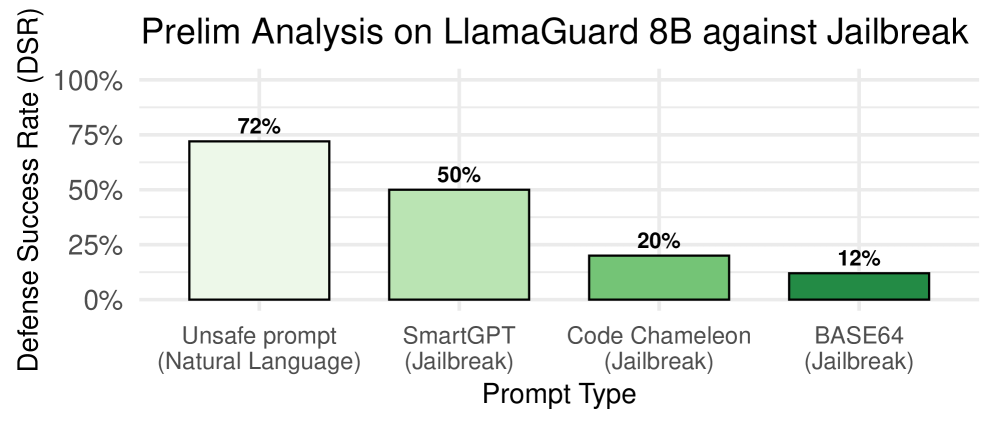
Guardrails对于保障基于大型语言模型(LLM)软件的安全部署至关重要。与输入输出空间受限的传统规则系统不同,LLM支持开放式、智能的交互,但也容易遭受用户输入的越狱攻击。Guardrails作为保护层,过滤不安全的提示。然而,现有研究表明,即使是GPT-4o等先进模型,越狱攻击的成功率仍然超过70%。虽然LlamaGuard等guardrails的准确率高达95%,但我们的初步分析表明,面对未知的攻击,其性能会急剧下降至12%。这突显了一个日益严峻的软件工程挑战:如何构建一个能够动态适应新威胁的部署后guardrail?为了解决这个问题,我们提出了AdaptiveGuard,一种自适应guardrail,它将新的越狱攻击检测为分布外(OOD)输入,并通过持续学习框架学习防御它们。实验评估表明,AdaptiveGuard实现了96%的OOD检测准确率,仅需两个更新步骤即可适应新的攻击,并在适应后保持超过85%的F1分数的分布内数据性能,优于其他基线。这些结果表明,AdaptiveGuard是一种能够响应部署后出现的新越狱策略的guardrail。我们发布了AdaptiveGuard和研究数据集,以支持进一步的研究。
🔬 方法详解
问题定义:论文旨在解决大型语言模型(LLM)驱动的软件在部署后,面对不断涌现的越狱攻击时,现有guardrails防御能力不足的问题。现有方法,如基于规则的系统或预训练的guardrails,难以泛化到未知的攻击模式,导致安全防护效果显著下降。
核心思路:AdaptiveGuard的核心思路是将新型越狱攻击视为分布外(Out-of-Distribution, OOD)的输入,利用OOD检测技术识别这些攻击,并采用持续学习的方法,使guardrail能够动态适应并学习防御新的攻击模式。这种自适应性是应对LLM安全挑战的关键。
技术框架:AdaptiveGuard包含以下主要模块:1) OOD检测模块:用于识别输入提示是否为新型越狱攻击。2) 持续学习模块:当检测到OOD攻击时,该模块会利用新的攻击样本更新guardrail的模型参数,使其能够防御该攻击。3) Guardrail模型:负责对输入提示进行安全评估,判断其是否包含恶意内容。整体流程是:输入提示首先经过OOD检测,如果被判定为OOD,则触发持续学习模块进行模型更新,然后Guardrail模型使用更新后的参数进行安全评估。
关键创新:AdaptiveGuard的关键创新在于其自适应性,能够动态地学习和适应新的越狱攻击模式。与传统的静态guardrails相比,AdaptiveGuard能够更好地应对LLM安全领域的持续演进的威胁。此外,将OOD检测与持续学习相结合,使得guardrail能够在不影响原有性能的前提下,快速有效地学习新的防御策略。
关键设计:OOD检测模块可以使用多种方法实现,例如基于距离的方法(如Mahalanobis距离)或基于密度的方法。持续学习模块可以使用多种算法,例如iCaRL或EWC。Guardrail模型可以使用预训练的语言模型,例如LlamaGuard,并进行微调。论文中可能详细描述了这些模块的具体实现方式和参数设置,例如OOD检测的阈值、持续学习的学习率、以及Guardrail模型的微调策略等。这些细节对于实际部署AdaptiveGuard至关重要。
🖼️ 关键图片


📊 实验亮点
AdaptiveGuard在实验中表现出色,实现了96%的OOD检测准确率,能够有效识别新型越狱攻击。仅需两个更新步骤,AdaptiveGuard即可适应新的攻击模式,展现了快速适应能力。在适应新攻击后,AdaptiveGuard仍能保持超过85%的F1分数,证明其在学习新知识的同时,能够有效保留原有性能。AdaptiveGuard在各项指标上均优于其他基线方法,验证了其有效性和优越性。
🎯 应用场景
AdaptiveGuard可广泛应用于各种基于LLM的软件系统中,例如聊天机器人、代码生成工具、内容创作平台等。通过提供自适应的运行时安全防护,AdaptiveGuard能够有效降低LLM软件遭受越狱攻击的风险,保障用户安全和系统稳定。该研究对于推动LLM技术的安全可靠应用具有重要意义。
📄 摘要(原文)
Guardrails are critical for the safe deployment of Large Language Models (LLMs)-powered software. Unlike traditional rule-based systems with limited, predefined input-output spaces that inherently constrain unsafe behavior, LLMs enable open-ended, intelligent interactions--opening the door to jailbreak attacks through user inputs. Guardrails serve as a protective layer, filtering unsafe prompts before they reach the LLM. However, prior research shows that jailbreak attacks can still succeed over 70% of the time, even against advanced models like GPT-4o. While guardrails such as LlamaGuard report up to 95% accuracy, our preliminary analysis shows their performance can drop sharply--to as low as 12%--when confronted with unseen attacks. This highlights a growing software engineering challenge: how to build a post-deployment guardrail that adapts dynamically to emerging threats? To address this, we propose AdaptiveGuard, an adaptive guardrail that detects novel jailbreak attacks as out-of-distribution (OOD) inputs and learns to defend against them through a continual learning framework. Through empirical evaluation, AdaptiveGuard achieves 96% OOD detection accuracy, adapts to new attacks in just two update steps, and retains over 85% F1-score on in-distribution data post-adaptation, outperforming other baselines. These results demonstrate that AdaptiveGuard is a guardrail capable of evolving in response to emerging jailbreak strategies post deployment. We release our AdaptiveGuard and studied datasets at https://github.com/awsm-research/AdaptiveGuard to support further research.