ArchesClimate: Probabilistic Decadal Ensemble Generation With Flow Matching
作者: Graham Clyne, Guillaume Couairon, Guillaume Gastineau, Claire Monteleoni, Anastase Charantonis
分类: physics.ao-ph, cs.AI
发布日期: 2025-09-19 (更新: 2026-01-28)
💡 一句话要点
ArchesClimate:利用Flow Matching生成概率性年代际集合气候预测,降低计算成本。
🎯 匹配领域: 支柱二:RL算法与架构 (RL & Architecture)
关键词: 气候预测 深度学习 Flow Matching 气候模型模拟 年代际预测
📋 核心要点
- 传统气候预测依赖于计算密集型的气候模型集合模拟,成本高昂,限制了不确定性量化和预测范围。
- ArchesClimate利用Flow Matching模型,学习气候模型的动态,实现快速且物理一致的年代际气候预测。
- 实验表明,ArchesClimate在长达10年的预测中保持稳定,且关键气候变量的模拟结果与IPSL模型相当。
📝 摘要(中文)
气候预测存在与气候系统各组成部分及其相互作用相关的不确定性。量化这些不确定性的一种典型方法是使用气候模型创建在不同初始条件下重复模拟的集合。由于这些模拟的复杂性,生成此类预测集合的计算成本很高。本文提出了ArchesClimate,一种基于深度学习的气候模型模拟器,旨在降低这种成本。ArchesClimate在IPSL-CM6A-LR气候模型的年代际后报数据上进行训练,空间分辨率约为2.5x1.25度。我们训练了一个遵循ArchesWeatherGen的Flow Matching模型,并对其进行调整以预测近期气候。训练完成后,该模型可以生成提前一个月的状态,并可用于自回归地模拟任意长度的气候模型模拟。我们表明,在长达10年的时间内,这些生成结果是稳定且物理上一致的。我们还表明,对于几个重要的气候变量,ArchesClimate生成的模拟结果可以与IPSL模型互换。这项工作表明,气候模型模拟器可以显著降低气候模型模拟的成本。
🔬 方法详解
问题定义:气候预测需要大量计算资源来生成气候模型集合,以量化不确定性。现有的气候模型模拟计算成本高昂,限制了预测的效率和范围。因此,需要一种计算效率更高的方法来生成可靠的气候预测集合。
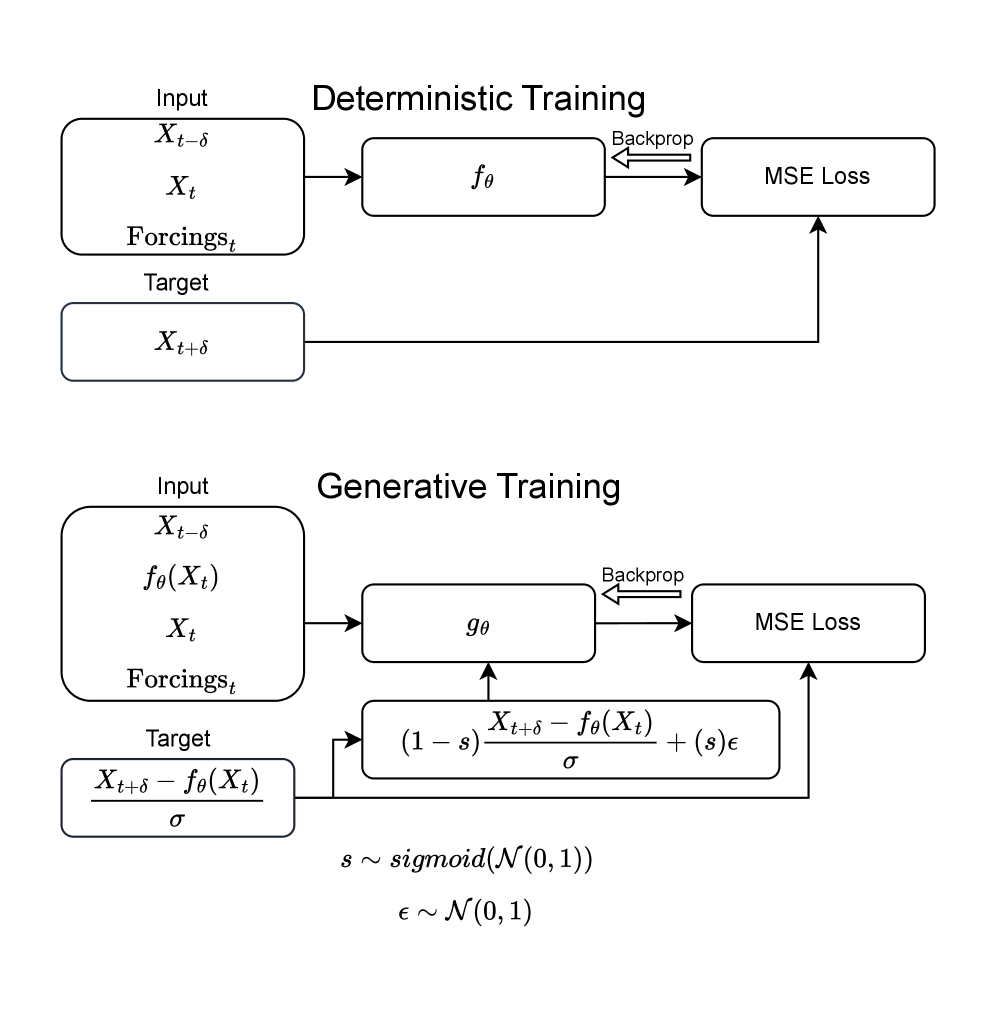
核心思路:利用深度学习中的Flow Matching模型,学习气候模型的动态特征,从而能够快速生成气候状态序列。Flow Matching通过学习数据分布之间的连续变换,能够生成高质量的样本,并保持物理一致性。
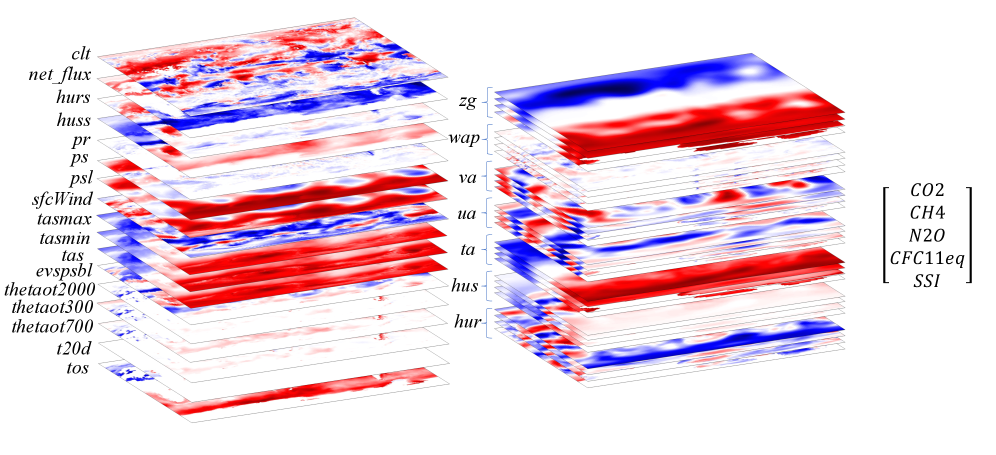
技术框架:ArchesClimate的整体框架包括以下几个阶段:1) 数据准备:使用IPSL-CM6A-LR气候模型的年代际后报数据,空间分辨率约为2.5x1.25度。2) 模型训练:训练一个Flow Matching模型,使其能够预测提前一个月的气候状态。3) 自回归生成:使用训练好的模型自回归地生成气候状态序列,模拟气候模型在未来一段时间内的演变。
关键创新:ArchesClimate的关键创新在于将Flow Matching模型应用于气候预测领域,并成功地生成了稳定且物理一致的年代际气候预测。与传统的气候模型模拟相比,ArchesClimate具有更高的计算效率,可以显著降低气候预测的成本。
关键设计:ArchesClimate采用了与ArchesWeatherGen相似的网络结构,并针对气候预测的特点进行了调整。具体的网络结构和参数设置在论文中没有详细描述,属于未知信息。损失函数的设计目标是使模型能够准确地学习气候模型的动态特征,并生成物理上合理的预测结果。具体损失函数的形式在论文中没有详细描述,属于未知信息。
🖼️ 关键图片

📊 实验亮点
ArchesClimate生成的年代际气候预测在长达10年的时间内保持稳定且物理一致。对于几个重要的气候变量,ArchesClimate生成的模拟结果可以与IPSL模型互换,表明该模型具有很高的准确性和可靠性。该研究表明,气候模型模拟器可以显著降低气候模型模拟的成本。
🎯 应用场景
ArchesClimate可应用于气候变化研究、风险评估和政策制定等领域。通过快速生成大量气候预测集合,可以更全面地评估气候变化的不确定性,为决策者提供更可靠的依据。此外,该方法还可以用于研究不同气候情景下的潜在影响,并制定相应的适应和减缓策略。
📄 摘要(原文)
Climate projections have uncertainties related to components of the climate system and their interactions. A typical approach to quantifying these uncertainties is to use climate models to create ensembles of repeated simulations under different initial conditions. Due to the complexity of these simulations, generating such ensembles of projections is computationally expensive. In this work, we present ArchesClimate, a deep learning-based climate model emulator that aims to reduce this cost. ArchesClimate is trained on decadal hindcasts of the IPSL-CM6A-LR climate model at a spatial resolution of approximately 2.5x1.25 degrees. We train a flow matching model following ArchesWeatherGen, which we adapt to predict near-term climate. Once trained, the model generates states at a one-month lead time and can be used to auto-regressively emulate climate model simulations of any length. We show that for up to 10 years, these generations are stable and physically consistent. We also show that for several important climate variables, ArchesClimate generates simulations that are interchangeable with the IPSL model. This work suggests that climate model emulators could significantly reduce the cost of climate model simulations.