Reverse Physician-AI Relationship: Full-process Clinical Diagnosis Driven by a Large Language Model
作者: Shicheng Xu, Xin Huang, Zihao Wei, Liang Pang, Huawei Shen, Xueqi Cheng
分类: cs.AI, cs.CE, cs.CL
发布日期: 2025-08-14
备注: 39 pages
💡 一句话要点
提出DxDirector-7B,以LLM驱动全流程临床诊断,显著提升诊断准确率并减轻医生负担。
🎯 匹配领域: 支柱九:具身大模型 (Embodied Foundation Models)
关键词: 大型语言模型 临床诊断 全流程诊断 人工智能 医疗AI
📋 核心要点
- 现有AI在临床诊断中主要作为辅助,无法从初始模糊主诉驱动全流程,限制了其降低医生工作量和提高诊断效率的能力。
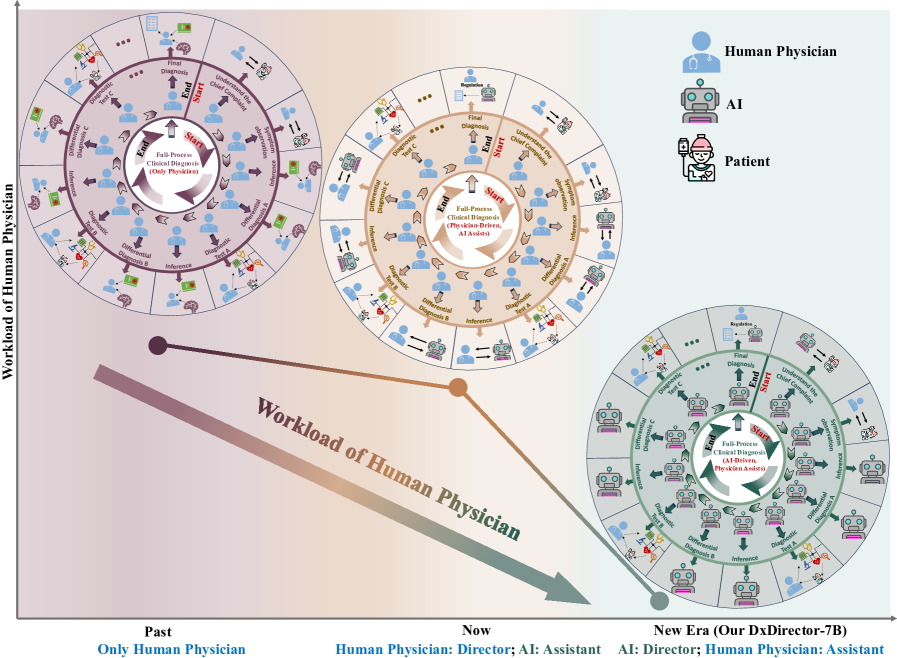
- 论文提出DxDirector-7B,将LLM定位为诊断流程的主导者,医生作为辅助,从而实现AI驱动的全流程诊断。
- 实验表明,DxDirector-7B在诊断准确率上显著优于现有医学LLM,并能大幅降低医生工作负担,具备替代医疗专家的潜力。
📝 摘要(中文)
本文提出了一种范式转变,将人工智能(特别是大型语言模型LLM)在临床诊断中的角色从辅助医生转变为主要驱动者。为此,作者提出了DxDirector-7B,一个具备深度思考能力的大型语言模型,能够以最少的医生参与来驱动全流程诊断。DxDirector-7B还建立了一个健全的误诊责任框架,明确了人工智能和人类医生之间的责任划分。在罕见、复杂和真实世界案例的全流程诊断评估中,DxDirector-7B不仅实现了显著优于现有医学LLM和通用LLM的诊断准确率,还大幅降低了医生的工作负担。对多个临床科室和任务的细粒度分析验证了其有效性,专家评估表明其有潜力成为医疗专家的可行替代方案。这些发现标志着人工智能从传统的医生助手转变为驱动整个诊断过程,从而大幅减少医生工作量的新时代,预示着一种高效、准确的诊断解决方案。
🔬 方法详解
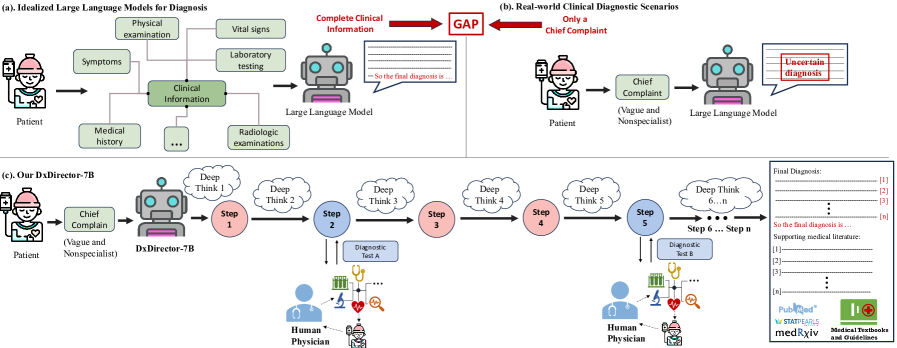
问题定义:现有医学人工智能系统,特别是基于大型语言模型(LLM)的系统,通常扮演医生助手的角色,只能在诊断过程的特定环节回答问题。它们缺乏从患者模糊的主诉开始,自主驱动整个诊断流程的能力。这导致医生仍然需要承担大量的工作,限制了AI在提高诊断效率和减轻医生负担方面的潜力。
核心思路:论文的核心思路是颠覆医生与AI的关系,将AI定位为诊断流程的主导者,而医生则作为辅助。通过赋予LLM更强的推理能力和全流程诊断能力,使其能够从患者的主诉出发,自主进行问诊、检查、分析和诊断,从而大幅减少医生的工作量。
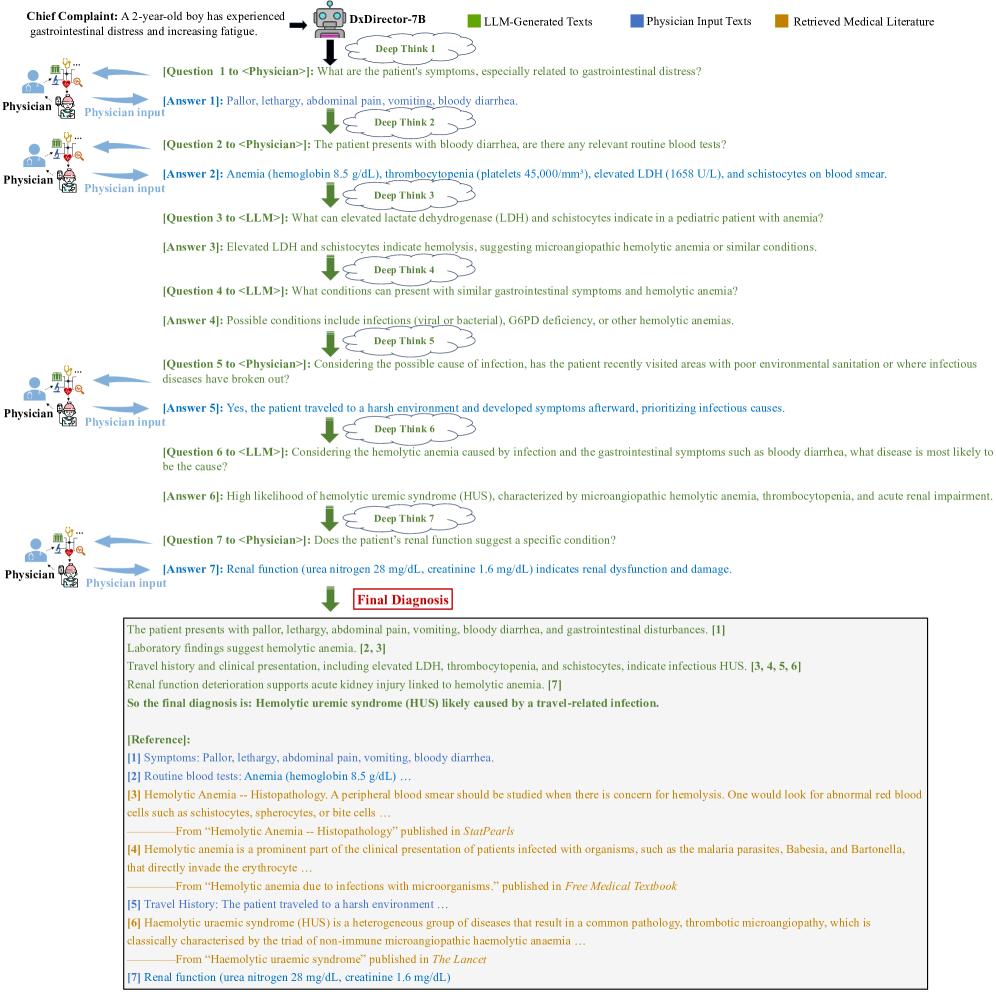
技术框架:DxDirector-7B的技术框架主要包含以下几个阶段:1) 主诉分析:从患者的初始主诉中提取关键信息。2) 问诊策略:根据当前信息,制定下一步需要询问的问题。3) 信息收集:通过与患者或医生交互,收集必要的病史、体格检查和实验室检查结果。4) 诊断推理:基于收集到的信息,进行诊断推理,给出可能的诊断结果。5) 责任划分:在出现误诊时,明确AI和医生各自承担的责任。
关键创新:论文最重要的创新点在于提出了AI驱动的全流程诊断范式,将LLM从医生助手转变为诊断流程的主导者。这种范式转变使得AI能够更全面地参与到诊断过程中,从而提高诊断效率和准确率。此外,DxDirector-7B还建立了一个误诊责任框架,明确了AI和医生各自的责任,这有助于提高AI在医疗领域的应用的可信度。
关键设计:论文中关于DxDirector-7B的关键设计细节包括:1) 使用7B参数的LLM作为基础模型。2) 通过指令微调(instruction tuning)赋予模型全流程诊断能力。3) 设计了专门的提示工程(prompt engineering)策略,引导模型进行有效的问诊和推理。4) 采用了特定的损失函数,优化模型的诊断准确率和责任划分能力。具体的参数设置和网络结构等细节在论文中可能没有详细描述,属于未知信息。
🖼️ 关键图片
📊 实验亮点
实验结果表明,DxDirector-7B在全流程诊断设置下,诊断准确率显著优于现有的医学LLM和通用LLM。在罕见、复杂和真实世界案例的评估中,DxDirector-7B不仅提高了诊断准确率,还大幅降低了医生的工作负担。专家评估表明,DxDirector-7B有潜力成为医疗专家的可行替代方案,表明其在实际临床应用中具有巨大的潜力。
🎯 应用场景
该研究成果可应用于多种临床场景,例如远程医疗、基层医疗和急诊科室。通过AI驱动的全流程诊断,可以提高诊断效率,减少误诊率,并减轻医生的工作负担。尤其是在医疗资源匮乏的地区,DxDirector-7B有望成为医疗专家的有效替代方案,为患者提供高质量的医疗服务。未来,该技术还可以与可穿戴设备和物联网技术相结合,实现更智能化的健康管理。
📄 摘要(原文)
Full-process clinical diagnosis in the real world encompasses the entire diagnostic workflow that begins with only an ambiguous chief complaint. While artificial intelligence (AI), particularly large language models (LLMs), is transforming clinical diagnosis, its role remains largely as an assistant to physicians. This AI-assisted working pattern makes AI can only answer specific medical questions at certain parts within the diagnostic process, but lack the ability to drive the entire diagnostic process starting from an ambiguous complaint, which still relies heavily on human physicians. This gap limits AI's ability to fully reduce physicians' workload and enhance diagnostic efficiency. To address this, we propose a paradigm shift that reverses the relationship between physicians and AI: repositioning AI as the primary director, with physicians serving as its assistants. So we present DxDirector-7B, an LLM endowed with advanced deep thinking capabilities, enabling it to drive the full-process diagnosis with minimal physician involvement. Furthermore, DxDirector-7B establishes a robust accountability framework for misdiagnoses, delineating responsibility between AI and human physicians. In evaluations across rare, complex, and real-world cases under full-process diagnosis setting, DxDirector-7B not only achieves significant superior diagnostic accuracy but also substantially reduces physician workload than state-of-the-art medical LLMs as well as general-purpose LLMs. Fine-grained analyses across multiple clinical departments and tasks validate its efficacy, with expert evaluations indicating its potential to serve as a viable substitute for medical specialists. These findings mark a new era where AI, traditionally a physicians' assistant, now drives the entire diagnostic process to drastically reduce physicians' workload, indicating an efficient and accurate diagnostic solution.