From Semantic Web and MAS to Agentic AI: A Unified Narrative of the Web of Agents
作者: Tatiana Petrova, Boris Bliznioukov, Aleksandr Puzikov, Radu State
分类: cs.AI, cs.CL, cs.CR, cs.HC, cs.MA
发布日期: 2025-07-14 (更新: 2025-08-02)
备注: 33 pages, 9 figures, 8 tables
💡 一句话要点
构建Agentic AI:提出Web of Agents演进的统一叙事框架,弥合多智能体系统与语义网的鸿沟。
🎯 匹配领域: 支柱九:具身大模型 (Embodied Foundation Models)
关键词: Web of Agents 多智能体系统 语义网 Agentic AI 大型语言模型
📋 核心要点
- 现有WoA研究分散在不同社区,缺乏对多智能体系统和语义网历史的整体理解,阻碍了领域发展。
- 提出一个四轴分类法,从语义基础、通信范式、智能中心和发现机制四个维度统一分析不同代际的代理架构。
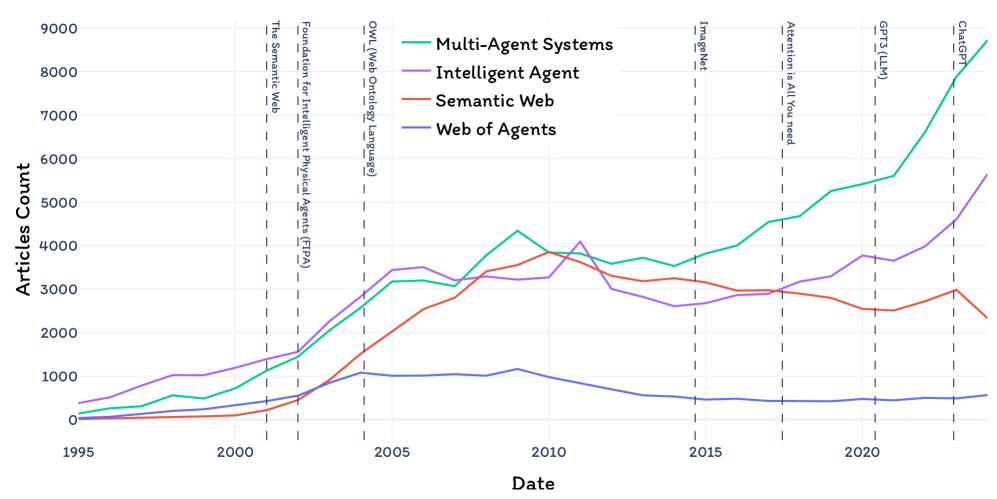
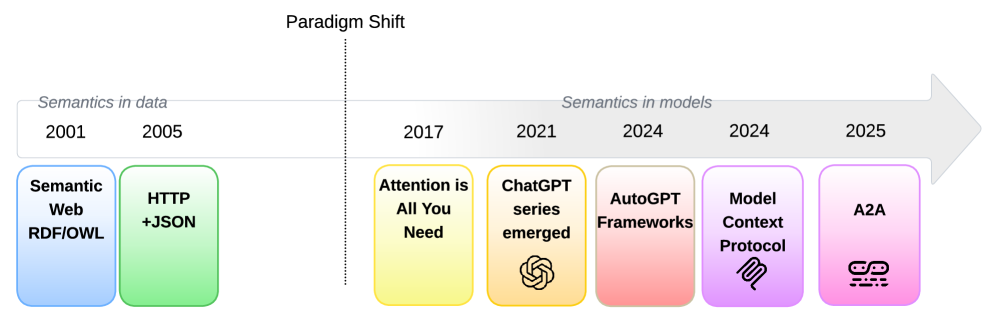
- 分析表明智能中心从外部数据或平台转移到代理核心模型(LLM),这是实现可扩展和自适应Agentic AI的关键。
📝 摘要(中文)
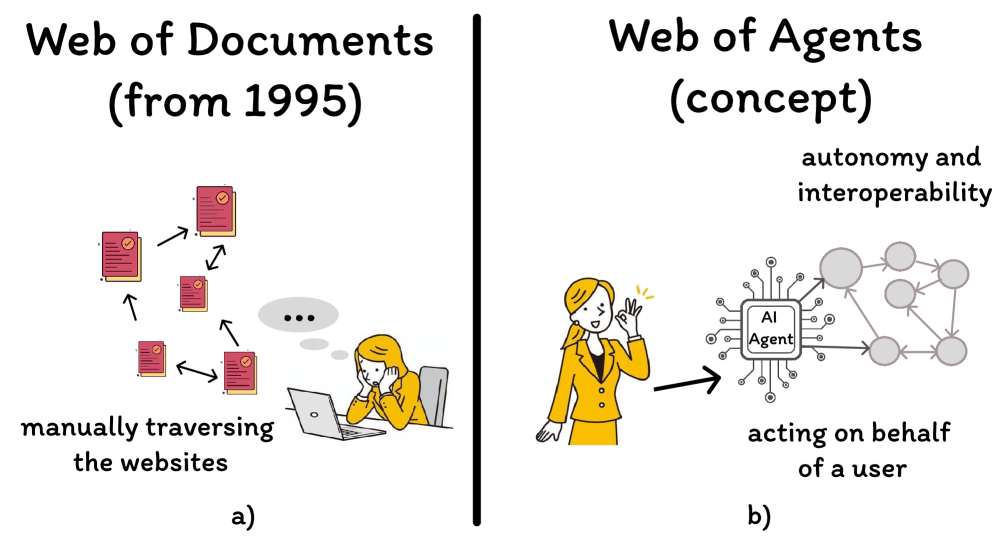
随着大型语言模型(LLMs)能力的提升,Web of Agents(WoA)的概念日益受到关注,它将静态的、以文档为中心的Web转变为代表用户行动的自主代理环境。然而,该领域的研究仍然分散在不同的社区中。现有的综述主要关注最新的LLM驱动框架,而多智能体系统(MAS)和语义网的丰富历史通常被视为独立的传统领域。这种碎片化掩盖了现代系统的知识渊源,阻碍了对该领域发展轨迹的整体理解。本文提出了第一个全面的WoA演进综述,揭示了A2A和MCP等现代协议是对FIPA标准和基于OWL的语义代理等早期标准局限性的直接演进。为了系统化分析,引入了一个四轴分类法(语义基础、通信范式、智能中心、发现机制),为跨代代理架构的比较提供了一个统一的分析视角,揭示了表面断裂的清晰传承关系。分析表明,“智能中心”发生了范式转变:从编码在外部数据(语义网)或平台(MAS)中,转变为嵌入在代理的核心模型(LLM)中。这种转变是现代Agentic AI的基础,实现了WoA长期设想的可扩展和自适应系统。结论认为,虽然新协议至关重要,但不足以构建一个强大、开放、可信的生态系统。最后,提出了下一个研究前沿在于解决持续存在的社会技术挑战,并规划了一个新的议程,重点关注新兴WoA的去中心化身份、经济模型、安全和治理。
🔬 方法详解
问题定义:Web of Agents (WoA)旨在构建一个由自主代理组成的网络,这些代理能够代表用户执行各种任务。然而,现有的研究存在碎片化的问题,多智能体系统(MAS)和语义网(Semantic Web)的历史发展往往被割裂开来,缺乏一个统一的视角来理解WoA的演进历程。此外,早期标准如FIPA和基于OWL的语义代理存在局限性,而现代协议如A2A和MCP的出现正是为了解决这些问题。
核心思路:本文的核心思路是提供一个全面的WoA演进综述,通过构建一个统一的分析框架,将MAS、语义网和基于LLM的Agentic AI联系起来。该框架旨在揭示现代协议与早期标准之间的演进关系,并识别WoA发展的关键范式转变。通过这种方式,可以更清晰地理解WoA的过去、现在和未来,并为未来的研究方向提供指导。
技术框架:本文提出了一个四轴分类法,用于分析不同代际的代理架构。这四个轴分别是:1) 语义基础:代理如何理解和处理信息;2) 通信范式:代理之间如何进行通信和协作;3) 智能中心:智能体现在哪里,是外部数据、平台还是代理自身;4) 发现机制:代理如何发现彼此和服务。通过这四个轴,可以对不同架构的代理进行系统性的比较和分析,从而揭示WoA的演进轨迹。
关键创新:本文最重要的技术创新在于提出了“智能中心”的范式转变。早期系统中,智能主要体现在外部数据(语义网)或平台(MAS)中,而现代Agentic AI则将智能嵌入到代理的核心模型(LLM)中。这种转变使得代理能够更加自主地进行决策和行动,从而实现了WoA长期设想的可扩展和自适应系统。
关键设计:本文并没有涉及具体的参数设置、损失函数或网络结构等技术细节。相反,它侧重于对WoA的整体架构和演进趋势进行分析和总结。关键设计在于四轴分类法的构建,以及对“智能中心”范式转变的识别。这些设计为理解WoA的发展提供了新的视角和框架。
🖼️ 关键图片
📊 实验亮点
该论文的核心亮点在于提出了一个统一的框架,用于理解Web of Agents的演进历程。通过四轴分类法,论文成功地将多智能体系统、语义网和基于LLM的Agentic AI联系起来,揭示了现代协议与早期标准之间的演进关系。此外,论文还识别了“智能中心”的范式转变,为未来的研究方向提供了重要的指导。
🎯 应用场景
Web of Agents 的研究成果可应用于构建更加智能、自主和个性化的Web服务。例如,可以开发能够自动完成预订机票、安排日程、管理财务等任务的代理。此外,WoA还有潜力改变人机交互的方式,使得用户能够通过自然语言与代理进行交互,从而更加高效地完成各种任务。未来,WoA有望成为构建下一代互联网的关键技术。
📄 摘要(原文)
The concept of the Web of Agents (WoA), which transforms the static, document-centric Web into an environment of autonomous agents acting on users' behalf, has attracted growing interest as large language models (LLMs) become more capable. However, research in this area is still fragmented across different communities. Contemporary surveys catalog the latest LLM-powered frameworks, while the rich histories of Multi-Agent Systems (MAS) and the Semantic Web are often treated as separate, legacy domains. This fragmentation obscures the intellectual lineage of modern systems and hinders a holistic understanding of the field's trajectory. We present the first comprehensive evolutionary overview of the WoA. We show that modern protocols like A2A and the MCP, are direct evolutionary responses to the well-documented limitations of earlier standards like FIPA standards and OWL-based semantic agents. To systematize this analysis, we introduce a four-axis taxonomy (semantic foundation, communication paradigm, locus of intelligence, discovery mechanism). This framework provides a unified analytical lens for comparing agent architectures across all generations, revealing a clear line of descent where others have seen a disconnect. Our analysis identifies a paradigm shift in the 'locus of intelligence': from being encoded in external data (Semantic Web) or the platform (MAS) to being embedded within the agent's core model (LLM). This shift is foundational to modern Agentic AI, enabling the scalable and adaptive systems the WoA has long envisioned. We conclude that while new protocols are essential, they are insufficient for building a robust, open, trustworthy ecosystem. Finally, we argue that the next research frontier lies in solving persistent socio-technical challenges, and we map out a new agenda focused on decentralized identity, economic models, security, and governance for the emerging WoA.